


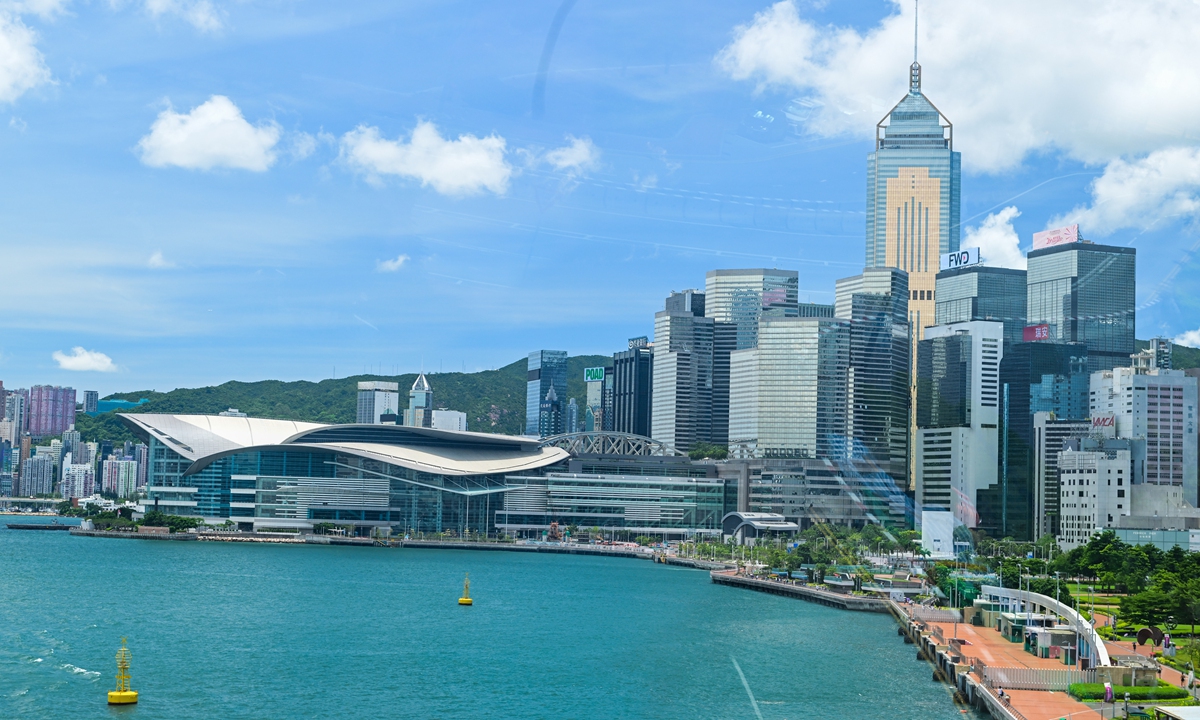
A view of Victoria Harbor, Hong Kong (Photo: VCG)
On Monday, Singapore's Lianhe Zaobao published a commentary analyzing where Stephen Roach's claim that "Hong Kong is over" went wrong. Roach, a senior fellow at Yale University and former chairman of Morgan Stanley Asia, claimed in late July that "the Hong Kong of old is over." The reasons he cited were the same familiar talking points he has repeated for years: Hong Kong's economy is becoming increasingly dependent on the Chinese mainland, weakening its international character; Hong Kong's political and judicial environment is no longer what it used to be; Hong Kong society is accelerating its "mainlandization," and foreign talent is fleeing.
This sensational rhetoric is nothing new. Roach's judgments on Hong Kong over the years can only be described as "flip-flopping." In 2024, he said Hong Kong was "finished;" in 2025, he changed his tune and talked about "rebirth;" and in 2026, he is once again declaring that "the Hong Kong of old is over." Such contradictory assessments amply demonstrate two possibilities: Either he has never truly understood Hong Kong, or he has always viewed Hong Kong through a lens of preconceived bias.
It must be acknowledged that today's Hong Kong is indeed different from what it used to be. Its ties with Chinese mainland cities of Shenzhen and Guangzhou in the Greater Bay Area have become closer, its integration into the country's overall development strategy has deepened, and its positioning and development path are undergoing transformation. But change does not equal decline, nor does transformation equate to being "over." As the Lianhe Zaobao commentary points out, Roach's biggest cognitive fallacy lies in his instinctive judgment of the so-called "mainlandization" as something negative, and his belief that Hong Kong's international character must be severed from its ties with the motherland - as if Hong Kong could only be considered "normal" if it remained within the old West-dominated order.
This is an outdated sense, where Hong Kong's value is seen as deriving not from its unique position of being backed by the motherland while connected to the world, but from maintaining distance from the mainland; not from contributing to China's modernization drive, but from serving as a "springboard" for the West to discuss, access and influence China.
Unfortunately, times have changed. Today's Hong Kong is no longer the Hong Kong of the 1990s, which relied primarily on re-export trade and Western capital. Amid the restructuring of the global landscape, Hong Kong is undergoing a historic transformation: from a "window for the West to view China" into an international financial center connecting China with the world. Leveraging its common law system, free flow of capital, professional services and internationally aligned regulatory frameworks, Hong Kong links the vast economic scale of the Chinese mainland with global markets. Its unique value has not disappeared; rather, it has been upgraded.
Objective data are telling. The recently released 2026 World Competitiveness Yearbook by the Switzerland-based International Institute for Management Development showed that Hong Kong's economic competitiveness ranking rose to the second place, behind only Singapore, surpassing Switzerland and ranking higher than China's Taiwan region. It marked Hong Kong's best performance since 2019. What is more noteworthy is that Hong Kong did not merely "luckily rise" based on a single indicator, but achieved systematic improvements across multiple key areas: second in government efficiency, third in business environment, eighth in infrastructure, and even ranked first globally in tax policies and business legislation.
A city's core competitiveness is never defined by the one-sided remarks of Western critics; rather, it hinges on governance efficacy, institutional stability, the business environment, and development outcomes. For international capital, enterprises, and professionals, what matters most is not who has penned a sensationalist newspaper article, but whether the city offers stability, clear rules, predictable prospects, and abundant opportunities. The fact that Hong Kong has reclaimed the No.2 spot in global competitiveness rankings demonstrates that it is far from "over." Instead, through the transition from chaos to order and from stability to prosperity, it has gathered even greater momentum.
Previously, some politicians in the Taiwan region were hyping the political slogan "Today Hong Kong, Tomorrow Taiwan," but it now appears increasingly hollow. The facts are laid bare: Hong Kong's competitiveness has returned to the second place globally, while Taiwan ranks fourth. This result once again proves that stability, order, and governance capacity remain the most solid foundations for development, whereas political tumult, ideological performances, and hollow slogans cannot translate into real competitiveness.
What some Western public opinions find difficult to accept is, in fact, that Hong Kong's development increasingly diverges from the image they were once familiar with and were happy to define. Yet, reality does not bend to accommodate outdated notions. In 1995, Fortune magazine ran a high-profile cover story about "the death of Hong Kong," claiming that Hong Kong would lose its status as an international financial hub after 1997. What was the result? Even Fortune itself had to admit later that its judgment was pessimistic. Today, the rhetoric of Roach is a repetition of the old script of "the Death of Hong Kong."
Over the years, China has never stagnated in the face of pessimistic forecasts, nor has Hong Kong declined amid smears and attacks. On the contrary, Hong Kong has adjusted its strategic layout, solidified its foundations, and reshaped its competitive advantages amid repeated external misjudgments, skepticism, and suppression.
What truly deserves to be "over" is never Hong Kong, but rather the outdated, arrogant, and prejudiced one-sided narrative.
Roach and his likes need to wake up. Remove the tinted glasses, and take a look at the real Hong Kong today. Perhaps not long from now, they will admit, just like Fortune magazine once did, that they have once again been mistaken.
(Source: Global Times)