


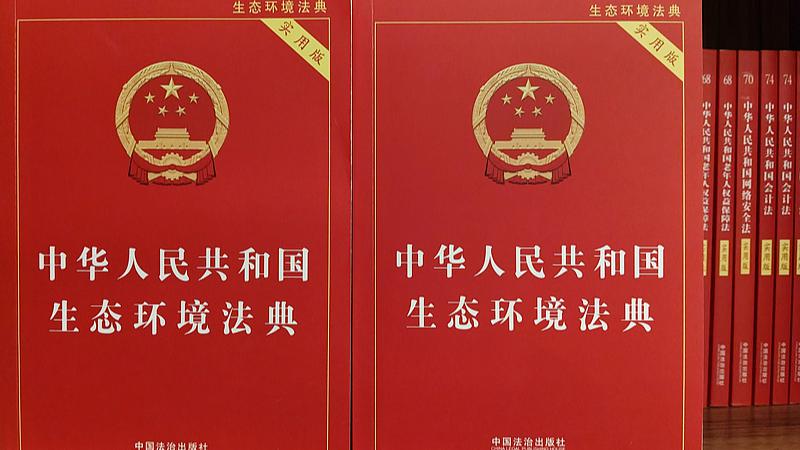
A bookstore features a dedicated section for books on China's Ecological and Environmental Code in Changzhou, China's Jiangsu Province, April 20, 2026. (Photo: CFP)
Environmental challenges do not follow administrative boundaries. A polluted river cannot be restored by addressing water quality alone; its health is also shaped by forests, farmland, cities, industry and climate. Yet environmental law has often developed around separate resources, pollutants and government departments. China's Ecological and Environmental Code, which was adopted on March 12, 2026, by the National People's Congress, is set to take effect on August 15.
As China's second formal statutory code following the adoption of the Civil Code in 2020, it marks a historic leap in China's environmental rule of law, from a landscape of scattered individual laws toward a more integrated system.
This is far more than a mere compilation of laws. It is a governance revolution centered on systemic restructuring, breaking down the long-standing barriers of fragmented governance by individual environmental elements, sectors and regions, offering a systemic "Chinese solution" for global environmental governance.
This reconstruction begins with the legal concept of the eco-environment. Article 2 treats it as the whole formed by natural and human-modified spaces, natural factors and the relationships among them, insofar as they affect human development and ecosystem functions. The change is substantive. Air, water, soil, forests, wetlands and wildlife are no longer understood merely as separate objects of regulation; their interactions become part of the legal object itself.
This reflects the systemic approach of Xi Jinping Thought on Ecological Civilization: Mountains, rivers, forests, farmlands, lakes and grasslands are a life community and must therefore be governed through coordinated action across regions, sectors and stages.
China's Ecological and Environmental Code follows a moderate codification model. It fully incorporates 10 revised environmental laws, selectively integrates rules from legislation on river basins, natural resources, biodiversity, the circular economy and energy conservation, and provides guidance on emerging fields such as climate change and carbon neutrality. Its adoption also establishes ecological and environmental law as a distinct branch of Chinese law, comprising the Code and over 20 complementary instruments that together form a coherent governance framework.
The Ecological and Environmental Code comprises five books, 59 chapters and 1242 articles, covering general provisions, pollution prevention and control, ecological conservation, green and low-carbon development, and legal liability and supplementary provisions. This structure turns a body of previously dispersed rules into a more coordinated system of governance.

View of clear water and lush green mountains along the Xiling Gorge on the Yangtze River in central China's Hubei Province, May 20, 2026. (Photo: CFP)
Book I, the General Provisions, provides a common institutional framework, linking value guidance with specific rules, basic institutions, resource support and multi-stakeholder governance. Books II, III and IV then apply this common framework to pollution control, ecological protection and green transformation.
Rules on air, water, soil, waste, noise and other pollutants sit within the same monitoring and accountability structure. Forests, grasslands, wetlands, oceans, rivers, deserts and species are addressed within an integrated conservation part. A separate chapter on major geographic units strengthens whole-region governance of areas such as the Yangtze River and Yellow River basins as well as the Qinghai-Tibet Plateau.
Meanwhile, the green and low-carbon development part connects the circular economy, cleaner production, energy transition, climate adaptation, carbon markets and China's carbon peaking and neutrality goals. Climate governance is thus no longer treated as an isolated policy field, but is incorporated into the broader transformation of production, consumption and resource use.
Together, China's Ecological and Environmental Code forms a full regulatory chain. At the source, plans, zoning controls, standards and environmental impact assessments are intended to prevent harmful projects and unsuitable development. During implementation, emission permits, integrated monitoring, information sharing and coordinated enforcement make compliance continuously observable.
When damage occurs, administrative penalties, civil liability and possible criminal responsibility operate alongside ecological restoration and compensation. Daily penalties – fines accumulating continuously as the days of violation continue – help prevent non-compliance from becoming a cheaper business option. This full-chain design also makes it possible to pursue carbon reduction, pollution control, green development and economic growth together.
Energy efficiency can reduce both greenhouse gases and conventional pollutants. Restoring forests, wetlands and grasslands can strengthen carbon sinks while conserving biodiversity and improving climate resilience. Circular production can reduce waste, resource consumption and operating costs.
By placing these goals within one legal architecture, the Code treats environmental protection not as a constraint on development, but as a condition for improving the quality and sustainability of growth.
The global relevance of this approach is clear. The world is now facing a "triple planetary crisis" of climate change, biodiversity loss and pollution, yet environmental governance remains fragmented across legal regimes. China's Ecological and Environmental Code marks a significant structural transformation in environmental governance, bringing previously dispersed policies and legal rules within a unified framework.
Yet effective implementation will still depend on inter-agency coordination, reliable monitoring, local capacity, public participation and consistent enforcement. By turning the unity of nature into the logic of law, China is providing a systemic legal response to a global environmental challenge.