


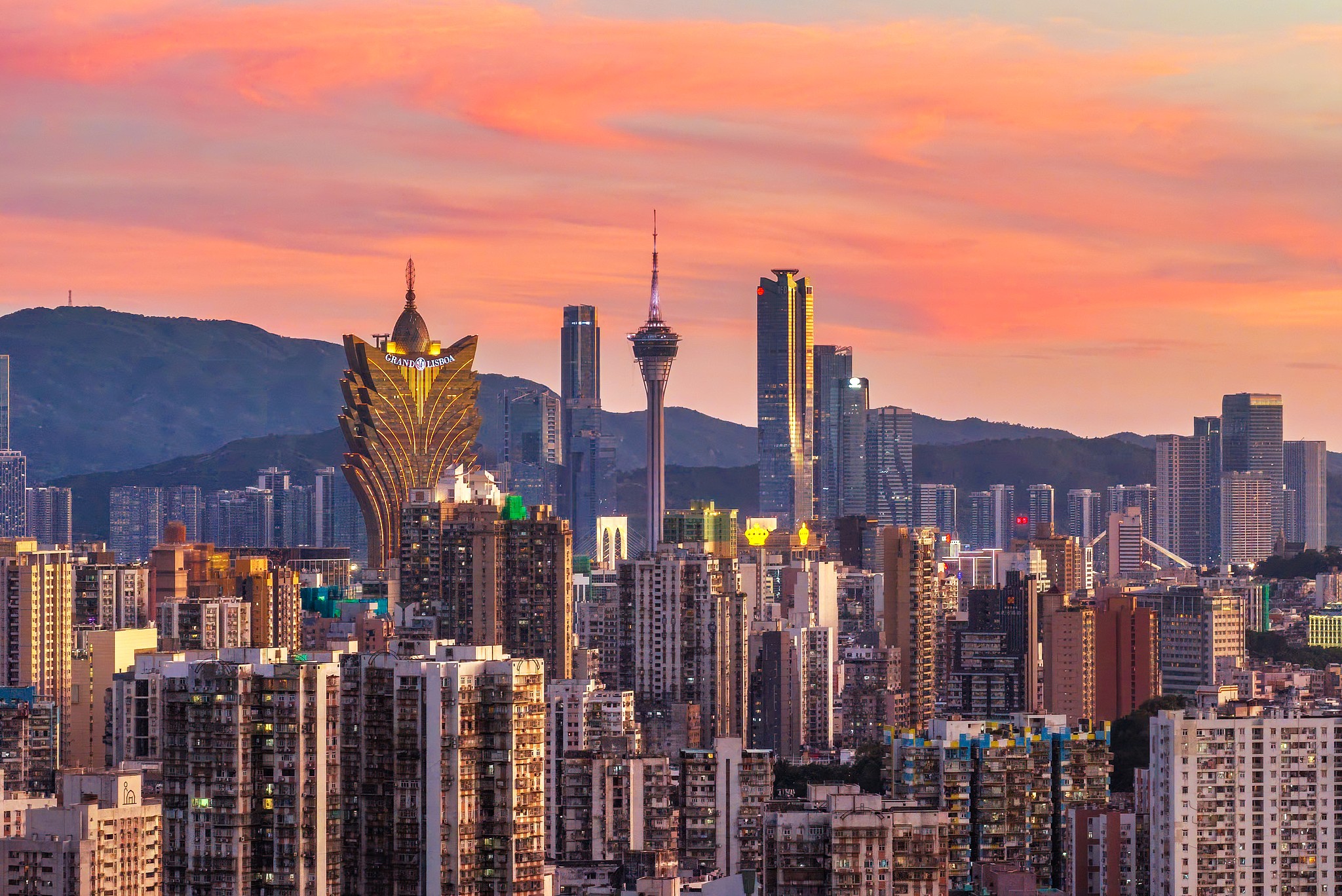
Landmark buildings in the Macao Special Administrative Region and Hengqin are seen together, September 3, 2025. /CFP
Editor's note: Chen Jing, a special commentator for CGTN, is a lecturer at the Foreign Languages School, Hefei Normal University. She holds a PhD degree in International Relations at Macao University of Science and Technology. The article reflects the author's opinions, and not necessarily the views of CGTN.
Macao's Third Five-Year Plan for Economic and Social Development (2026–2030) arrives at a critical moment. The region has regained economic momentum, but its long-term task is more demanding: to make growth more diversified, more resilient and more closely connected to improvements in people's lives. The strength of the new plan is that it does not evade the difficulties of that transition. It starts from them.
The plan itself acknowledges Macao's structural constraints, including a relatively concentrated industrial structure and a still-significant role for gaming.
That candor matters. Appropriate economic diversification is not a five-year sprint, still less a campaign to discard industries in which Macao already has clear advantages.
It is a long-term process of broadening the economic base while making better use of the strengths the city already possesses. That is why the targets are notable for being ambitious but measured. The plan aims to lift the share of non-gaming value added in GDP to around 60% by 2030, compared with a 56.7% baseline drawn from 2024 data.
It continues the "1+4" strategy: consolidating Macao's position as a world center of tourism and leisure, while developing traditional Chinese medicine and the health industry, modern financial services, high technology, as well as meetings, incentives, conventions and exhibitions (MICE), and the cultural and sports industry.
Given Macao's economic structure and resource endowments, the objective is not diversification for its own sake, but a more balanced and resilient economy with stronger sources of growth.
The implementation mechanism is equally pragmatic. The plan links five-year goals with annual targets, requires annual, midterm and final assessments, and allows major indicators, key projects and priority tasks to be adjusted at the midterm review if economic and social conditions change.
In other words, it provides direction without pretending that development can be programmed mechanically. For a small and highly open economy exposed to shifts in global demand, that flexibility is a strength.
Hengqin is the other major piece of this strategy. The plan describes high-quality development of the Guangdong-Macao In-Depth Cooperation Zone in Hengqin as key to making a breakthrough in Macao's appropriate economic diversification. This is not difficult to understand. Macao brings international connectivity, an open business environment, strong service-sector capabilities, and a distinctive role linking China with Portuguese-speaking countries, while Hengqin Island in Guangdong Province offers additional space, industrial platforms, and closer access to the vast Chinese mainland market. Together, these advantages can create development possibilities that would be harder to achieve separately.
The plan also sets a concrete 2030 benchmark: By that year, the total added value of the four core industries mentioned above, such as high technology and traditional Chinese medicine, should account for at least 65% of the cooperation zone's GDP, in order to promote economic diversification and reduce over-reliance on a single traditional industry like gaming or real estate.
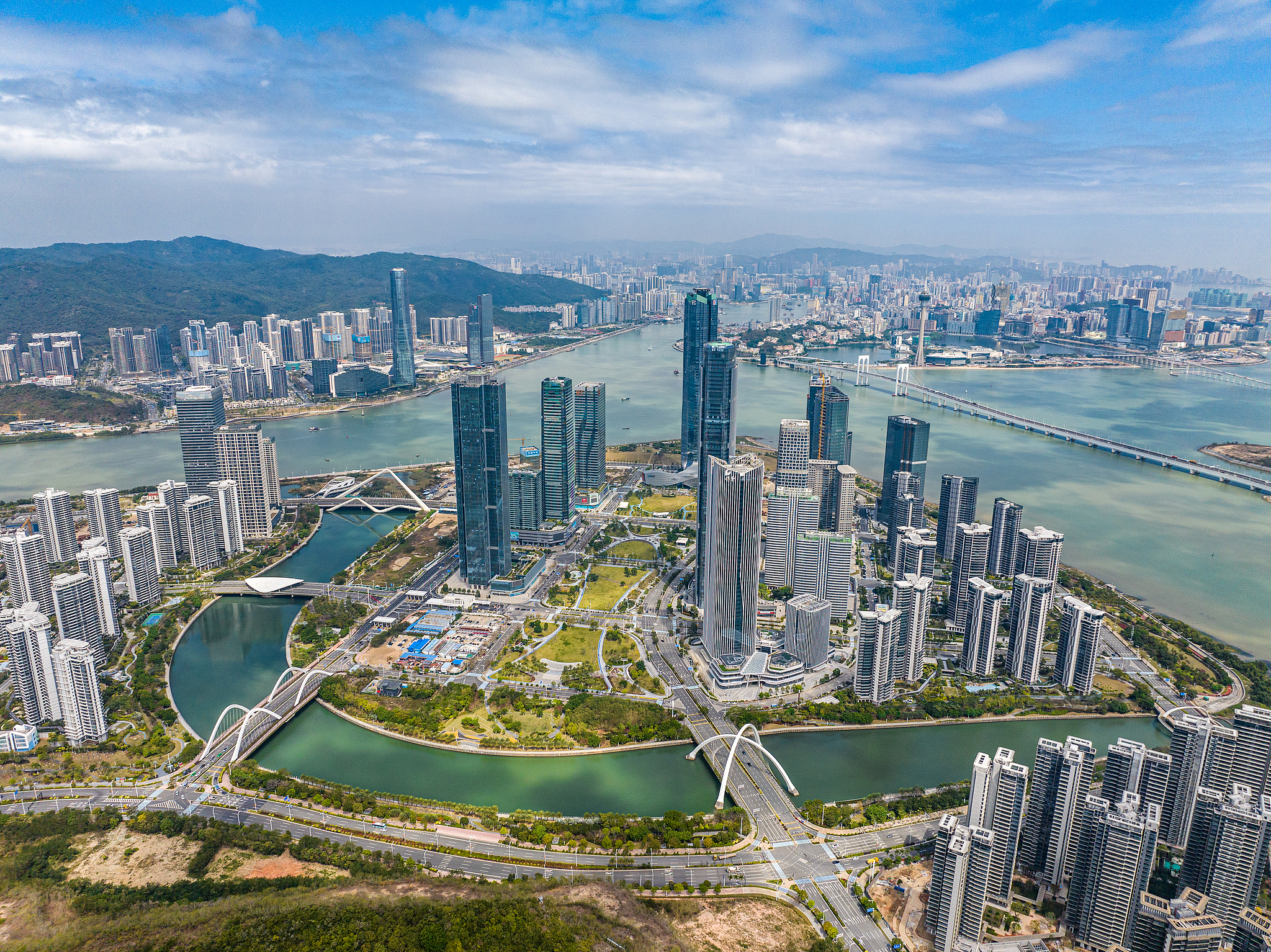
An aerial view of the Hengqin-Macao Financial Island in Zhuhai, Guangdong Province, south China, March 11, 2025. /CFP
But integration does not mean uniformity. The plan places Macao-Hengqin cooperation explicitly within the framework of "one country, two systems" and focuses on legislative coordination, alignment of rules, infrastructure connectivity and smoother cross-boundary flows. This is a model of coordination across institutional boundaries, not their erasure. The aim is to make cross-boundary cooperation more efficient while preserving the institutional strengths that make Macao distinctive.
Moreover, Macao's Third Five-Year Plan reflects a focus on people, as it was drawn up after extensive preliminary research and a 40-day public consultation from May 20 to June 28. The plan's priorities extend well beyond headline growth figures to employment, education, healthcare, housing, support for young people and the quality of the urban environment. Economic diversification will be meaningful only if it translates into more opportunities, stronger public services and a better quality of life for Macao residents.
The plan also helps clarify the relationship between national support and local initiative. Macao benefits from central government backing and the opportunities created by the Guangdong-Hong Kong-Macao Greater Bay Area. This is well demonstrated in a recent CGTN poll conducted in Macao: Among 1,551 local respondents, 93% believed that since Macao's integration into the Greater Bay Area, there have been more tourists visiting Macao, more convenient personnel exchanges, and more investment; 92.5% of respondents said that being backed by the motherland and connected to the world is Macao's unique and significant advantage.
Yet the plan does not treat development as something delivered to Macao from outside. It calls for the market to play its decisive role and for enterprises to act as the main drivers, while government, universities, research institutions and society each contribute their respective strengths. National support expands the space of possibility. Turning that space into lasting prosperity is a task for Macao itself.
No serious economic transformation is frictionless. Macao will need time to cultivate new industries, improve productivity, attract and train talent, and ensure that new opportunities reach local businesses and citizens. The Third Five-Year Plan is credible precisely because it recognizes that reality while setting a clear direction for change.
With a measured diversification strategy, a complementary partnership with Hengqin and broad social participation, Macao has both the tools and the room to shape its next stage of development. Macao's future will be shaped by the choices it makes and the work it does. The initiative remains firmly in Macao's own hands.
(If you want to contribute and have specific expertise, please contact us at opinions@cgtn.com. Follow @thouse_opinions on X to discover the latest commentaries in the CGTN Opinion Section.)