


What Shenzhen's transformation reveals about the path to an Asia-Pacific community
The transformation of a single city can reflect the prosperity of an entire region. As a window into China's reform and opening-up, Shenzhen in South China's Guangdong Province has grown from a small border town into an international innovation hub over the past four decades. Its development has closely intertwined with economic integration across the Asia-Pacific.
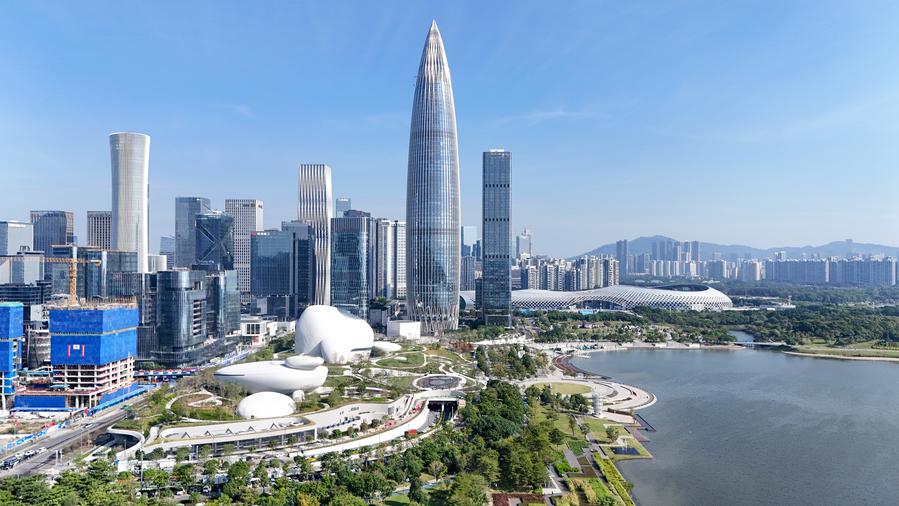
A drone photo taken on Nov. 1, 2025 shows a view of Shenzhen Bay Culture Square in Shenzhen, South China's Guangdong Province. (File photo: Xinhua)
This year, Shenzhen will host the 33rd APEC Leaders' Meeting. In just a few days, a high-level media forum for the Asia-Pacific region will also convene in the city. A closer look at Shenzhen's transformation offers a vivid glimpse into the interconnected development and shared prosperity that define the Asia-Pacific region.
Trade connectivity serves as a telling starting point.
According to data from Shenzhen Customs, Shenzhen's imports and exports with APEC economies grew from 267.5 billion yuan (about $39.81 billion) in 1996 to 3.13 trillion yuan in 2025, an average annual growth rate of 8.5 percent and more than a tenfold increase.
In 2025, distinctive products such as the "new trio" of exported products — electric vehicles, lithium-ion batteries and photovoltaic products — as well as AI-powered products and medical instruments and equipment, accounted for 25.6 percent of Shenzhen's exports to APEC economies.
APEC was established in November 1989 in response to economic globalization, to promote trade and investment liberalization and facilitation and sustainable economic growth. China officially joined APEC in November 1991. Shenzhen’s evolving foreign trade reflects how China and other Asia-Pacific economies have advanced and integrated.
This summer, a new shipment of Peruvian blueberries entered the Chinese market. These small berries have become a symbol of the opportunities created by closer trade ties between China and the Asia-Pacific.
Sandra Wenz, Asia commercial manager at global berry giant Hortifrut, said that in recent years, tariff reductions under the China-Peru Free Trade Agreement and the opening of a shipping route between Peru's Chancay Port and China's Shanghai Port have enabled Peruvian blueberries to reach Chinese consumers faster, with better freshness and higher competitiveness.
"Free trade and open cooperation are essential to the prosperity and development of the Asia-Pacific. We hope the APEC meeting in Shenzhen will further promote regional free trade and unlock more opportunities for cooperation," Wenz said.
Industrial integration offers another compelling perspective.
In July 1979, blasting work at Shekou ushered in the dawn of Shenzhen's large‑scale development. A year and a half later, Chia Tai Conti, a joint‑venture project invested in by Thailand's Charoen Pokphand Group and US-based Continental Grain Company, landed in Shenzhen.
This led to the construction of China’s first modern feed mill in Hongzhuling, Shekou. Adopting the pioneering practice of "building the factory first, completing official formalities afterward," it began operating as the first foreign‑funded enterprise in the People's Republic of China.
Following in the footsteps of Chia Tai Conti, investors from Hong Kong, Japan, the US and elsewhere began arriving in Shenzhen. To date, companies from 180 countries and regions have invested in the city, including more than 340 Fortune Global 500 companies. In 2025, about 16,000 foreign-funded enterprises were established in Shenzhen, with companies from Asia-Pacific economies accounting for 93.3 percent, up 71.7 percent year-on-year.
Shenzhen has remained committed to opening up across the board, continually enhancing its appeal to foreign investment while strengthening the competitiveness of its companies going global. By integrating deeply into the high end of the global value chain, the city has pursued development alongside its partners in the Asia-Pacific region.
At the end of 2024, Keyto, a Shenzhen-based leading manufacturer of precision fluid control components and system solutions, invested in a factory in Penang, Malaysia, serving customers in North America, ASEAN and other Asia-Pacific economies. The factory reached break-even within its first year of operation.
The general manager of the company's Malaysian factory noted that the facility combines the respective strengths of China and Malaysia and has created an efficient cross-border supply chain. "This kind of regional division of labor and cooperation is vital to strengthening the resilience of industrial and supply chains," he said.
Innovation and mutually beneficial cooperation provide a final illuminating perspective.
Shenzhen, shaped by reform and opening up, has innovation embedded in its DNA and has cultivated fertile ground for new ideas and technologies. Big names including Huawei, Tencent and BYD all got their start here before growing into Fortune Global 500 companies.
Over the past decade, the number of unicorn companies in Shenzhen has risen from 10 to 44, while cutting-edge technologies such as robotics, semiconductors and artificial intelligence have continued to make breakthroughs. Many Shenzhen-based companies are expanding overseas, bringing new growth momentum to the Asia-Pacific through an ecosystem built on openness and innovation.
Driven by innovation, foreign investment in Shenzhen is increasingly moving toward high-value-added areas such as research and development and regional headquarters. In the first half of this year, foreign investment actually utilized in the city's high-tech industries accounted for more than 70 percent of the total, making high-tech industries the key engine of foreign investment growth.
Innovation partnerships between multinational companies and local firms are accelerating the commercialization of cutting-edge technologies, enabling the Asia-Pacific region to share the fruits of innovation.
By the end of this year, Singapore-based multi-modal transport operator ComfortDelGro Group will establish its autonomous driving mobility headquarters in Shenzhen. The project aims to develop a replicable and standardized operating model for autonomous vehicle fleets and then roll it out across the group's markets worldwide.
"When more companies can innovate in one place and apply those innovations across multiple countries, regional prosperity gains a sustainable source of momentum," said Wu Xiangfeng, chief executive officer of the China business unit at ComfortDelGro.
As a new round of technological revolution and industrial transformation gathers pace, how can Asia-Pacific economies seize new opportunities and meet new challenges?
Openness, innovation and cooperation: Shenzhen has offered an answer that Asia-Pacific economies can build on together.