


Asia-Pacific needs its own lens to understand its future
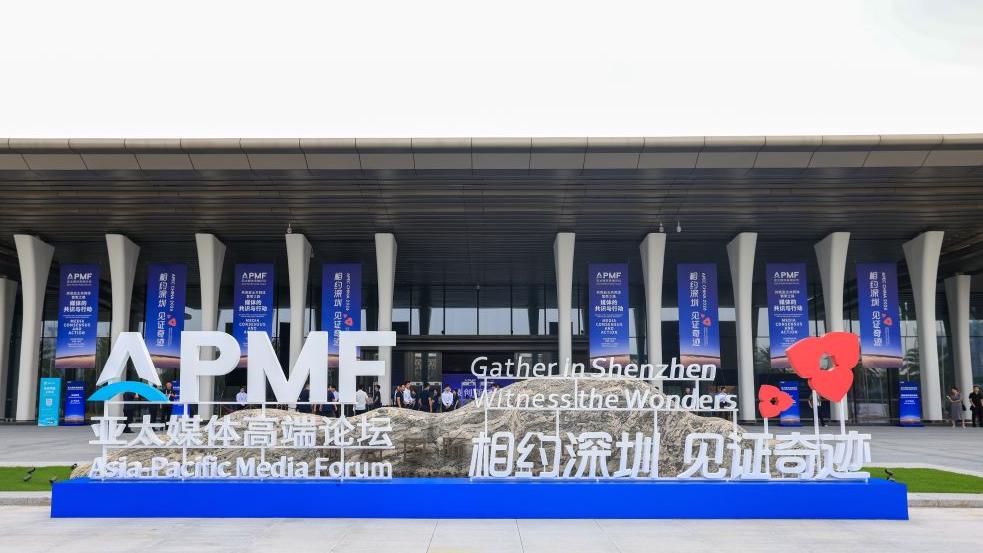
As the Asia-Pacific Media Forum opens in Shenzhen, Guangdong Province in south China, bringing together more than 400 Chinese and international media professionals, its logo is seen outside the venue, September 5, 2026. (Photo: Xinhua)
Editor's note: Wang Wen, a special commentator for CGTN, is the dean of the Chongyang Institute for Financial Studies at Renmin University of China. The article reflects the author's opinions and not necessarily the views of CGTN.
For much of the discussion about the Asia-Pacific amid today's global transformation, one analytical framework has become almost instinctive: the Western realist assumption that the rise of a major power inevitably produces a clash of interests, that growing strength leads to a struggle for dominance, and that conflict is an inescapable feature of international relations.
But is this really the only way to understand Asia's past – or to imagine its future? The history of the Asia-Pacific tells a more complicated story. For centuries, the region's civilizations interacted through exchange rather than conquest, coexistence rather than zero-sum rivalry. This tradition deserves to be seen on its own terms, rather than through the lens of Europe's wars, colonial expansion and balance-of-power politics.
Consider the seventh-century Chinese monk Xuanzang. A pilgrim who traveled to India to study Buddhism, his journey was not simply a one-way search for foreign knowledge. After spending more than a decade studying in India, Xuanzang translated Chinese philosophical thought into Sanskrit and brought introduced it to South Asia. Upon returning to China, he translated large numbers of Sanskrit Buddhist texts, enriching the Chinese civilization with ideas from abroad.
His story illustrates something fundamental about Asia's civilizational exchanges: They were not simply about one side teaching and the other learning. They were processes of mutual enrichment.
The same spirit can be found in Asia's maritime history. In the eighth century, Tang Dynasty envoy Yang Liangyao sailed from Guangzhou across the South China Sea to the Middle East. His mission carried diplomatic letters and gifts, not an army seeking territory.
In the 15th century, Chinese admiral and explorer Zheng He's seven voyages brought enormous fleets across the Indian Ocean. China possessed considerable naval power, yet these expeditions did not result in colonial conquest. In places such as Malacca in Malaysia and what is now Thailand, they facilitated trade, diplomacy and peaceful relations.
I once had a fascinating conversation with a Western journalist. I told him that during the Tang Dynasty (618-907), China’s GDP at one point accounted for 80% of Asia’s total. The maritime fleet led by Zheng He was, in terms of overall capability, roughly 10 times as powerful as the fleet Columbus used to cross the Atlantic more than 80 years later.
By the logic of Western maritime expansion in the modern era, if China had chosen the path of colonial conquest, perhaps all of Asia would be speaking Chinese today. But history took a different course. China did not choose that path.
The historical contrast is striking. Power can be used to dominate, but it can also be used to build bridges. The maritime traditions of Asia offer examples of the latter.
That tradition has not disappeared into history books. It continues to live in the everyday interactions of people across the region. Films, cultural exchanges, student exchanges, heritage projects, tourism and trade create connections that cannot easily be captured by geopolitical maps.
A film from south China's Chaoshan region about family letters, for example, resonated with audiences in Singapore, Malaysia and Brunei not because of any grand geopolitical narrative, but because its story of family and longing crossed linguistic and national boundaries. In Malacca, the memory of Zheng He has become part of contemporary local cultural life.

Tourists flock to Jieyang Ancient City, the filming location of the Chinese family drama Dear You, in Jieyang, Guangdong Province, south China, June 19, 2026. (Photo: CFP)
These seemingly ordinary encounters matter. The cohesion of the Asia-Pacific does not come only from treaties and strategic arrangements, it is also built through connections among ordinary people.
Yet today, this reality is often obscured by an imported narrative framework. When every instance of a major power's development is interpreted as evidence of hegemonic ambition, when regional cooperation is automatically viewed as geopolitical maneuvering and when differences among Asian countries are portrayed as signs of an impending civilizational conflict, the region's complexity is reduced to a single storyline: confrontation.
Such thinking risks becoming a self-fulfilling prophecy. Conflict is assumed in advance; evidence is then selectively interpreted to reinforce that assumption; and the resulting conclusion is that major powers must inevitably compete for dominance. The possibility of cooperation is pushed to the margins.
Western realism is a product of particular historical experiences. It should not automatically be treated as a universal law governing every region and civilization. The Asia-Pacific, with its extraordinary diversity of cultures, political systems and peoples, has repeatedly demonstrated that strength does not necessarily have to lead to domination.
This is where the media have an important role to play.
Journalists are not merely observers of history. Through the stories they select and the frames they use, they also help shape how societies understand themselves and one another. Asia-Pacific media should therefore ask whether they are explaining the region through their own historical experience or unconsciously reproducing assumptions developed elsewhere.
Three priorities deserve attention. First, the region needs to reclaim greater ownership of its historical narrative. Stories of Xuanzang's two-way cultural exchange, Yang Liangyao's peaceful diplomacy and Zheng He's engagement with neighboring societies deserve greater attention.
Asia's history should not always be reduced to a story of hegemonic succession. Its traditions of harmony amid difference and mutual learning are equally important parts of its historical inheritance.
Second, media should tell more stories about ordinary people. Geopolitical confrontation may generate headlines, but the daily reality of the Asia-Pacific is also shaped by cultural exchanges, young people traveling and studying abroad, artistic cooperation, heritage projects, trade and personal friendships.
A film that moves audiences across borders or a cultural exhibition that brings communities together can sometimes reveal more about the region’s future than another abstract debate about great-power rivalry.
Third, media should preserve what might be called "rational presence" – resisting the temptation to view every disagreement through a binary, confrontational lens. Differences among Asian countries are real and will not disappear. But disagreement does not make conflict inevitable. Responsible journalism should create space for multiple perspectives, rely on firsthand observation rather than secondhand assumptions and illuminate complexity rather than amplify polarization.
The Asia-Pacific is now at a crossroads. It has an opportunity not simply to reproduce the historical patterns of other regions, but to draw on its own civilizational experience.
The task for the region's media is therefore not to ignore competition or differences, but to ensure that they do not become the only story we tell. By recovering the region's traditions of mutual understanding and giving greater visibility to the connections among its peoples, the media can help create the intellectual and public space for a more peaceful Asia-Pacific future.