


BRICS financial autonomy: Motivations, conditions and limits
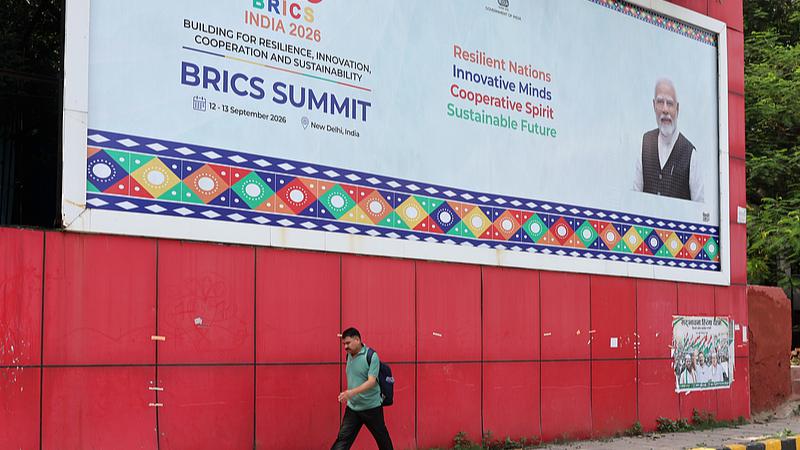
An Indian man walks in front of a BRICS billboard placed ahead of the upcoming BRICS Heads of State Summit near the venue of the summit in New Delhi, India, September 8, 2026. (Photo: CFP)
BRICS members are assessing a new digital payments framework designed to interconnect national currencies and reduce exposure to Western sanctions, tariffs and dollar volatility. Under a proposal put forward by the Reserve Bank of India, members would allow cross-border transactions to be settled in local currencies. The issue is expected to reach the New Delhi summit this September.
The Indian initiative has two options. The first is to interconnect the fast-payment systems that member states already operate. Once India's Unified Payments Interface (UPI) and Brazil's Pix are linked, cross-border payments could be made as easily as domestic ones. Meanwhile, the second is interconnection between central bank digital currencies. In concrete terms, India is already running pilots of the digital rupee, China has the e-CNY, and Russia the digital ruble.
The push reflects both external pressure and internal capacity. The first is the security pressure arising from the transformation of the dollar clearing infrastructure from a public good into a geopolitical instrument.
Recently, the United States has threatened secondary sanctions to cut off Iran's oil revenues, imposed about 50% tariffs on Brazilian exports to the US, and placed Pix under a Section 301 investigation – all of which have undoubtedly heightened the security anxieties of BRICS countries.
The second is cost pressure. Under the dollar-centric system, a single cross-border payment may pass through three to five intermediaries, with total costs amounting to roughly 3-5% of the transaction value, whereas settlement in local currencies can save 2-3% in exchange-conversion costs. These quantifiable savings have turned financial autonomy from a value-based aspiration into a calculable rational choice. Technology, meanwhile, has matured to the point where it offers BRICS members a new way of easing both pressures. They have already built out substantial payment and clearing infrastructure.
Pix in Brazil processes over 7 billion transactions a month; India's UPI rests on a mature architecture; As of end of 2025, China's CIPS counts 193 direct and 1,573 indirect participants; and mBridge has cleared some $55.5 billion in total, about 95% of it in e-CNY. Because these rails already exist, linking the members' domestic payment systems is no longer an aspiration but a practical proposition.
Four conditions lend it support to BRICS' pursuit of financial autonomy. The first is a turn towards pragmatism. India has explicitly opposed a common currency, proposing instead a payment bridge that would link UPI, Pix, e-CNY, Drex and the digital rupee, and the 2025 Rio Declaration likewise encouraged inter-operability among payment systems. The second is that the market has moved ahead of policy.

A visitor displays a cup of coffee purchased with China's digital yuan, or the e-CNY, at an exhibition of the 6th Digital China Summit in Fuzhou, southeast China's Fujian Province, April 26, 2023. (Photo: Xinhua)
On July 30, 2026, China UnionPay International launched a QR-code payment pilot connecting to Brazil's Pix. The third is liquidity arrangements are already in place. The China-Brazil local-currency swap line amounts to 157 billion Brazilian reals. The fourth is settlement patterns have already changed. According to Russian officials, more than 67% of intra-BRICS trade settlement is now conducted in local currencies.
The constraints are no less clear. The top concerns are standards and compliance. While Pix maintains its native API specifications (albeit with partial ISO 20022 compatibility), UPI and CIPS are largely built around ISO 20022, making data mapping costly. The cross-border mutual recognition on data localization and anti-money-laundering supervision has yet to be achieved, and the legal meaning of settlement finality differs across jurisdictions.
The currency asymmetry is also a problem. In the absence of a multilateral clearing pool and hedging instruments, mismatched local-currency positions must still be squared in the dollar market. Even the New Development Bank, on which so many hopes rest, still denominates its charter and capital structure in dollars.
Next comes the fragility of political coordination. India stresses "diversification rather than confrontation," and general elections such as that in Brazil and Argentina may usher in policy shifts that disrupt continuity in cross-border financial cooperation. More fundamental still is the weight of the incumbent order. IMF data shows that in the first quarter of 2026 the US dollar still accounted for 57.13% of global foreign-exchange reserves while independent estimates put its share of global export invoicing at around 54%. This suggests no alternative currency can replicate the network effects of the US dollar in the near term.
Looking ahead, whether BRICS financial autonomy proves feasible depends above all on combining a "low political profile" with "high engineering substance." That is, positioning any new arrangement as a supplement to SWIFT rather than a replacement, keeping dollar channels open, piloting first in less sensitive sectors such as agricultural goods and energy, and turning CBDC interconnection, a common gateway and a multilateral liquidity pool into verifiable, working systems. In the short run, this process is unlikely to dislodge the dollar, yet it will still erode the marginal effectiveness of unilateral sanctions.