


Putting development back at the center of global cooperation
The world is witnessing extraordinary advances in science, technology, and innovation. Yet for hundreds of millions of people, the promise of progress remains out of reach. Poverty, food insecurity, inadequate healthcare, climate vulnerability, and widening inequality continue to shape everyday life across much of the developing world.
Geopolitical tensions, trade fragmentation, sanctions, and supply-chain disruptions have further complicated the pursuit of sustainable development. Many countries in the Global South also believe that the current international economic system has too often concentrated the benefits of development among a relatively small number of advanced economies, rather than ensuring that development remains a universal opportunity accessible to all.
Against this backdrop, China's call to align the Global Development Initiative (GDI) with the United Nations 2030 Agenda for Sustainable Development comes at a particularly important moment. As strategic competition increasingly dominates international relations, development risks being pushed to the margins of global governance. Reversing that trend is essential. Sustainable peace, economic resilience, and shared prosperity ultimately depend on placing development back at the center of international cooperation.
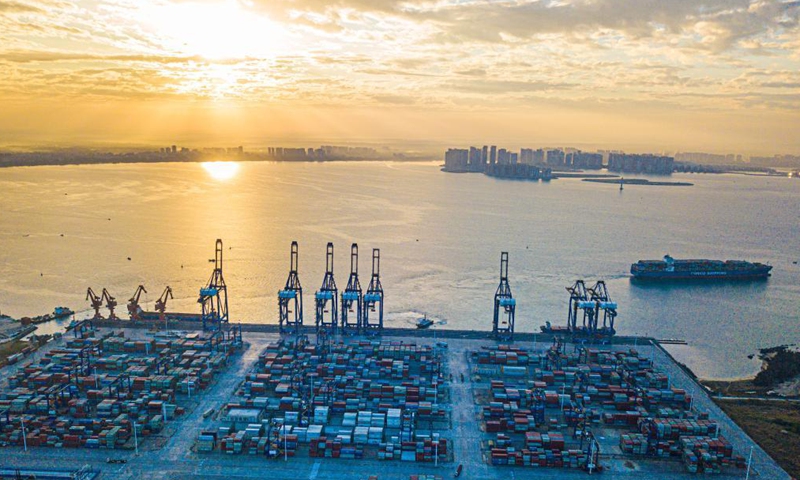
Aerial photo taken on Dec. 5, 2021 shows the sunrise scenery of the Yangpu international container port at Yangpu economic development zone in south China's Hainan Province. (Photo: Xinhua)
The GDI has evolved from a policy proposal into a broad platform for international development cooperation. More than 130 countries and international organizations have expressed support for the initiative, while nearly 100 have signed cooperation documents with China. More importantly, the GDI has moved beyond declarations to practical implementation. More than $23 billion has been mobilized to support over 1,800 "small and beautiful" livelihood projects, while professional training has reached more than 200,000 people from developing countries, generating tangible benefits across more than 120 countries.
What distinguishes the GDI is not merely the resources it mobilizes, but the philosophy that underpins it. Rather than treating development as another arena of geopolitical competition, it seeks to restore development to its rightful place at the center of the international agenda. Its underlying premise is straightforward: Lasting peace and prosperity require sustained investment in poverty reduction, infrastructure, education, healthcare, technological innovation, and digital inclusion.
This emphasis resonates strongly with the priorities of the Global South. For many developing countries, the central challenge is not choosing sides in geopolitical competition, but accelerating national development. Governments are judged less by their geopolitical alignment than by their ability to create jobs, modernize infrastructure, strengthen public services, attract investment, reduce poverty, and improve living standards. Development is therefore not a geopolitical choice—it is a national necessity.
Equally important, the GDI is designed to complement rather than compete with the existing international development architecture. China has consistently called for closer alignment between the initiative and the United Nations 2030 Agenda while reaffirming support for multilateralism, stronger international cooperation, and a more effective development role for the United Nations. At a time when progress toward the Sustainable Development Goals continues to lag, strengthening coordination among existing institutions is likely to be far more productive than creating competing development frameworks.
Another defining feature of the GDI is its emphasis on innovation as a driver of sustainable development. Development today is no longer defined solely by roads, ports, and power plants. Digital connectivity, AI, green technologies, scientific cooperation, and knowledge sharing have become equally important foundations of economic transformation.
Recognizing this reality, China has argued that narrowing the digital and AI divide between developed and developing countries should become a global priority. This vision is reflected in its proposal to establish the World Artificial Intelligence Cooperation Organization (WAICO), which seeks to strengthen international cooperation on AI development and governance while enabling developing countries to participate more fully in the next wave of technological progress rather than being left behind.
Perhaps the GDI's greatest strength lies in its emphasis on implementation. Rather than remaining a statement of principles, it seeks measurable outcomes through development financing, technology cooperation, institutional partnerships, professional training, and capacity building. This practical approach has become increasingly important at a time when many developing countries are looking for partners capable of translating ambitious goals into tangible improvements in people's lives.
None of this suggests that the GDI alone can solve the world's development challenges. No single initiative can. Climate change, debt sustainability, uneven development, technological inequality, and financing gaps require stronger cooperation among governments, international organizations, multilateral development banks, the private sector, and civil society. The GDI's value lies in reinforcing these broader efforts by mobilizing additional resources, strengthening partnerships, and accelerating implementation of the Sustainable Development Goals.
Ultimately, the GDI represents something larger than a single development program. It reflects a growing recognition that development should once again become the foundation of international cooperation rather than its afterthought. In a world increasingly defined by geopolitical rivalry and economic fragmentation, lasting stability cannot be built through competition alone. It requires inclusive development, stronger multilateral partnerships, and a shared commitment to improving the lives of people everywhere.
The ultimate test of any development initiative is not the number of agreements signed or institutions created, but the lives it changes. Success should be measured by whether more children receive a quality education, more communities gain access to modern infrastructure, more businesses benefit from technological innovation, and more countries achieve sustainable and inclusive growth. These are not the aspirations of one region or one political system—they are the universal hopes of every nation and every people.
If the international community is serious about achieving the United Nations 2030 Sustainable Development Goals, development must once again become the organizing principle of global cooperation. In this respect, the GDI should be viewed not as an alternative to the existing international system, but as a complementary effort to strengthen it through broader cooperation, practical implementation, and a shared commitment to ensuring that the benefits of development are enjoyed by all countries, not just a fortunate few.
(The author is the Founding Director of the Belt and Road Initiative Sri Lanka. Article was compiled by Bai Yuanqi.)