


Observer: Japan cannot move forward without breaking with militarism

On September 18, air raid sirens were once again sounded across China to commemorate the 95th anniversary of the September 18 Incident.
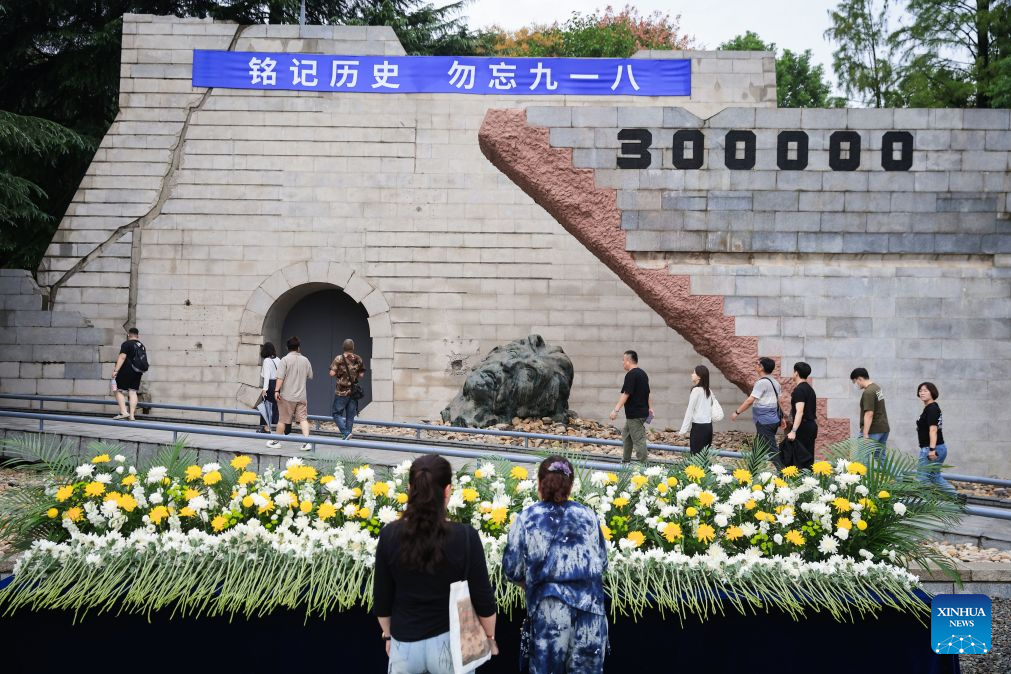
People visit the Memorial Hall of the Victims in Nanjing Massacre by Japanese Invaders in Nanjing, East China's Jiangsu Province, Sept. 18, 2026. (Photo: Xinhua)
Ninety-five years ago, Japanese militarists deliberately provoked the September 18 Incident and brazenly launched a war of aggression against China. The Chinese people rose up in resistance, marking the beginning of the eastern front of the World Anti-Fascist War.
After 14 years of bitter struggle and enormous national sacrifice, the Chinese people won a great victory in which justice prevailed over evil, writing a momentous chapter in the history of the World Anti-Fascist War.
Commemorating the September 18 Incident and remembering this history is by no means about perpetuating hatred. Rather, it is about safeguarding peace and creating a better future by drawing lessons from history and setting the record straight.
On the fundamental issue of historical understanding, Japan, as the perpetrator of the war of aggression, has never truly reflected on its past. Instead, it has gone further down the path of distorting history.
Not long ago, the Sanae Takaichi administration issued its first major defense policy document, the Defense White Paper 2026. The white paper makes much of the issue of so-called cognitive warfare, applying blatant double standards throughout.
On the one hand, it labels China's normal explanations of its defense policies and legitimate articulation of its historical positions as "public opinion warfare, psychological warfare and legal warfare." It baselessly accuses China of infiltration and deliberately stoking confrontation, putting on a show of warning against so-called "external cognitive threats" while casting itself as a "victim" of information warfare.
On the other hand, it says nothing about Japan's own record of systematically distorting the history of aggression and spreading false historical narratives, while instead identifying the development of cognitive-warfare capabilities as a priority for military expansion. Japan's practice of reversing right and wrong and confusing truth with falsehood is, in essence, an attempt to pursue historical revisionism under the guise of "countering cognitive warfare."
For years, right-wing forces in Japan have repeatedly crossed the line on historical issues, steadily eroding the consensus on historical justice and distorting Japanese society's understanding of the past, with increasingly serious consequences.
At the level of official narratives, Japan has repeatedly revised school textbooks to downplay its heinous acts of aggression, including the Nanjing Massacre. It has deliberately amplified narratives portraying Hiroshima and Nagasaki as victims of the atomic bombings to obscure Japan's own role as an aggressor.
Japanese politicians have taken turns visiting the so-called Yasukuni Shrine, where Class-A war criminals are enshrined, rejecting the legal authority of the Tokyo Trials and promoting the claim that responsibility for the war remains unsettled, repeatedly challenging the bottom line of historical justice.
At the level of intergenerational indoctrination, Japan has for years published children's editions of the Defense White Paper, packaging military-related content in confrontational terms as educational material and distributing it to thousands of elementary schools across the country.
Recruitment messages for the Self-Defense Forces have also been incorporated into school activities, while external threats have been exaggerated, subtly instilling militaristic thinking in the minds of young people whose worldviews are still taking shape.
At the level of public opinion manipulation, right-wing forces have used generative artificial intelligence to mass-produce false audio and video content that distorts the history of Japan's aggression against China, while using crowdsourcing platforms to pay for the dissemination of falsehoods.
According to publicly available budget data from Japan's Ministry of Foreign Affairs, Japan has allocated more than 56 billion yen (about $360 million) since 2015 under the heading of "overseas strategic information dissemination," specifically for smearing others in public opinion and revising the historical narrative.
The Japanese right wing's efforts to distort historical understanding are far more than isolated acts of manipulating public opinion. Their fundamental aim is to remove ideological obstacles and lay the groundwork for breaking through the postwar system and pursuing comprehensive remilitarization.
A profound reflection on the history of aggression and the eradication of the roots of militarism should be a prerequisite and foundation for Japan to pursue peaceful development, as well as a key line of defense for upholding the postwar international order.
Today, however, Japan's right-wing forces are moving in the opposite direction, systematically dismantling this line of defense for peace.
Domestically, they seek to reduce public resistance to military expansion and war preparations, manufacturing so-called justification for a defense budget that has risen for 14 consecutive years and surpassed 9 trillion yen.
Externally, they deliberately conceal the offensive nature of their military expansion, seeking to ease international opposition to a series of moves that break through the postwar framework, including the development and deployment of long-range offensive weapons, the reorganization of the Air Self-Defense Force into an "Air and Space Self-Defense Force" and the relaxation of restrictions on exports of lethal weapons.
Japan is continually breaking through the constraints of the postwar framework, accelerating the loosening of military constraints and the expansion of its military capabilities through multilateral military exercises, joining forces with countries outside the region in bloc confrontation and deliberately creating tensions and instability in the region. Step by step, it is heading down the dangerous path toward neo-militarism.
When war criminals are put on a pedestal, lies are written into textbooks, children are taught hostility and the bottom line for peace is repeatedly breached, Japan is gradually destroying its own future.
The distortion of historical understanding is the ideological root of the growth of neo-militarism in Japan. Unless this root cause is eradicated, the lingering influence of militarism cannot be fully eliminated. Japan will be unable to win the trust and understanding of the international community, especially its Asian neighbors, and the foundation for peace and development in the region cannot be firmly consolidated.
This year marks the 80th anniversary of the opening of the Tokyo Trials. At this important historical juncture, Japan should face up to the history of its aggression, deeply reflect on its responsibility for the war and fundamentally break with militarism. This is the right choice in the fundamental interests of the Japanese people.