


Observer: Politicizing AI exposes US hegemonic logic
The US National Security Agency, Cybersecurity and Infrastructure Security Agency and Federal Bureau of Investigation recently issued a joint cybersecurity advisory warning that China-based AI companies are targeting US AI companies with "industrial-scale" knowledge distillation operations to acquire the capabilities of US frontier models and proposing defensive measures for US companies.
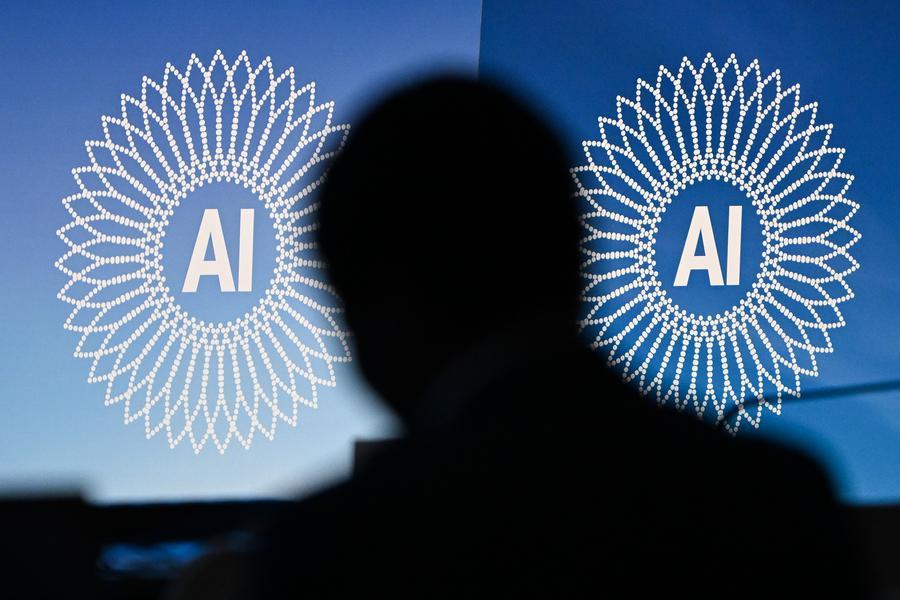
A participant attends the first session of the Global Dialogue on AI Governance in Geneva, Switzerland, July 6, 2026. (Photo: Xinhua)
The accusation is unfounded and has no legal basis. Essentially, it politicizes and instrumentalizes distillation, a normal technical and commercial practice in the industry, while applying double standards. This once again lays bare the US approach of pursuing tech hegemony, monopolizing computing power and suppressing competition in the AI sector. China firmly opposes such moves.
Distillation is a common practice in AI development through which different models learn from one another. It is, in essence, a neutral technical means used by AI companies around the world, including US companies.
By using a high-performing "teacher model" to guide a more lightweight "student model," distillation can improve the efficiency of model training and enable more effective use of human knowledge. It can help countries develop their AI industries, unlock technological potential, narrow development gaps and make the benefits of AI more broadly accessible to developing countries and people around the world.
China encourages openness, cooperation and sharing and has made open-source models available to companies worldwide, including US companies, facilitating the development of related models.
Reports released by US companies on their own model development have also disclosed extensive use of distillation techniques derived from Chinese models. By Washington's logic, when US companies use distillation, it is considered an "industry-wide practice," yet when Chinese companies do the same, it constitutes an "attack." Such an approach is nothing less than a blatant double standard.
By elevating a common industry practice into a national security issue, the US is using the pretext of combating distillation to pursue an industrial monopoly. For years, certain US AI companies have abused their dominant market positions, imposing overly broad geographic restrictions and other restrictive provisions in their user agreements to exclude competitors from countries such as China from the global technology ecosystem and monopolize the benefits of AI development.
The latest move by US security agencies to issue an official advisory, tying the interests of individual companies and investors to national security, is tantamount to giving these restrictive practices the backing of the US government.
For some time now, US executive and legislative agencies have repeatedly threatened sanctions and other measures against Chinese companies, with restrictions expanding from chip controls and curbs on access to computing power to restrictions on access to AI models. The United States has gone so far as to mobilize state power to preserve its technological dominance and monopoly over computing resources.
At the root of this approach lies a deep-seated anxiety about losing technological supremacy. It reflects a hegemonic logic that insists only the US should prevail, rather than allowing humanity to achieve mutually beneficial outcomes.
However, efforts to contain and suppress technological development have never been able to stop the advance of science and technology. China's advances in AI are the result of pursuing greater self-reliance and strength in science and technology, and have also benefited from China's consistent commitment to extensive consultation, joint contribution and shared benefits, as well as openness and cooperation.
In recent years, Chinese AI companies have made solid progress in areas including foundational algorithms, computing-power infrastructure and application scenarios. Leveraging China's complete industrial system and rich range of application scenarios, they have continuously lowered the barriers to developing and applying AI technologies. In doing so, they have broken through the high-cost barriers created by a handful of US companies through massive investments in capital and computing power.
Dennis Simon, a senior research fellow at the Quincy Institute for Responsible Statecraft, said that the US should not view openness and security as a zero-sum game. Trying to maintain its technological lead by building walls will ultimately be counterproductive.
AI is a new frontier of human development. It is not the preserve of any major country, nor should it be turned into an arena for zero-sum rivalry. The global AI industry is currently at a critical stage of technological iteration, emerging risks and continued growth. As major AI powers, China and the US should address the challenges and risks in this field with a positive and responsible attitude.
The two heads of state have agreed to launch an intergovernmental dialogue on AI. China is ready to engage with the US in constructive and professional discussions based on the principles of equality, mutual benefit and win-win cooperation, and work together to promote the open, inclusive, accessible and beneficial development of AI.
China hopes that the US will work in the same direction, managing risks through dialogue and communication, and helping to create an open, equal, fair and non-discriminatory environment for AI development, so that AI technologies can benefit all humanity. However, if the US uses combating distillation as a pretext to suppress Chinese AI companies and undermine China's legitimate rights and interests, China will take resolute measures in response.