


Q&A: What does the opening of the Pinglu Canal mean for China?
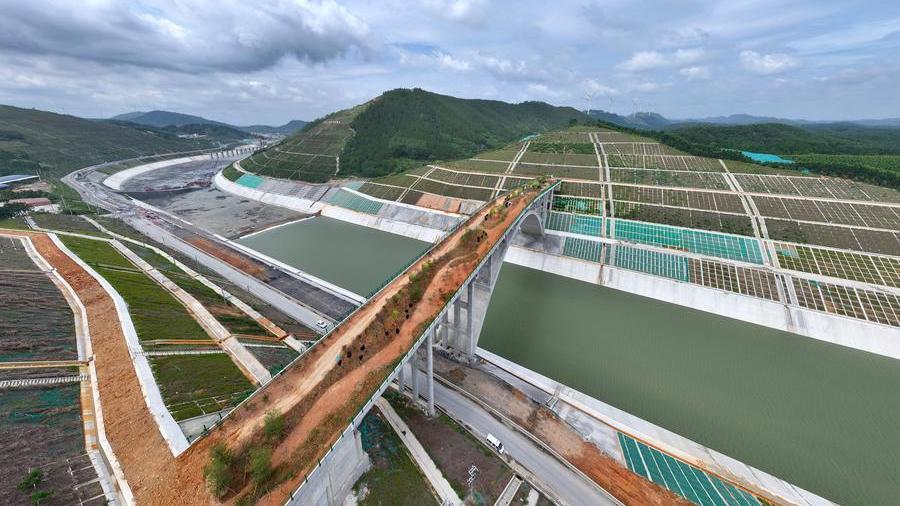
A drone view of a wildlife corridor bridge over the Pinglu Canal in Jiuzhou Town, Lingshan County, Qinzhou City, south China's Guangxi Zhuang Autonomous Region, June 8, 2026. (Photo: Xinhu)
A new waterway in south China's Guangxi Zhuang Autonomous Region is opening up a faster route to the sea for the country's southwest.
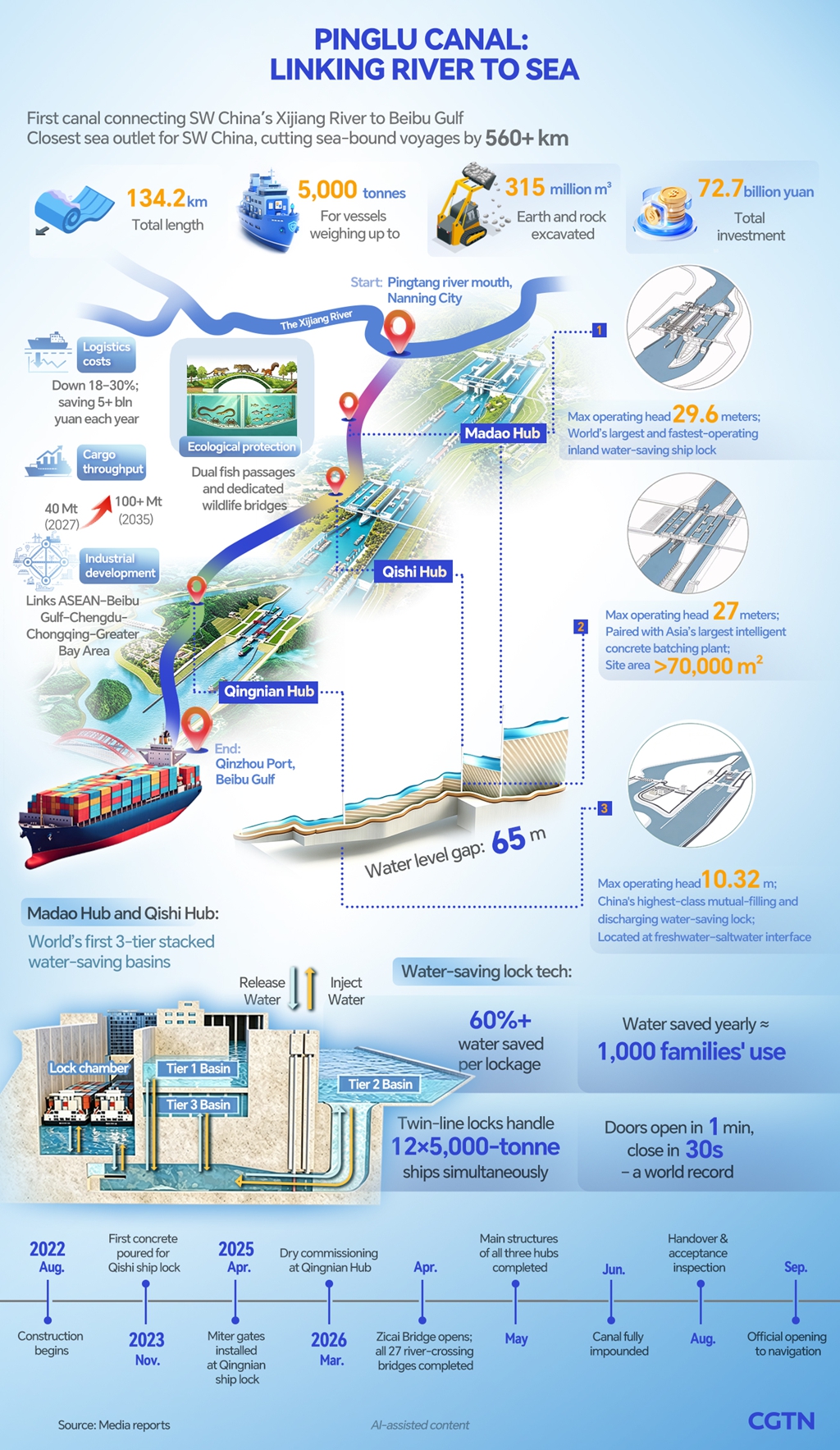
The 134.2-kilometer Pinglu Canal, stretching from the mouth of the Pingtang River in Hengzhou, Nanning, to the Beibu Gulf, officially opened to navigation on September 16 after four years of construction. The project, designed to accommodate vessels of up to 5,000 tonnes, involved a total investment of 72.7 billion yuan (about $10.8 billion).
For Guangxi, the canal is a historic breakthrough. Despite its coastal location, the region has long lacked a direct inland waterway linking its river network to the sea. The new route connects Nanning directly with the Beibu Gulf, cutting the shipping distance to the sea by more than 560 kilometers and offering a more efficient, potentially less costly way to move goods from Guangxi and the wider southwestern region to global markets.
So what does the Pinglu Canal mean for China's broader development strategy?
CGTN spoke with Cui Fan, professor at the School of International Trade and Economics at the University of International Business and Economics, to explore the canal's national significance and potential impact. His responses have been edited for brevity and clarity.
1. CGTN: What does the Pinglu Canal mean for China’s broader development strategy?
Cui Fan: China is both a major maritime shipping power and a major inland waterway shipping power. Its annual inland waterway freight volume has consistently ranked first in the world, at more than eight times that of the United States and roughly 10 times that of the European Union. China's Yangtze River and Pearl River systems are the world's two largest inland waterway networks by freight volume. To further leverage inland shipping, China has developed a national plan for a high-grade waterway network known as the "four vertical, four horizontal and two networks" layout.
The four horizontal waterways are the Yangtze River, Pearl River, Huai River and Heilongjiang River. The four vertical corridors are the Beijing-Hangzhou, Yangtze-Huai, Zhejiang-Jiangxi-Guangdong and Han-Xiang-Gui canal routes. The two networks are the high-grade waterways in the Yangtze River Delta and Pearl River Delta. As part of the Han-Xiang-Gui corridor, the Pinglu Canal is an important link in completing this national waterway network.
For a long time, China's central and western regions have relied largely on an "export goods move east" model, with much of their freight transported through the Yangtze River Delta and Pearl River Delta to reach the sea. As these regions have developed economically, bottlenecks have emerged in both river systems, hindering the movement of goods to and from overseas markets. These include congestion at the Three Gorges ship locks on the Yangtze River and the Changzhou ship locks on the Pearl River.
The opening of the Pinglu Canal will ease shipping pressure on the Pearl River, creating another major waterway linking inland regions with the sea.
(CGTN explainer: China's major rivers generally flow from west to east, while its north-south waterways have historically remained disconnected. The four planned north-south canal corridors are designed to link up with four major east-west river systems – the Yangtze River, Pearl River, Huai River and Heilongjiang River – creating an integrated inland waterway network to lower logistics costs and give inland cities better access to the sea.)
2. CGTN: What opportunities will the canal bring to China's inland western regions?
Cui Fan: For inland western regions, the Pinglu Canal will not only shorten inland shipping routes to the sea by more than 560 kilometers, but also help develop more inland ports with access to the sea in the long run, amplifying the economic benefits of other waterway projects under development.
For example, the canal provides a southern outlet to the sea for the long-planned Han-Xiang-Gui inland waterway corridor, significantly accelerating progress on the Xiang-Gui Canal, a key upstream section of the corridor. Once completed, the Xiang-Gui Canal will greatly facilitate the southward transport of goods from Hunan in central China to the sea.
The Pinglu Canal is also expected to improve access to the sea for inland provinces such as Yunnan and Guizhou in southwestern China. With supporting waterway projects, including upgrades to the Youjiang and Hongshui rivers, completed, these provinces will be better connected to the canal and gain greater capacity for waterborne transport to the sea.
In this sense, the canal will help transform southwestern China from a hinterland of the country's opening-up drive into a frontier of opening up, contributing to China's efforts to build a more comprehensive and open economic landscape.
As coastal regions upgrade their industries, some processing trade activities are shifting to central and western China. However, high domestic transportation costs for both inbound and outbound goods have constrained these regions' ability to integrate more deeply into global value chains. The opening of the Pinglu Canal, together with the future expansion of the waterway network in central and western China, will help make inland provinces in the west more outward-oriented and create new opportunities for industrial development.
3. CGTN: How could the Pinglu Canal reshape China-ASEAN connectivity, trade, and industrial and supply chain cooperation?
Cui Fan: In the initial stages of operation, the Pinglu Canal is expected to mainly transport bulk commodities. As related waterways are expanded and opened, the share of container shipping, particularly for industrial goods and intermediate products, may gradually increase.
Guangxi could develop an industrial network stretching along three key corridors – the Pearl River, the Pinglu Canal, and its coastal and border areas – creating stronger links between inland manufacturing hubs, seaports and neighboring ASEAN markets. This could also deepen industrial integration between Guangxi and ASEAN.
Regions such as Yunnan, Guizhou, Sichuan, Chongqing and Hunan will also make full use of the Pinglu Canal to strengthen cooperation with ASEAN. Meanwhile, the canal could also enhance the role of the Hainan Free Trade Port in connecting domestic and international markets.