


Beijing Xiangshan Forum at 20: A platform for dialogue in a fragmented world
The 13th Beijing Xiangshan Forum, held from September 15 to 17, marked two decades of China's effort to create a major international platform for defense and security dialogue. Its 20th anniversary comes at a time when geopolitical tensions are rising, traditional arms-control mechanisms are under pressure and emerging technologies are rapidly changing the character of warfare.
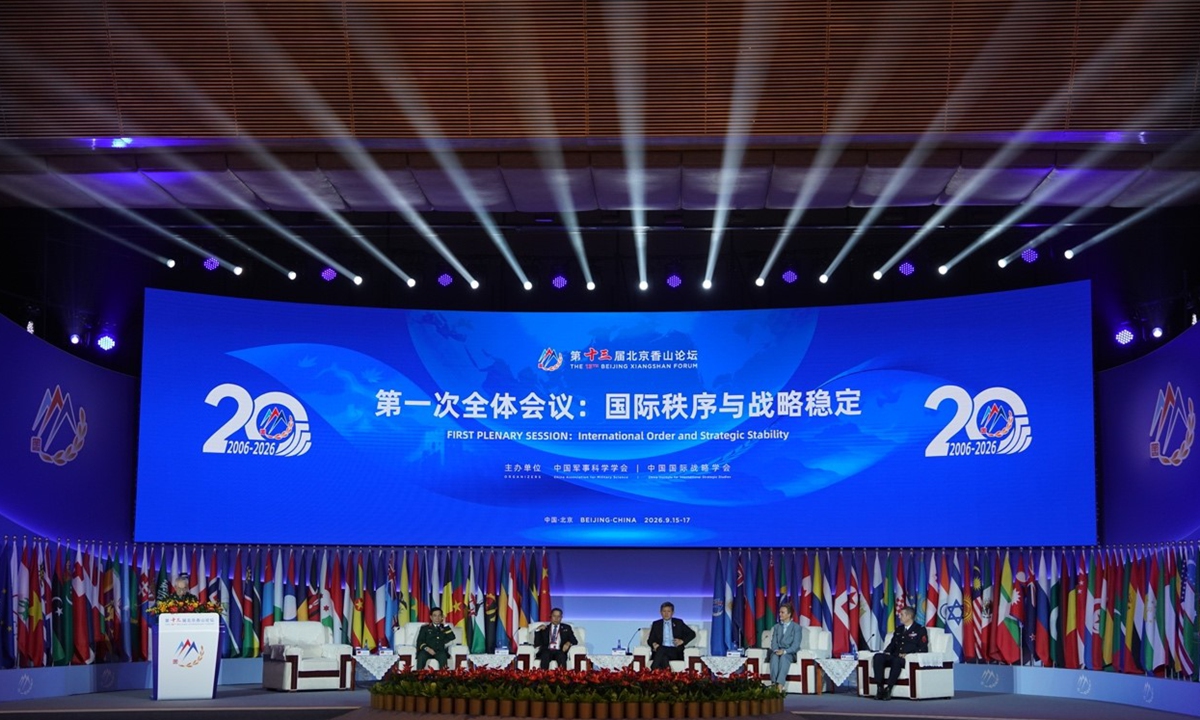
First plenary session of the 13th Beijing Xiangshan Forum titled "International Order and Strategic Stability" is held on September 16, 2026. (Photo: Feng Fan/GT)
The scale of this year's gathering was significant. Around 2,000 officials, experts and observers from more than 100 countries, regions and international organizations participated. Since its establishment in 2006, the forum has evolved from a Track-II exchange among defense scholars into a prominent Track 1.5 platform involving defense officials, military leaders, diplomats and academics.
The central message of the 20th anniversary forum was captured in its theme: "Build Consensus on Stability, Advance Security Governance Together." That message is particularly relevant when military competition increasingly risks overshadowing diplomacy.
Chinese Defense Minister Dong Jun argued that global security is at a critical juncture and called for multilateralism, dialogue, negotiated solutions and practical cooperation. He also stressed the need for greater international coordination in emerging areas of security.
The forum's discussions extended beyond conventional military questions. Participants examined international order and strategic stability, regional conflicts, Asia-Pacific security, maritime security, outer-space governance and the risks associated with military applications of emerging technologies.
This broader agenda is one of the forum's most important contributions. Security today cannot be understood solely through troop numbers or weapons systems. Artificial intelligence, autonomous weapons, cyber capabilities, drones, space technologies and critical infrastructure are creating challenges that cannot be managed effectively by individual countries acting alone.
The Xiangshan Forum also demonstrates China's expanding role in international security diplomacy. Its growing participation does not mean that all governments share Beijing's views. Nevertheless, dialogue remains valuable precisely because differences exist. A security forum becomes meaningful not when participants agree on everything, but when competing perspectives can be discussed without automatically becoming confrontation.
China has increasingly presented multilateral dialogue, negotiated dispute resolution and cooperation on emerging security challenges as elements of its approach to global governance. At the Xiangshan Forum, Chinese officials again emphasized dialogue, international cooperation and the development of rules for emerging technologies.
The forum's China-Africa dimension was also noteworthy. The concurrent China-Africa Peace and Security Forum provided an additional channel for discussing maritime security, peace and security cooperation and capacity building between China and African partners. This reflects the growing importance of developing countries in debates about the future international security architecture.
After 20 years, the most important takeaway from the Beijing Xiangshan Forum is therefore not simply that China has established another major international conference. Its greater significance lies in the creation of a continuing venue where countries with different political systems, strategic interests and security priorities can meet.
In an increasingly fragmented international environment, communication itself is a form of risk management. The Xiangshan Forum cannot resolve major geopolitical disputes by itself, but it can contribute to maintaining channels of communication, building confidence and identifying areas where cooperation remains possible.
China's positive contribution to global security will ultimately be measured not only by the forums it hosts, but by whether dialogue is translated into practical cooperation, crisis prevention and responsible behavior. The 20th anniversary of the Xiangshan Forum provides an opportunity to move in that direction: from managing rivalry through confrontation toward managing differences through sustained diplomacy and shared security interests.
Zamir Ahmed Awan is a sinologist, former Pakistani diplomat and the founding chair of the Global Silk Route Research Alliance (GSRRA), based in Islamabad, Pakistan.