


Observer: China's continued opening-up fuels shared growth opportunities

The 23rd China-ASEAN Expo and the China-ASEAN Business and Investment Summit opened on September 17 in Nanning, South China's Guangxi Zhuang Autonomous Region.
The venue brimmed with vitality. Stalls showcasing regional specialties such as durians, coffee, and intricately carved rosewood crafts drew steady crowds. At a special Pinglu Canal exhibition area, merchants from ASEAN nations learned about this river-sea "golden waterway." An "AI superstore" featured over 70 enterprises presenting more than 500 consumer AI products, which visitors could test and purchase right on site.
This vibrant gathering offered a vivid illustration of the expo's theme of "CAFTA 3.0 Opportunities, Better Life." The high value of China's opportunities is translating into tangible gains for people across China and ASEAN.
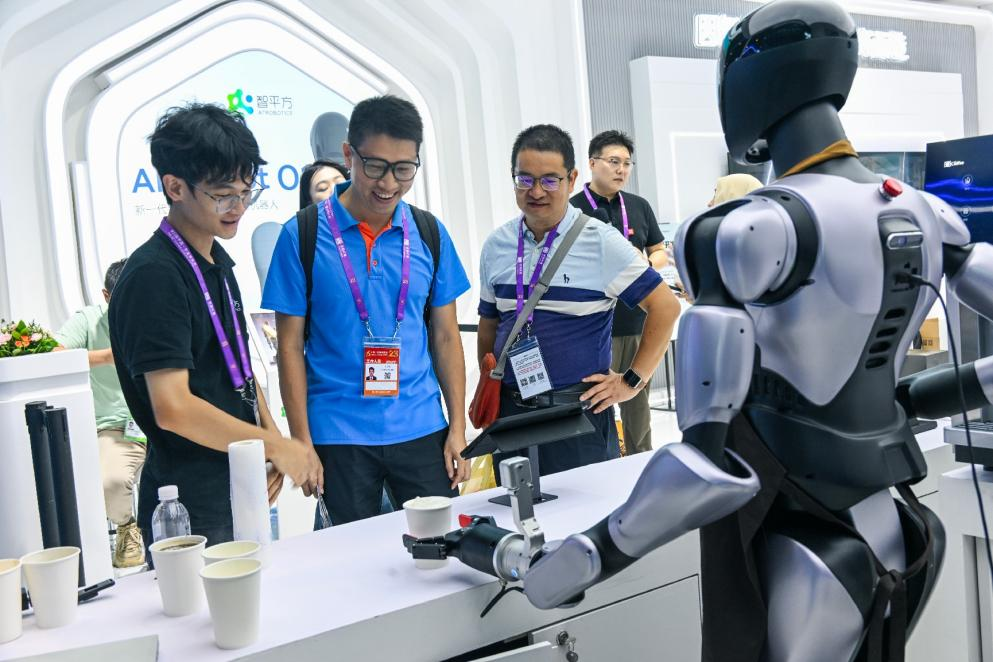
An embodied intelligence robot prepares coffee for visitors at the 23rd China-ASEAN Expo in Nanning, South China's Guangxi Zhuang Autonomous Region, September 17, 2026. The event features dedicated AI exhibition areas showcasing cutting-edge consumer applications. (Photo: Fang Yongtao/People's Daily)
This year marks the fifth anniversary of the establishment of the China-ASEAN comprehensive strategic partnership and the 35th anniversary of China-ASEAN dialogue relations. Over the past 35 years, ties between China and ASEAN have developed by leaps and bounds, from the establishment of dialogue relations to the building of a closer China-ASEAN community with a shared future, driving sustained expansion and upgrading of cooperation across a wide range of areas.
China has been ASEAN's largest trading partner for 17 consecutive years, while ASEAN has held the same position for China for six years. In the first eight months of 2026, trade between China and ASEAN reached 5.95 trillion yuan (about $890 billion), up 20.6 percent year on year. Mutually beneficial cooperation continues to deliver greater rewards, bringing tangible gains to over 2 billion people on both sides.
This year's expo coincided with the opening to navigation of the Pinglu Canal, a century-level mega-project. As the first artificial river-to-sea canal project planned and built since the founding of the People's Republic of China in 1949, it represents a breakthrough in regional hardware connectivity and has been described by overseas media as a new "logistics lifeline" linking China and ASEAN.
The combined opportunities of the expo as a "golden platform" and the canal as a "golden waterway" are helping accelerate two-way exchanges between China and ASEAN.
The year 2026 is a key moment to accelerate implementation of the upgraded China-ASEAN Free Trade Area (CAFTA) 3.0 protocol following its signing. Focusing on the new opportunities brought by CAFTA 3.0, this year's expo expanded its exhibition areas for the digital economy and green and low-carbon development, added a dedicated "AI + finance" section, and for the first time set up an "AI superstore" and held a China-ASEAN AI supply-demand matchmaking event.
High-tech products such as AI glasses, household AI robots, and photovoltaic cleaning robots became new attractions at the expo.
Cooperation in areas such as the digital economy, green economy, blue economy, and AI closely aligns with ASEAN countries' development and transformation needs. It is emerging as a new highlight of China-ASEAN cooperation.
According to data from the China Association of Automobile Manufacturers, China exported 2.355 million new energy vehicles in the first half of 2026, up 120 percent year on year, with strong demand and robust performance in ASEAN markets. China's computing infrastructure and AI services are also expanding into ASEAN markets at a faster pace, helping local businesses lower the barriers to AI adoption.
The benefits of China's high-quality development and high-standard opening-up continue to be released, creating new space and generating fresh momentum for China-ASEAN cooperation.
Since September, a series of major events showcasing China's opening-up have been held one after another.
The 21st China International Small and Medium Enterprises Fair was held in Guangzhou, South China's Guangdong Province, focusing on empowering small and medium-sized enterprises with AI and providing Chinese and foreign SMEs with a targeted platform for matching supply with demand.
The 26th China International Fair for Investment and Trade concluded in Xiamen, East China's Fujian Province, bringing together businesspeople from 129 countries and regions to explore ways to expand two-way investment and promote global development.
The 2026 China International Fair for Trade in Services also concluded in Beijing, where more than 200 new achievements were unveiled, over 100 products and services made their global or national debuts, and 200 forums, meetings, and business matchmaking events were held, highlighting the growing international influence of Chinese services.
Through these major events, the international community has witnessed China's resolute strides in advancing high-standard opening-up and felt the robust momentum that China's new quality productive forces are injecting into global growth.
Against the backdrop of a complex and volatile international landscape, the rougher the seas, the more important it is for all sides to strengthen the bonds of cooperation and promote a universally beneficial and inclusive economic globalization.
Through concrete actions, China is sending a clear message to the world: China will continue to pursue high-quality development, expand high-standard opening-up, share opportunities with countries around the world, and work together to create greater prosperity.