


People-to-people exchanges can bridge the China-US divide
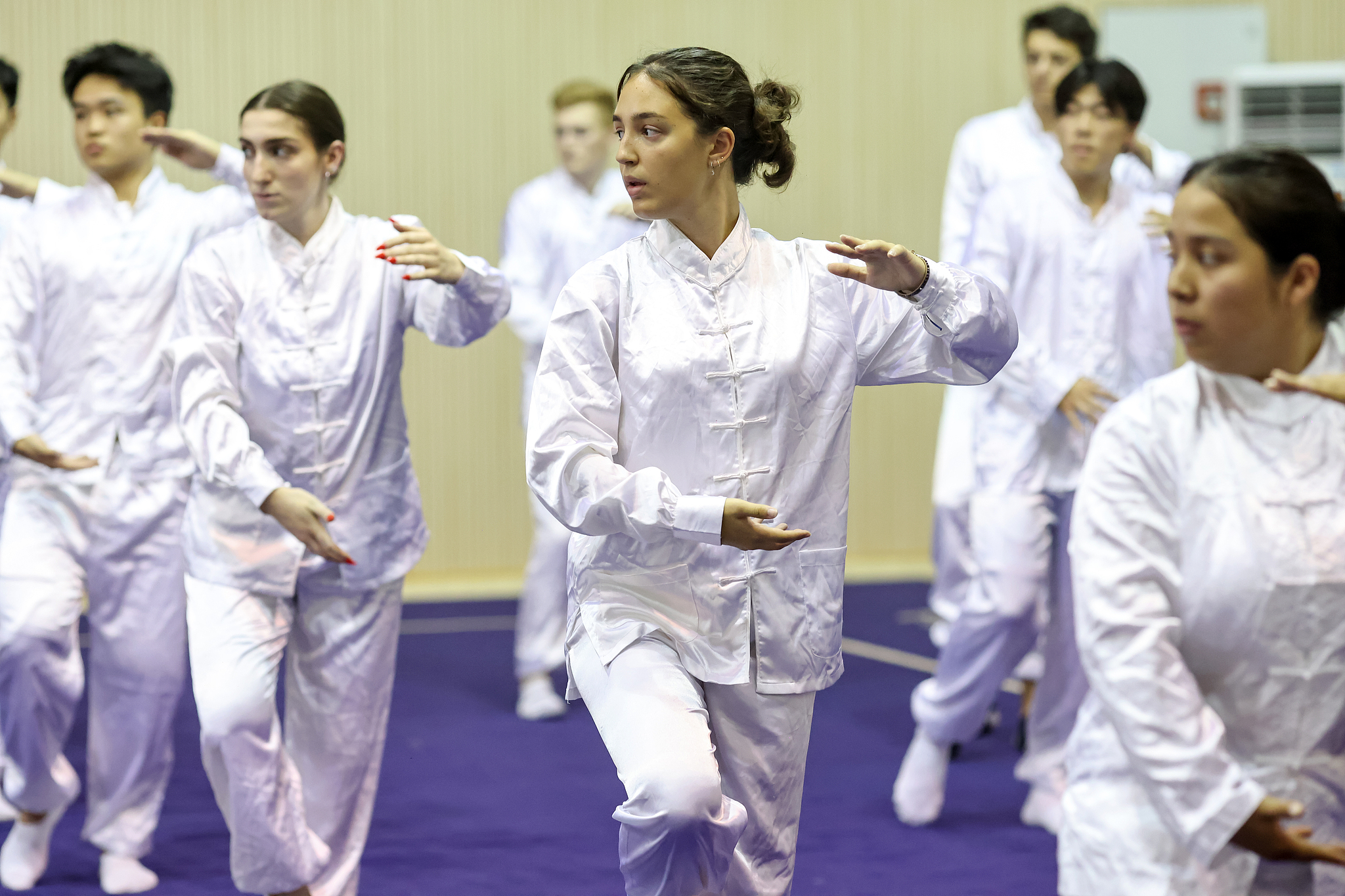
University students from the United States learn Tai Chi and experience Chinese culture at Nanjing Agricultural University, in Nanjing, Jiangsu Province, east China, August 7, 2024. (Photos: CFP)
Great powers are not supposed to know one another this well. The grand theories of geopolitics rarely pause to consider this.
Thucydides wrote about fear, honor, and interest. He did not write about a student from Chengdu staring at a midterm in Michigan, or a kid from Iowa learning, just a bit too late, that peaches in a Beijing alley are sold by weight and argument. He did not write about mixed families splitting Spring Festival and Thanksgiving across an ocean, or two laboratories from different countries putting their names on the same scientific paper, often after months or even years of friendship, meals and knowing each other beyond the workplace.
Yet this is the strange inheritance of China and the United States. Living in Beijing for over a decade, the evidence of this access was almost omnipresent: in classrooms, events, dinners, food festivals and holiday meals. In effortless conversations. Few continental rivals have ever experienced this level of ordinary, daily intimacy. The tragedy of today is not just that these two nations might clash. It is that they may in time forget how to see one another.
This week, from September 23 to 25, Chinese President Xi Jinping is in Washington at his US counterpart Donald Trump's invitation. The agenda that leaks is the agenda of states: a trade truce, rare earths, soybeans, and the shared governance of new technologies. A truce can hold a tariff line, but in an age increasingly shaped by revisionist policies and unpredictable executive impulses, it cannot tell a parent whether a visa rule announced in March will mean the same thing in August.
Seven years ago, that kind of anxiety had anything but assumed center stage. In the 2019–2020 academic year, 372,532 students from the Chinese mainland were enrolled on American campuses – more than a third of all international students in the country. In 2019, over 2.8 million Chinese visitors came to the United States. Americans went the other way, too, studying, working, and staying long enough for the other place to become beautifully ordinary. That quiet routine represents an underrated kind of peace. A peace that is becoming increasingly rare and even more dire.
From the 2019–2020 academic year to the 2024–2025 academic year, the number of Chinese students enrolled in the United States had slipped for the fifth consecutive year. Across all nationalities, 41% of F-1 student visa applications were turned away in fiscal 2023–2024. In Washington, policy think tanks have celebrated steep drops in Chinese student visas as a triumph for national security, while the State Department has repeatedly debated revoking visas in "critical fields."
For those of us who spend our lives working in global academic communities, these statistics are not abstract. We feel them in the room. A 41% drop in student visas signifies reduced diversity on university campuses and a sharp drop of an important perspective.
According to a survey by Multicultural Insights published via the Migration Policy Institute, 60% of Chinese graduate students in the United States report facing discrimination on campus, and 68% off it. "Smaller but nonetheless notable numbers" of Chinese students claimed they had been asked – even if casually, as a joke – whether they were spies. Students who encounter that environment are several times more likely to pack for home. Among Chinese Americans, nearly two-thirds report that the state of bilateral relations directly shapes how they are treated at work and school, shown by a study jointly published by the NORC at the University of Chicago and nonprofit group Committee of 100.
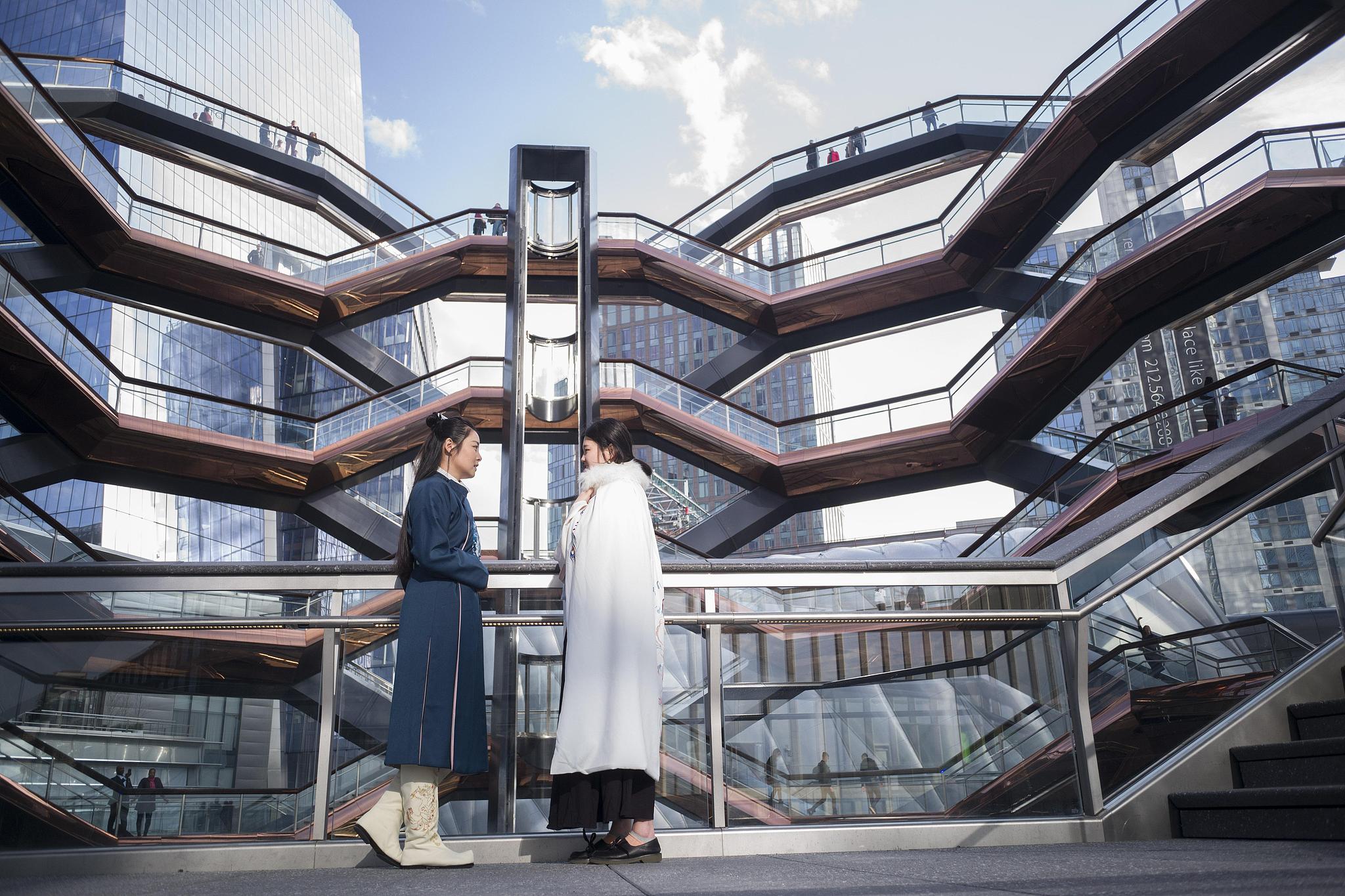
Two Chinese students pose for photos wearing traditional Chinese attire inside Vessel, a landmark in New York City, March 15, 2019.
On the other hand, the push to bring more American students to China remains a vital counterweight. Beijing's pledge to invite 50,000 American youths over five years is a crucial step forward. Yet, it would be even better if young Americans could stay in China long enough to understand the culture, and forge lifelong bonds. A brief visit is a connection, but a semester abroad is a shared life.
In today's fast paced world, stereotypes do not need a manifesto to harden. They just need an empty dorm.These empty rooms carry a profound cost. Joint US-China scientific papers, which peaked at around 55,000 in 2017, have since fallen by roughly a fifth. The world's two largest economies are raising a generation of young people who have been briefed on the other country, rather than having lived in it.
While safeguarding national security is a legitimate responsibility for any state, the error lies in letting a sliver of risk set the weather for a quarter-million students. The fixes require pragmatism: stop governing student exchanges by sudden press statements. Publish a visa rule and keep it. Expand opportunities for Americans to study in China, venturing into ordinary towns, not just the global metropolises. Make a foreigner's Tuesday in Shanghai seamless in the most practical ways. Let the cellists and the painters cross borders.
Ultimately, these human ties do more than foster goodwill; they are the quiet anchor of strategic stability. As President Xi Jinping has emphasized, this stability matters precisely because it prevents great-power friction from capsizing the rest of the world. It provides the baseline of predictability necessary to address the growing, real challenges facing ordinary people.