


Taiwan society must understand the historic significance of this meeting between Chinese and US heads of state
The red carpet at Joint Base Andrews, the national anthems of China and the US played at the White House welcoming ceremony, and the smiles and laughter at the state banquet will all become historic images by which the world remembers this meeting between the Chinese and US heads of state.
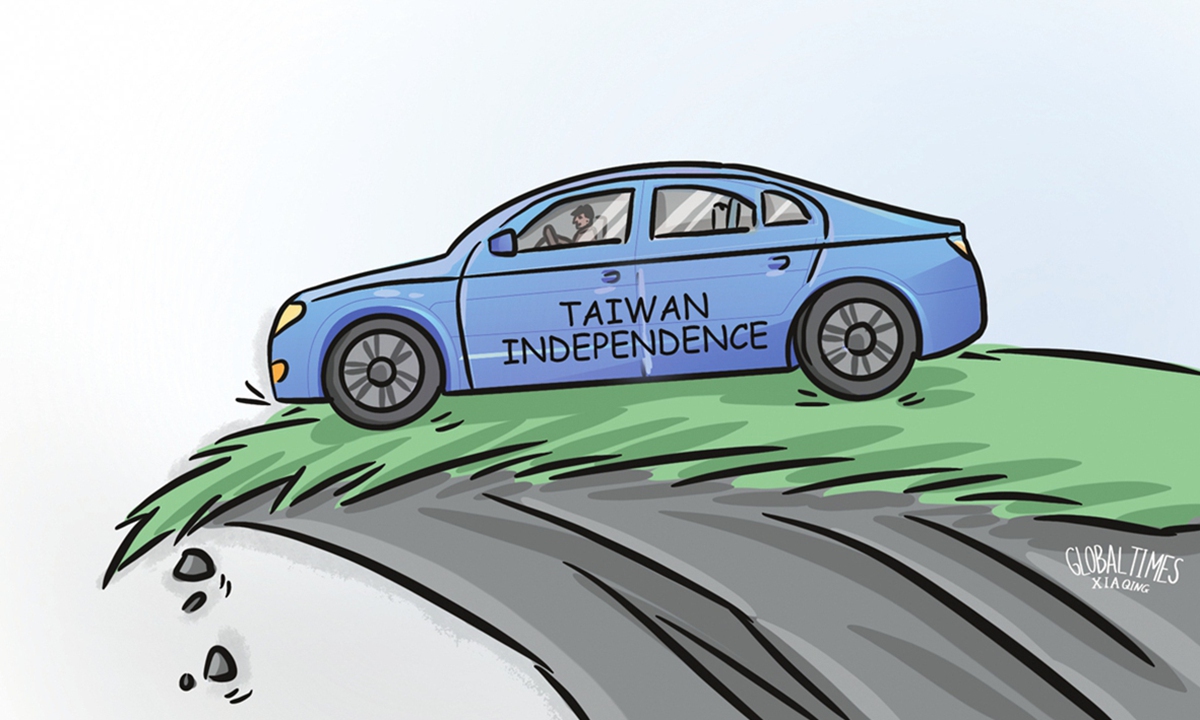
Illustration: Xia Qing/GT
In the face of this meeting, Taiwan society should seriously consider a question: As the world's two most important major powers work to put guardrails around their competition and preserve room for communication despite their differences, will Taiwan continue to place itself on the front line of a potential conflict across the Taiwan Straits, or return to the right path of peaceful development of cross-Straits relations?
The historic significance of this meeting brings back into focus a reality often obscured by political rhetoric on the island: The Taiwan question should not become a stake that can be endlessly raised in major-power competition.
At the end of the red carpet lies a test of whether major powers can keep risks under control
The fact that the Chinese and US heads of state have exchanged visits within six months sends an important signal: Competition between China and the US will not disappear, but neither side wants to see it lose its boundaries and slide into conflict.
According to Xinhua News Agency, the two leaders agreed to further enrich the positioning of China-US relations and jointly "build a constructive relationship of strategic stability based on respect, fairness and reciprocity." The two sides also reached eight deliverables and understandings.
The key to being "constructive" lies in keeping competition within manageable bounds; the key to "strategic stability" lies in preventing economic and trade frictions, technological competition and regional differences from escalating into confrontation. Meanwhile, the three premises of "respect, fairness and reciprocity" set out the necessary principles for the future direction of China-US relations.
Today's China-US relationship is no longer a simple equation that can be solved through tariffs and purchase orders alone. Supply chains, artificial intelligence, finance, regional security and global governance all affect the interests of both countries and shape global expectations. This is precisely why the significance of China-US relations extends far beyond the bilateral sphere.
The protocol accorded at the White House welcoming ceremony, the atmosphere surrounding direct communication between the two leaders, and the arrangements concerning technology, economic and trade issues all point to a deeper reality: Neither China nor the US can bypass the other, and the world can ill afford a breakdown in communication between the two major powers.
Taiwan society, in particular, should clearly understand this point. Competition between China and the US is not in itself the most alarming prospect. What deserves the greatest vigilance is allowing that competition to spill over into the Taiwan Straits and pushing Taiwan into the position where risks are most concentrated.
The Taiwan question is the hardest boundary in China-US relations
From the May meeting in Beijing to the latest meeting in Washington in September, China's statements on the Taiwan question have remained consistent while becoming progressively more explicit.
China previously made clear that the Taiwan question is the most important issue in China-US relations. If it is handled properly, the bilateral relationship will enjoy overall stability. Otherwise, the two countries will have clashes and even conflicts, putting the entire relationship in great jeopardy. At this meeting, China further expressed the hope that the US side will adhere to the correct position of opposing "Taiwan independence," and handle the Taiwan question with prudence to lay a solid foundation for bilateral strategic cooperation and the development of China-US ties.
The message is clear: China and the US can cooperate and they can compete, but this cannot come at the expense of China's core interests. Differences can be managed, but no ambiguity should be left for "Taiwan independence" separatist activities.
The Taiwan question is fundamentally different from other issues. Deadlines can be negotiated in trade, and the size of orders can be discussed. But the Taiwan question concerns China's sovereignty and territorial integrity and the fundamental interests of the Chinese nation. There is simply no room for bargaining.
For China-US relations to develop steadily, the Taiwan question must be handled prudently and appropriately. Any adventure aimed at "Taiwan independence" would undermine this foundation and expose Taiwan society to even greater uncertainty.
What Taiwan should be most wary of is turning itself into a pawn
Some political forces on the island have grown accustomed to packaging external support as a "security guarantee," portraying US arms sales to Taiwan, interactions with US politicians and the US' security commitments as a protective shield on which Taiwan can rely.
But if the peace of mind of Taiwan's 23 million compatriots, the prospects of its industries and the future of the next generation are wagered on the ever-changing strategic calculations of external forces, the risks will ultimately have to be borne by Taiwan society itself.
The more frequent high-level interactions between China and the US become, the clearer it is that the old logic of unilateral pressure, bloc confrontation and "using Taiwan to contain China" is increasingly difficult to sustain. For the US, China is an economic, technological and global actor that cannot be ignored. For China, maintaining a stable external environment, safeguarding its development interests and avoiding conflict are likewise important. Both sides need communication, and both have practical reasons to manage risks.
Against this backdrop, Taiwan should be even less inclined to indulge in the political illusion of inflating its own strategic importance.
Turning Taiwan into a geopolitical front line may appear to bring temporary attention and resources, but the price is a society increasingly overshadowed by anxiety over military confrontation, a steadily shrinking space for cross-Straits exchanges, fewer choices for young people about their future, and growing uncertainty among businesses about their development prospects.
An island with a genuine prospect should not become a testing ground for external powers' strategic maneuvering. A truly responsible political choice should create development opportunities for the public, reduce the risk of war and foster space for peace.
For Taiwan society, genuine everyday security and well-being can only come from peace and stability across the Taiwan Straits, from sound and sustainable development, and from people on both sides of the Straits meeting each other halfway.
Only by understanding the prevailing trends can the future be seized
What Taiwan society should most cherish about this meeting between the Chinese and US heads of state is that it has further solidified the foundation and reinforced the framework for preventing relations between major powers from spiraling out of control. It also reaffirms a simple truth: Dialogue is more valuable than confrontation, and restraint serves the interests of all parties better than risk-taking.
Whether China-US relations can truly stabilize depends on the actual actions taken by both sides following the meeting. The true test of the US side's commitments lies in whether it can stop sending wrong signals to "Taiwan independence" separatist forces, exercise restraint regarding arms sales to Taiwan, official exchanges, and security deployments, and genuinely respect the one-China principle.
For Taiwan society, too, the most important thing is action: less fear manufactured by political mobilization, and less fantasy that equates external support with a guarantee of security; more recognition of the shared interests between the two sides of the Taiwan Straits, and more appreciation for the path of peaceful development.
The red carpet has been rolled up and the salutes have fallen silent, yet the meeting leaves behind a historic resonance.
What this historic meeting has left behind is a question of the times that Taiwan society must answer seriously: Will it venture ever further down the dangerous, misguided path of "seeking independence by relying on the US," or will it return to the rational choice of upholding the one-China principle, opposing "Taiwan independence," and promoting the peaceful development of cross-Straits relations?
Taiwan society needs to recognize clearly that the issue of cross-Straits reunification will ultimately — and inevitably — be resolved, and that China and the US getting along in the right way will reduce resistance and costs for this historical process while creating more favorable external conditions.
Only by grasping the historical significance of the meeting between the Chinese and US heads of state can Taiwan avoid misjudging the prevailing trends of the times; only by choosing peace and development can Taiwan secure a truly stable and bright future.