


What illusion does Japan still hold as China, US move toward strategic stability?
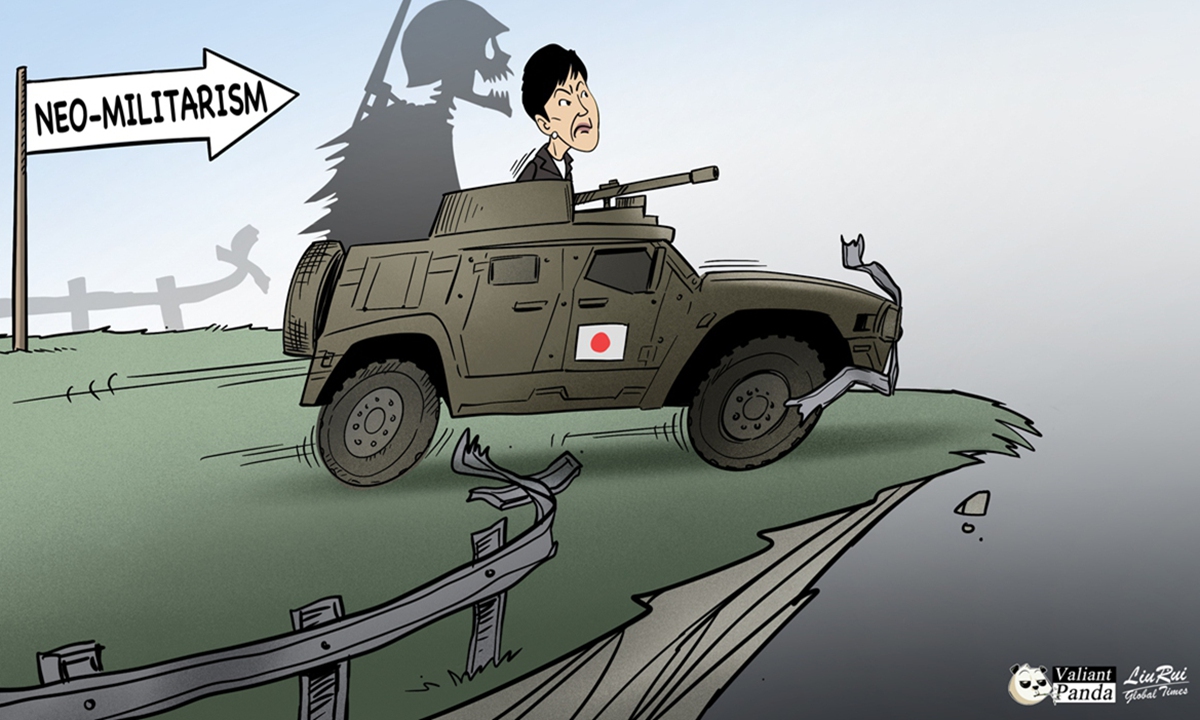
Militaristic emblem Illustration: Liu Rui/GT
Recently, New York and Washington hosted, less than 24 hours apart, two diplomatic events of wholly different character.
On September 22, Japanese Prime Minister Sanae Takaichi rushed to New York during the UN General Assembly to meet US President Donald Trump. According to several media outlets, she arrived as a supplicant, hoping Trump would uphold America's security commitments in East Asia and step in to help ease pressure from China.
The next day, Trump appeared at Joint Base Andrews to personally welcome the Chinese leader, followed by a White House welcome ceremony, talks and a state dinner.
By contrast, one leader had come seeking an audience with her alliance's patron; the other was received as a state guest with many special arrangements, which are very telling.
But what is worth pondering is not the protocol, but the world behind it - a world that has changed.
The first of the consensus on eight outcomes reached by China and the US after the White House talks is that both sides agreed to build "a constructive China-US relationship of strategic stability on the basis of respect, fairness and reciprocity."
During the talks, the Chinese leader stated explicitly that while China and the US compete in AI, they have even more reasons to cooperate, and that, as both major countries in AI, the two sides should leverage respective strengths in AI rather than guard against each other. He also said that China hopes the US side will adhere to the correct position of opposing "Taiwan independence" and handle the Taiwan question with prudence.
In the two sides' outcome consensus, it is explicitly recalled that China and the US were allies in World War II, fighting shoulder to shoulder to win the war. This stance constitutes a decisive blow to the Japanese government, which is currently seeking to alter the course of history and revive militarism.
This is the most important fact of international politics in 2026: China and the US are no longer competing over who can hold the other down, but are constructively managing their competition. The US is beginning to acknowledge that it must build a constructive relationship with China. This is a reality forced into being by shifts in the global balance of power.
Against this backdrop, Japan's predicament looks especially acute.
Japan's alliance patron - the superpower that once promised unconditional support for Japan - is now building constructive relationship with China and holding back on its ally's requests.
In other words, the US has already signaled to Japan through its actions: Your problem is not one America can solve.
For Japan, this means the collapse of a political gamble.
Japan's definition of its national interests has long rested on one assumption: As long as it follows the US loyally enough, and takes a hard enough line on China, America will support Japan forever and unconditionally, whatever the cost. Reality has shattered that assumption.
The US-Japan alliance still exists, but it is no longer absolute, exclusive and unconditional. It has become conditional, balanceable and relative. It also still serves to restrain Japan from embarking once more on the path of militarism.
The US needs to maintain a constructive relationship with China, and this has become an important component of the US' national interest. On that premise, Japan's expectations of the US are themselves unrealistic.
The problem goes far beyond disappointed expectations. Japan's entire diplomatic logic has gone wrong. Takaichi's erroneous remarks regarding China's Taiwan, Japan's excessive reliance on military alliances, and its anxious response to rare earths and other strategic materials all stem from the same outdated assumption.
Takaichi has treated Japanese right-wing forces' anti-China sentiment and domestic political needs as the basis for shaping national strategy. But national strategy should be built on a clear-eyed judgment of the international situation, not on domestic political anxiety.
As relations between China and the US move toward strategic stability, Japan is still investing in confrontation. This misalignment in timing has placed Japan in an insoluble deadlock: to change its China policy, it would face pressure from right-wing forces; to continue on its current course, it can neither withstand diplomatic pressure nor secure America's absolute support.
The real question is this: will Japan sink into wave after wave of fresh despair? Japan must answer that question for itself.