


America needs more 'panda huggers'

A file photo of an animal keeper holding a giant panda for members of the media at the National Zoo in Washington, DC, United States, December 14, 2015. (File photo: CFP)
Two new arrivals in Atlanta offer Americans something refreshingly simple: a reason to be curious about China. Giant pandas Ping Ping and Fu Shuang landed on September 27 and moved into Zoo Atlanta, where they will undergo quarantine before meeting the public. For families looking forward to seeing them, the appeal is immediate. For the wider relationship between the two countries, their arrival invites a question: Why has being interested in China, and willing to work with it, become something Americans sometimes feel obliged to defend?
"Panda hugger" has long been used in American foreign-policy debates to dismiss people who favor engagement with China. The implication is that they are too trusting or insufficiently tough. Yet people who understand another country, speak its language and maintain relationships there provide something valuable. America needs more of that knowledge, and more room for those who bring it into the public debate.
Understanding China is an American asset
The practical case begins close to home. Businesses need reliable information about customers and suppliers. Farmers need to understand overseas markets. Researchers need to know what colleagues elsewhere are discovering. Officials negotiating with Beijing need advisers who can explain Chinese institutions, priorities and public attitudes. These are everyday requirements for making sound decisions in an interconnected world. Treating familiarity with China as a liability makes each task harder.
For ordinary Americans, the consequences of poor understanding can be tangible. A business that misreads a market may lose opportunities. A university that loses international connections may offer its students fewer avenues for learning. A government that misinterprets another country's intentions may miss viable opportunities for cooperation. Engagement cannot guarantee success, but it provides information and relationships that would otherwise be missing. Those are resources Americans have good reasons to preserve.
There are serious disagreements between Washington and Beijing, and Americans will continue to argue about how to address them. That makes informed debate more necessary. When "panda hugger" becomes a way to dismiss an argument without examining its evidence, the discussion deteriorates. People should be free to recommend cooperation where it serves a useful purpose and criticize policies where they see problems. A confident country benefits from experts who can challenge prevailing assumptions without having their loyalty questioned.
A forest offers a different perspective
Sometimes, the value of engagement is clearest in a story far removed from diplomatic negotiations. NBC recently reported on Ronald Sakolsky, a retired American teacher who helped raise $5,000 more than two decades ago to support Chinese farmer Yin Yuzhen's efforts to plant trees in the desert. When he returned to China, he saw how years of work had helped transform the landscape. Chinese President Xi Jinping recalled this cross-border friendship in a speech during his recent US visit.
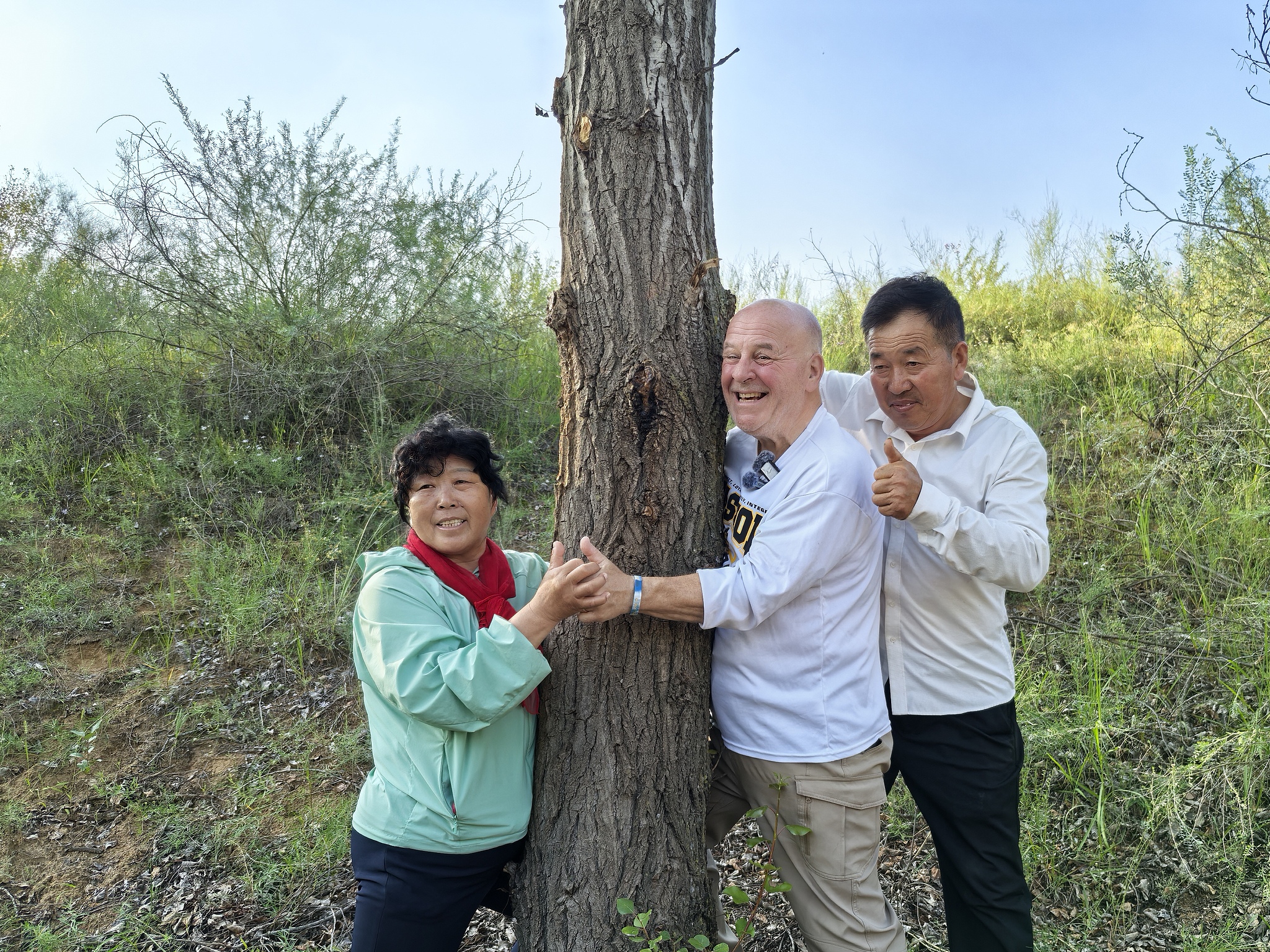
Chinese farmer Yin Yuzhen, left, and retired American teacher Ronald Sakolsky, center, pose for a photo with a tree they had planted 26 years ago, in Ordos, Inner Mongolia Autonomous Region, August 24, 2026.(Photo: CFP)
The story resonates because its human meaning is easy to recognize. Someone saw another person trying to improve her community and offered help. She honored that trust through sustained effort. Their backgrounds differed, but they shared an understandable ambition: to leave something better for the next generation. The trees grew because an initial contribution was followed by years of care. Cooperation, too, depends on people continuing to do the work after the first gesture.
American audiences deserve more opportunities to encounter this dimension of China. Journalism should scrutinize governments, investigate problems and examine disagreements. It should also reveal the complex qualities of ordinary people, including their generosity, resilience and capacity for friendship. Reporting that makes room for such experiences gives readers a fuller basis for judgment. Readers deserve to see the possibilities alongside the problems.
Give curiosity room to grow
The same principle applies to education and travel. China's announcement that it will invite 100,000 young Americans to visit over the next five years offers an opportunity to build firsthand knowledge. Participants can raise challenging questions, compare what they encounter with what they have read and draw their own conclusions.
The value of such exchanges does not depend on whether the participants ultimately reach a consensus regarding China, but instead lies in helping them replace assumptions with experience and develop the confidence to make informed judgments.
That experience can serve Americans throughout their lives – as employees, entrepreneurs, teachers and public servants. Both countries should make legitimate educational and cultural exchanges easier to pursue, with clear procedures and fewer unnecessary obstacles. Communities, schools and universities also have a role in sustaining contacts when national relations become strained. Relationships built over time provide channels for asking questions, correcting misunderstandings and discovering opportunities. Losing those connections is easy; rebuilding the knowledge and trust behind them takes much longer.
The pandas in Atlanta will not settle trade disputes or resolve security disagreements, but they offer an opening for interest and conversation. America should welcome that opening and the people prepared to build on it. More informed reporting, more firsthand contacts and more space for constructive voices would give Americans a clearer view of China and a wider range of choices.
Wang Peng, a special commentator for CGTN, is a research fellow at the School of Marxism and Institute of State Governance under the Huazhong University of Science and Technology (HUST).