


Signals conveyed by repeated emphasis on resolutely fighting 'Taiwan independence' separatist forces: Hai Feng
At the reception to celebrate the 77th anniversary of the founding of the People's Republic of China, Chinese President Xi Jinping, also general secretary of the Communist Party of China (CPC) Central Committee and chairman of the Central Military Commission, delivered an important speech. He called for efforts to deepen exchanges and cooperation across the Taiwan Straits, resolutely fight secessionist forces seeking "Taiwan independence," oppose external interference, and promote the peaceful development of cross-Straits relations to advance national reunification.
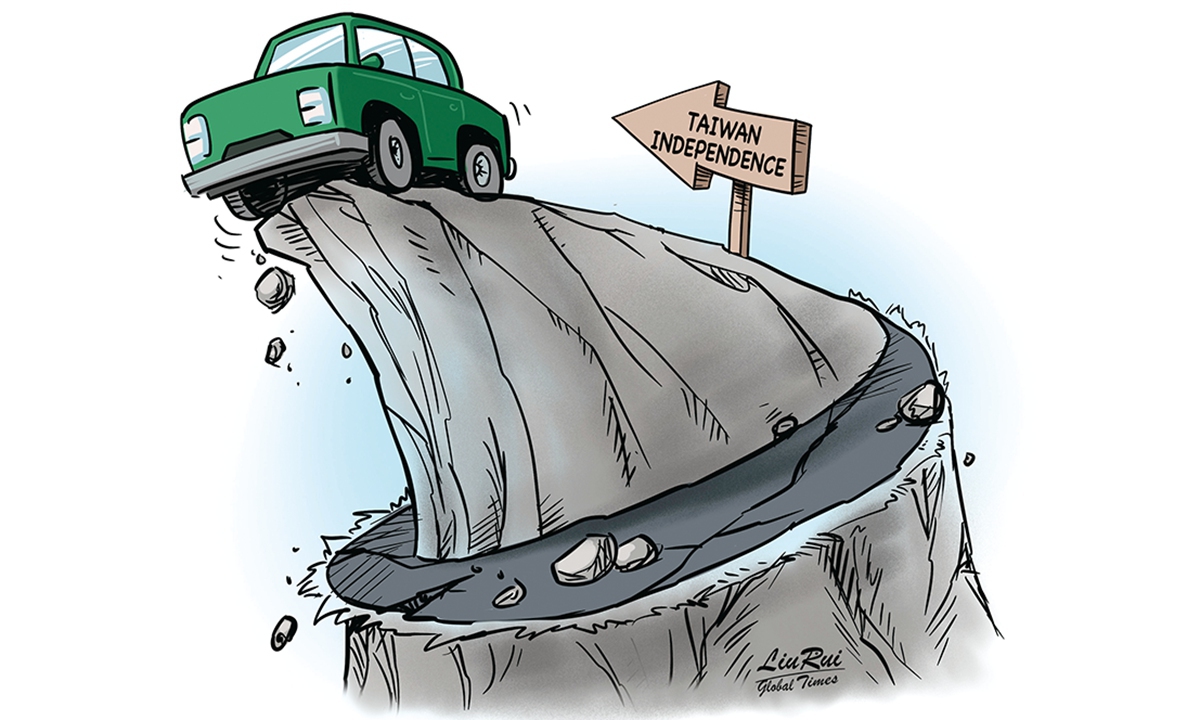
"Taiwan independence" Illustration: Liu Rui/GT
I. The Taiwan question is the most important issue in China-US relations
From his May 14, 2026 meeting with US President Donald Trump, who was in China on a state visit, to the July 1 ceremony marking the 105th founding anniversary of the Communist Party of China (CPC), to his September 24 meeting with Trump at the White House, and finally to the September 30 National Day reception, Xi has made important statements on the Taiwan question on various occasions, particularly emphasizing on multiple occasions the need to "resolutely fight secessionist forces seeking 'Taiwan independence.'" The repeated use of this phrasing sends a clear and significant signal.
On May 14, during his talks with President Trump, President Xi clearly pointed out that the Taiwan question is the most important issue in China-US relations. If it is handled properly, the bilateral relationship will enjoy overall stability. Otherwise, the two countries will have clashes and even conflicts, putting the entire relationship in great jeopardy.
This assessment reveals the special status of the Taiwan question in China-US relations.
Compared to areas such as trade, economy, science and technology, and finance, the Taiwan question directly concerns China's national sovereignty and territorial integrity. It is the core of China's core interests and the issue in China-US relations most likely to trigger strategic miscalculations and most likely to breach the bottom line of bilateral relations.
Therefore, properly handling the Taiwan question is crucial to maintaining overall stability in China-US relations and also reflects the shared expectations of the international community.
II. From "opposing" to "fighting": A clearer stance
In March of this year, the phrase "resolutely fighting against separatist forces aimed at 'Taiwan independence,'" replaced "resolutely opposing 'Taiwan independence' separatism" and was included in the report on the work of the government for the first time. On July 1, Xi emphasized at the gathering in celebration of the 105th anniversary of the founding of the CPC that we must take resolute actions to fight secessionists seeking "Taiwan independence." On September 30, at the reception celebrating the 77th anniversary of the founding of the People's Republic of China, this phrasing appeared once again.
The shift from "opposing" to "fighting" reflects a more explicit stance on "Taiwan independence" separatist forces and demonstrates a clearer policy bottom line regarding the safeguarding of national sovereignty and territorial integrity.
It must be recognized that this change in wording does not imply a shift in the direction of promoting the peaceful development of cross-Straits relations. The important speech delivered at the National Day reception also emphasized the need to deepen exchanges and cooperation across the Taiwan Straits, promote the peaceful development of cross-Strait relations to advance national reunification. This fully demonstrates that "peaceful reunification and 'one country, two systems'" remain the basic policy for resolving the Taiwan question.
For our fellow Taiwan compatriots, we will expand exchanges and cooperation and promote integrated development; for "Taiwan independence" separatist forces, we will engage in firmly combat and fight against them in accordance with the law; and for external interfering forces, we will express clear opposition and effectively contain them.
Peaceful development has its prerequisites, and exchanges and cooperation have their bottom lines. No person or force will be allowed to misinterpret the Chinese mainland's willingness to maintain peace and stability in the Taiwan Straits as tolerance for "Taiwan independence" separatist forces.
III. Repeated emphasis means the red line must not be tested
During his meeting with President Trump on September 24, President Xi stressed that the Chinese side's position on safeguarding national reunification and territorial integrity is clear-cut. He expressed the hope that the US side will adhere to the correct position of opposing "Taiwan independence," and handle the Taiwan question with caution, so as to lay a solid foundation for China-US strategic cooperation and the development of bilateral relations.
This serves not only as yet another clear reminder to the US but also as a public declaration to the international community.
In recent years, external interfering forces have been vigorously pushing for the "internationalization of the Taiwan question," attempting to manipulate the Taiwan question through political, military, economic, trade, and public opinion channels to hollow out the one-China principle, with the aim of curbing China's development.
However, safeguarding national sovereignty, unity and territorial integrity is the unshakable will shared by the Chinese people. The more external interference forces attempt to cross the red line through ambiguous statements, incremental probing, and de facto actions, the more necessary it is for China to articulate its position more clearly and spell out the consequences more explicitly.
The repeated emphasis on "resolutely fighting" sends precisely this signal: There is no room for ambiguity on the Taiwan question; national sovereignty and territorial integrity cannot be challenged; and "Taiwan independence" separatist forces must not cross the bottom line in any form.
IV. Maintaining peace and stability in the Taiwan Straits is consistent with opposing "Taiwan independence"
Some people attempt to separate "opposing 'Taiwan independence'" from "maintaining peace in the Taiwan Straits," and even portray the Chinese mainland's legitimate actions to safeguard national unity as the root cause of regional tensions.
This argument reverses the cause and effect.
During his talks with President Trump, President Xi emphasized that "Taiwan independence" and cross-Straits peace are as irreconcilable as fire and water, and that safeguarding cross-Straits peace and stability is the biggest common denominator between China and the US. In other words, the foundation of peace and stability in the Taiwan Straits lies in upholding the one-China principle and opposing "Taiwan independence" separatism and interference by external forces.
Only when the "Taiwan independence" separatist forces cease their provocations and external forces stop interfering will there be more room for cross-Straits exchanges, and will there be more opportunities for the situation across the Taiwan Straits to return to the path of peaceful development.
Conversely, any attempt to package "Taiwan independence" separatist activities as "democratic choices" or to package external interference as "support for Taiwan" will only increase risks in the Taiwan Straits, undermine regional peace, and harm their own interests.
V. The trend toward reunification is irresistible
At present, China-US relations are at a new starting point, and the Taiwan question requires even more prudent handling.
If the US truly hopes to maintain stability in China-US relations, it should clearly and firmly adhere to the correct position of opposing "Taiwan independence," stop sending erroneous signals to "Taiwan independence" separatist forces, and certainly must not seek geopolitical interests at the expense of peace in the Taiwan Straits.
China's trend toward full reunification is irresistible, and national rejuvenation is unstoppable. Any attempt to sever Taiwan from China will inevitably face the unanimous opposition of the Chinese people, and any act aimed at obstructing China's great cause of reunification will surely be crushed by the wheels of history.
This is the clearest signal conveyed by the repeated emphasis on "resolutely fighting 'Taiwan independence' separatist forces."