


Lai's rhetoric of 'peace' cannot conceal the agenda of confrontation
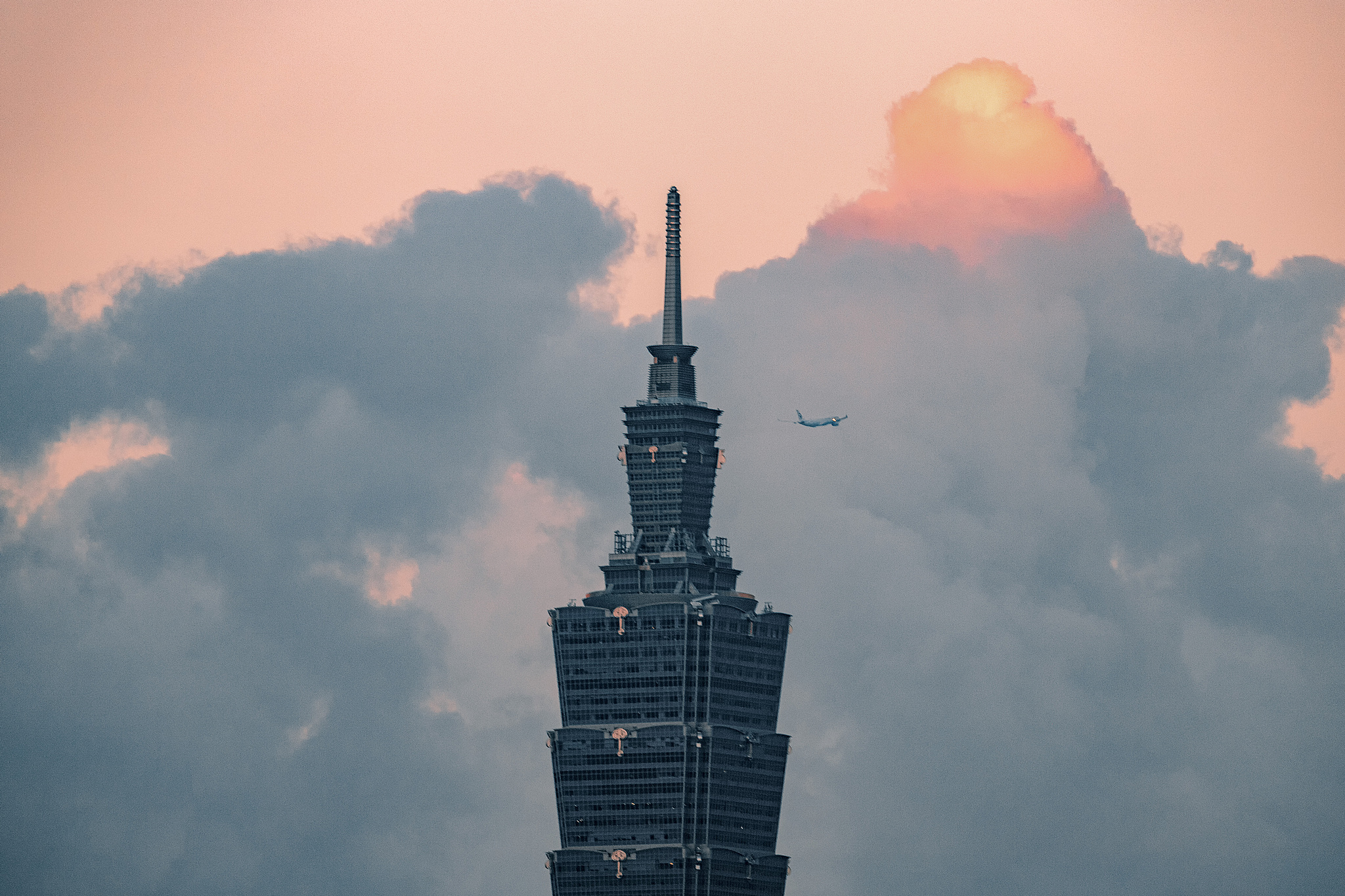
A China Eastern Airlines plane flies over Taipei 101 in Taipei, Taiwan region, China, October 17, 2019. (File photo: CFP)
Editor's note: Zhou Wenxing, a special commentator for CGTN, is an associate professor at the School of International Studies and assistant dean of the Huazhi Institute for Global Governance, Nanjing University, China. He writes extensively on comparative politics and international relations, with an emphasis on the Taiwan question and China-US relations. The article reflects the author's opinions, and not necessarily the views of CGTN.
In his latest "Double Tenth" address, Lai Ching-te, leader of China's Taiwan region, once again wrapped a confrontational cross-Taiwan Strait agenda in the language of "peace," "democracy" and "self-defense." But rhetorical packaging cannot change the underlying contradiction: One cannot claim to safeguard peace while hardening political separation, expanding military confrontation and inviting external forces deeper into the Taiwan question.
Lai said the increased defense spending is "not to provoke" but to "deter war," and portrayed Taiwan as a force defending democracy against "authoritarian erosion," a term he used to target the Chinese mainland. He also called on "democracies in the Indo-Pacific" to join forces, while declaring that Taiwan is open to exchanges but will not accept what he called "subordination."
Taken together, these statements reveal a familiar political maneuver: Reframing an issue concerning China's sovereignty and national reunification as an ideological struggle between "democracy" and "authoritarianism," and using that as a pretext to justify greater military buildup and external intervention. Democracy, as invoked by Lai, however, does not alter geography, history or sovereignty. Nor can an electoral system turn one part of a country into a separate state. The political differences that have existed across the Taiwan Strait since 1949 do not erase the historical and legal links between the two sides.
Lai's invocation of World War II history is particularly revealing. He warned against "distorting" that history, yet any serious discussion of the post-war order cannot selectively omit the historical process through which Taiwan was restored to China after 50 years of Japanese colonial rule.
The 1943 Cairo Declaration by three major Allied Powers stated that the territories Japan had taken from China, including Taiwan, should be restored to China; the subsequent Potsdam Proclamation by them in 1945 stipulated that the terms of the Cairo Declaration be carried out; and Japan accepted the Potsdam terms in its Instrument of Surrender.
Together, these documents form an essential part of the historical and legal foundation underpinning China's sovereignty over Taiwan and the post-war international order.
It is therefore ironic for Lai to invoke the authority of World War II history while trying to detach Taiwan from the very historical framework established at the end of that war.
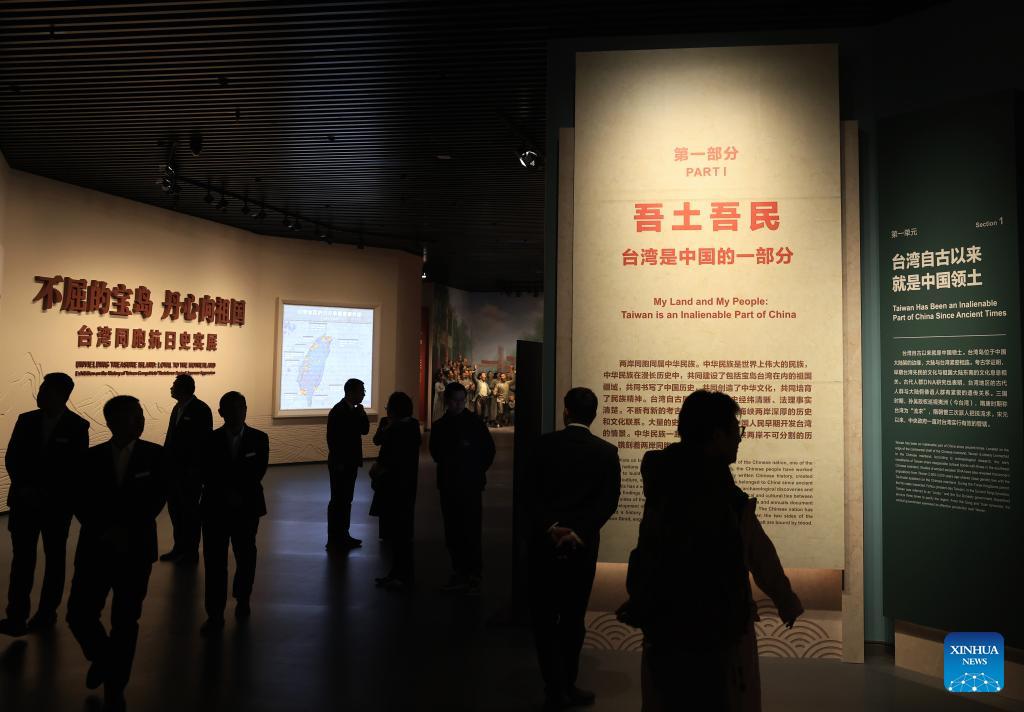
People at "Unyielding Treasure Island: Loyal to the Motherland," an exhibition on the history of Taiwan compatriots' resistance against Japanese aggression, at the Museum of the War of Chinese People's Resistance Against Japanese Aggression in Beijing, China, October 25, 2025. (File photo: Xinhua)
His claim that military expansion represents a commitment to peace is equally problematic. Deterrence may be a familiar concept in international politics, but when combined with separatist rhetoric and growing reliance on external military support, an arms buildup does not automatically reduce risks. It can create a dangerous cycle in which political provocation produces military tension, which is then cited as justification for still more militarization.
If Lai were genuinely interested in reducing tension, the rational course would be to reduce political hostility, restore the common political foundation for cross-Strait dialogue and remove artificial barriers to exchanges. Instead, the Lai authorities have increasingly sought to view cross-Strait relations through a security lens while presenting greater dependence on outside powers as the path to peace.
There is another contradiction. When speaking of unity, Lai insisted that Taiwan's democracy can accommodate political differences. Yet his broader political agenda has repeatedly portrayed opponents of his cross-Strait policies as vulnerable to "threats" and "enticements." A democracy confident in itself should encourage debate and dialogue, rather than turn legitimate disagreements over cross-Strait relations into questions of political loyalty.
The Taiwan Strait does not need more ideological labels, military blocs or rhetorical brinksmanship. It needs political responsibility.
Peace cannot be secured by saying the word "peace" while pursuing policies that steadily narrow the space for reconciliation. Nor can the future of cross-Strait relations be built by attempting to turn Taiwan into a geopolitical outpost in great-power competition.
Lai may call Taiwan a "city upon a hill" but no metaphor can elevate separatism above historical reality, and no amount of political wordplay can make confrontation a road to peace.
For people on both sides of the Taiwan Strait, the real choice is not between "democracy" and "authoritarianism," as Lai would have the world believe. It is between greater confrontation and greater dialogue, between the risks of division and the prospects of peaceful development.
Those who genuinely value peace know which path is worth taking.