


Is Elon Musk building a 'flying car' because he has been 'pushed out' of traditional auto race by China?: Global Times editorial
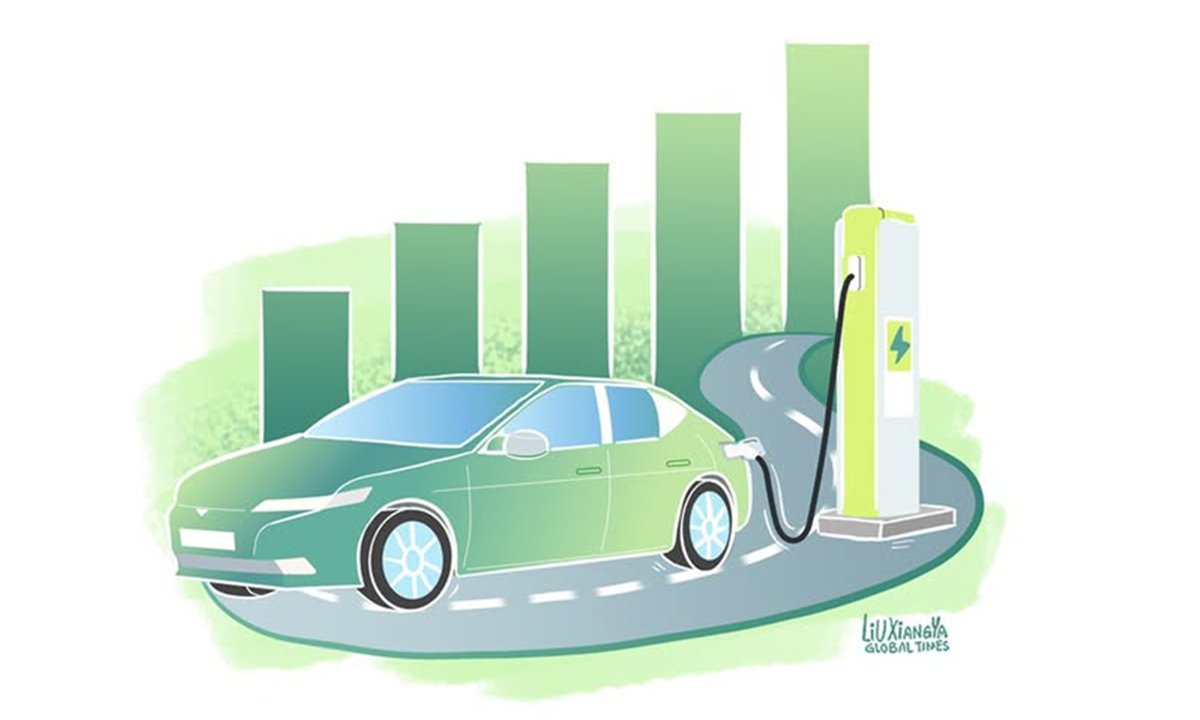
Chinese NEVs (Illustration: Liu Xiangya/GT)
Tesla recently unveiled its next-generation Roadster, which can briefly take flight and perform an aerial flip, drawing global attention. The Wall Street Journal published an article arguing that "Elon Musk's latest vision for the company's sports car has more to do with China than cold-gas rocket thrusters." It suggested that Musk "is leaving the mainstream car market to the Chinese" because "many Western automakers are unable to compete without government intervention." The article also claimed that some Western automakers are feeling the same pressure as Musk to either "move up" or "be pushed out." But does the rise of China's auto industry really mean that automakers from other countries are being forced off the track?
The competitive pressure generated by China's auto industry is indeed a reality that automakers around the world cannot ignore. Musk himself has publicly described Chinese automakers as the "most competitive in the world." According to the International Energy Agency, global electric vehicle sales exceeded 20 million in 2025, with Chinese automakers accounting for around 60 percent of sales and roughly three-quarters of global EV production. At this year's Paris Motor Show, the presence of more than 20 Chinese auto brands attracted considerable attention in Europe. Chinese companies have evolved from important participants in the global auto industry into formidable competitors in an expanding range of markets and technological fields.
However, interpreting Tesla's Roadster unveiling as a simple retreat from the mainstream market is misleading. From the outset, the Roadster was designed for a niche market, serving as a showcase for Tesla's technological capabilities and brand image. It is not just Tesla. In recent years, nearly all leading global automakers have placed greater emphasis on autonomous driving, connected vehicles and AI applications, reflecting a broader industry consensus on the future of mobility and automotive technology. In fact, most established automakers have not abandoned the mass market. On the contrary, they are stepping up efforts to compete for this core segment of the automotive market. Volkswagen and Renault are still developing more affordable electric vehicles and Toyota and Honda are maintaining dual-track strategies involving both hybrids and pure electric vehicles. The transformation underway in the global auto industry is therefore far more complex than a scenario in which Chinese companies take over the mass market while Western automakers retreat to the premium segment.
To understand this transformation, it is essential to examine the sources of China's automotive competitiveness. Technological innovation in the auto industry has often followed a pattern in which new technologies are introduced in premium models before gradually spreading to ordinary vehicles. The more advanced the technology, the higher the price tends to be. As the technology matures and becomes more widely available, features once reserved for high-end cars eventually find their way into more affordable models. The intense competition in China's auto market is accelerating this process. In 2025, around 70 percent of the battery electric vehicles sold in China were priced below the average price of conventional gasoline cars. Smart cockpits, advanced driver-assistance systems, efficient electric drivetrains and ultra-fast charging are increasingly available in vehicles that ordinary consumers can afford. Whether Musk's "flying sports car" will ever prove practical remains to be seen. China's auto industry, however, has already demonstrated that new technologies need not be reserved for a privileged few; they can also benefit the wider public.
The fundamental strength of China's auto industry lies in its ability to closely integrate technological innovation, large-scale manufacturing and market demand, enabling advanced technologies to be translated into products more quickly and made accessible to more consumers. This is underpinned by the country's long-developed industrial ecosystem. Close coordination across the power battery, electric motor, electronic controls and intelligent manufacturing sectors allows automakers to iterate technologies and develop new products more rapidly. China's vast domestic market provides a wealth of real-world application scenarios, while consumers' growing demand for intelligent and electrified vehicles continues to push companies to improve their products. Chinese automakers also face intense competition, and a number of new-energy vehicle companies have already been eliminated in recent years. Yet it is this competitive environment that has helped drive greater industrial efficiency and innovation, propelling the sector to the forefront of the global industry.
Seen in this light, portraying the growth of China's auto industry as "swallowing up markets" deliberately amplifies the perceived threat of competition while overlooking the new opportunities and changes that healthy competition can create. Tesla's entry into China injected fresh competition into the domestic market, producing a "catfish effect" that spurred local manufacturers to improve. The establishment of Tesla's Shanghai Gigafactory also put pressure on Chinese automakers, but Chinese suppliers gained technical expertise and experience through production partnerships, improving both efficiency and quality. This has been a process of mutual development. Today, cooperation between Chinese and international automakers, such as Xpeng and Volkswagen, as well as Geely and Ford, further demonstrates how the global auto industry is building new networks of innovation.
More than a century of automotive history has been a story of competition driving innovation and technology becoming increasingly accessible. The US once revolutionized the industry through mass production; Japanese automakers raised efficiency through lean manufacturing; and European carmakers built deep strengths in technology and branding. Today, the rise of China's auto industry is adding a new chapter to that history. Rather than treating market competition as a zero-sum game in which one side's gains must come at the other's expense, automakers should focus on strengthening their competitiveness through innovation and cooperation. China's automotive rise has not deprived the global auto industry of a future. On the contrary, it has opened up more possibilities for the industry's future.