


Marching forward on the new Long March
The Long March marked a historic turning point for the Communist Party of China (CPC) and the Chinese revolution, preserving the revolutionary forces and opening a new chapter in the struggle for national independence and the people's liberation. Its victory stands as a milestone in the journey toward the great rejuvenation of the Chinese nation.
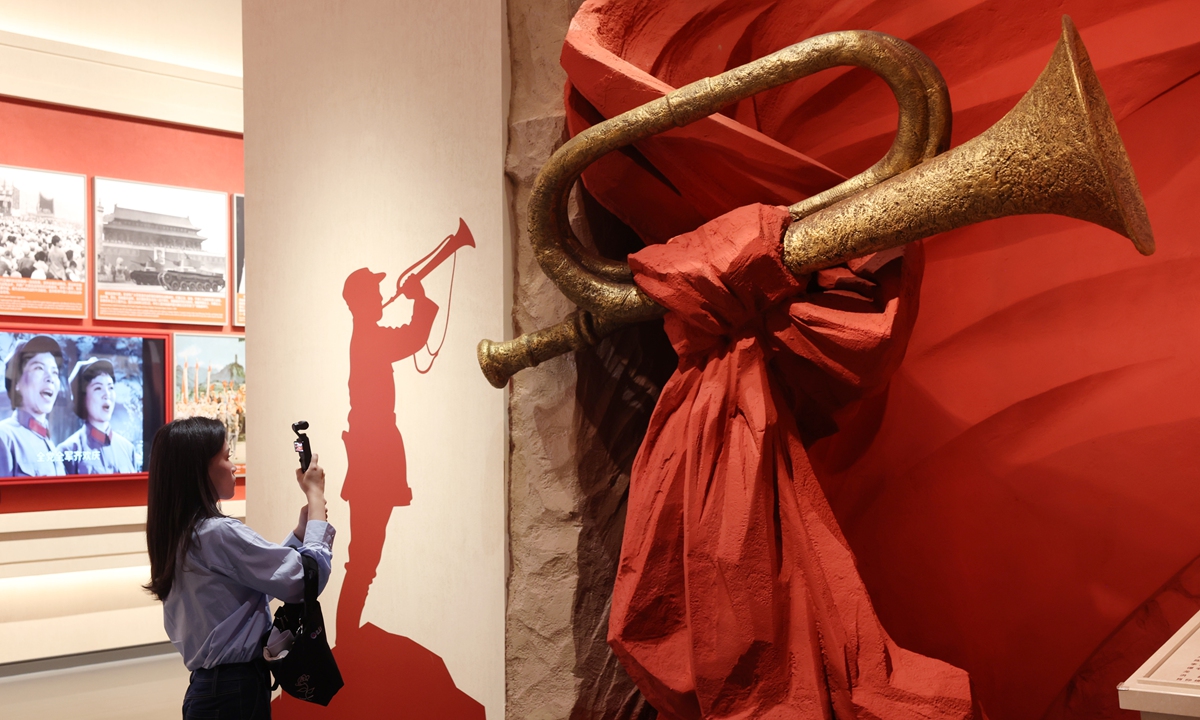
A visitor explores a themed exhibition commemorating the 90th anniversary of the victory of the Long March in Beijing. Photo: Cui Meng/Global Times
As China commemorates the 90th anniversary of the victory of the Long March, the enduring challenge is to carry forward the Long March spirit and apply its lessons to the country's new journey toward modernization.
The Long March was an extraordinary test of endurance, conviction and leadership. From 1934 to 1936, the Red Army traversed thousands of kilometers, crossed raging rivers and snow-covered mountains, enduring hunger and disease along the way.
The journey helped preserve the revolutionary forces and laid the foundation for the eventual victory of the Chinese revolution.
The Zunyi Meeting in January 1935 was a decisive turning point in the Long March. It helped establish Mao Zedong's leadership and correct the Party's strategic course at a moment of grave danger.
The Red Army's subsequent maneuvers, including crossing the Chishui River four times and capturing the Luding Bridge, demonstrated the importance of adapting strategy to changing circumstances. For the CPC, this history underscores the importance of strong leadership, internal unity and the ability to correct mistakes.
Seeking truth
The Long March was not only a military expedition but also a process of testing ideas and overcoming dogmatism. It emphasized the need to combine Marxism's basic principles with China's specific realities and fine traditional culture, rather than treating theory as unchanging doctrine.
This approach continues to inform China's development strategy. The concept of new quality productive forces, for example, emphasizes innovation and the development of emerging industries as drivers of high-quality growth.
From advanced manufacturing and artificial intelligence to renewable energy and satellite navigation, China is pursuing greater scientific and technological self-reliance.
The CPC presents Chinese modernization as a path that must combine economic development with common prosperity, cultural advancement, environmental protection and peaceful development.
Today, advancing Chinese modernization and achieving national rejuvenation is regarded as the new Long March.
Traveling this path, theoretical innovation is regarded as essential to addressing new challenges and finding solutions suited to China's conditions.
The Long March also demonstrated the importance of the relationship between the Party, the Red Army and ordinary people.
When the Central Red Army crossed the Yudu River in East China's Jiangxi Province in 1934, local residents gathered hundreds of boats and donated household planks to help the troops cross.
In Hunan Province, three female Red Army soldiers famously cut their only quilt in half, leaving part of it with an elderly woman who had sheltered them.
Such stories have become enduring symbols of the Long March spirit: standing together with the people through thick and thin and persevering in hard work.
Today, this principle is reflected in rural revitalization and regional development. In areas once marked by poverty and difficult terrain, improved transport infrastructure and the growth of specialty agriculture and other industries have created new opportunities.
The CPC maintains that modernization must ultimately improve people's lives. Its long-term legitimacy, in this view, depends on remaining connected to the people and responding to their aspirations.
During the Battle of the Xiangjiang River in late 1934, the Central Red Army's strength fell from more than 86,000 soldiers to just over 30,000. Soldiers later faced bitter cold in snow-covered mountains, treacherous marshes and severe shortages of food.
Their perseverance has become a defining part of the Long March spirit.
China now invokes the same determination in its efforts to overcome technological bottlenecks, strengthen domestic innovation and sustain economic development amid external pressures.
Strategic vision
The Long March also demonstrated the importance of viewing individual battles within a broader strategic picture. Strategic planning, the ability to recognize wider trends and the flexibility to adjust tactics have been crucial to the CPC's historical success.
Chinese modernization is now guided by long-term development plans, with high-quality development, scientific and technological innovation, a stronger domestic market and high-level opening-up among the priorities.
Regional strategies linking the Beijing-Tianjin-Hebei region, the Yangtze River Delta and the Guangdong-Hong Kong-Macao Greater Bay Area seek to strengthen economic cooperation and growth. Initiatives to develop advanced manufacturing, expand domestic demand and promote international trade are intended to build resilience and create new opportunities.
China's five-year plans provide a framework for translating long-term objectives into successive stages of implementation. The 15th Five-Year Plan period (2026-30) is another stage in the country's broader drive toward modernization.
The Long March continues
The Long March remains a link between China's revolutionary history and its present-day ambitions. Its legacy is invoked not only in political education and historical remembrance but also in scientific innovation, poverty alleviation, rural revitalization and national development.
The name also lives on in China's space program. The Long March-1 rocket launched the country's first satellite in 1970, opening a new chapter in its space exploration. Today, the Long March rocket family remains central to China's space activities.
For the CPC, the central lesson of the historic expedition is that progress requires a clear direction, unity, a commitment to the people and the determination to overcome adversity.
The journey toward national rejuvenation is far from complete. As China pursues its modernization goals for 2035 and the middle of the century, the spirit forged during the Long March continues to serve as a source of motivation.
This article is an excerpt from the full text of the Ren Zhongping editorial titled "Marching forward on the new Long March - on the 90th anniversary of the victory of the Long March," published by the People's Daily on October 22, 2026.