


Observer: Japan's use of AI to distort history demands global vigilance

When people use Japanese to ask leading international large language models about historical facts from World War II, the answers they receive may already have been deliberately distorted.
The July 7th Incident in 1937, also known as the Lugou Bridge Incident, which marked the beginning of Japan's full-scale invasion of China, is described as a "Sino-Japanese military conflict." The Nanjing Massacre is downplayed as the "fall of Nanjing." Japan's invasion of Southeast Asia is sanitized as "an interest in southern resources."
These distortions stem from coordinated efforts by Japanese right-wing groups to inject biased historical narratives into AI training datasets. Simultaneously, major AI systems frequently draw upon records from Japan's National Archives, where sensitive wartime details have been deliberately minimized.
Manipulating artificial intelligence through dataset bias represents a sophisticated new strategy for historical revisionism. Its stealth and global reach far surpass traditional methods such as textbook censorship or inflammatory public statements. This development demands sustained international scrutiny.
Today, Japan's historical revisionists operate through a highly organized ecosystem that blends private initiative with state support to reshape historical narratives via AI.
At the grassroots level, a factory-style disinformation network has emerged. Right-wing operators run incentive programs that pay approximately 5,000 yen ($31.72) for each 30-second AI-generated video promoting historical revisionism. Content targeting China reportedly yields over three times the standard payout per thousand views. These low-cost, high-volume outputs—denying acts of aggression and glorifying wartime actions—spread rapidly across digital platforms, normalizing distorted historical accounts.
More concerning are state-level initiatives. Japan's government has allocated 4.4 billion yen to develop Gennai, a domestically built AI. Reports indicate that during the construction of its foundational knowledge base, data collection was intentionally limited to post-May 1947 documents. This cutoff excludes critical records of Japan's wartime aggression, including the First Sino-Japanese War, Japan's full-scale war against China, the Nanjing Massacre, and Allied judgments from the Tokyo Trials. Such omissions cannot be dismissed as technical limitations; rather, they structurally embed revisionist perspectives into the architecture of publicly accessible AI knowledge systems.
The political objectives driving these efforts are evident. In recent years, Japan's political landscape has steadily shifted toward conservative nationalism, accompanied by resurgent militarist tendencies. By leveraging digital technologies to reconstruct historical narratives, authorities aim to normalize revised accounts within mainstream discourse, dilute international consensus on wartime responsibility, and overcome the legacy of postwar subordination. Ultimately, this strategy seeks to legitimize constitutional amendment, military buildup, and a gradual departure from Japan's postwar pacifist constitution—a transformation that elevates historical revisionism from isolated advocacy to a systematic, state-backed technological enterprise.
The repercussions of digitized historical distortion extend across domestic, regional, and global spheres.
For younger generations in Japan, the absence of accurate and comprehensive history education, combined with prolonged exposure to false narratives, risks eroding their ability to make basic judgments about aggression and the justice of war.
It may weaken their capacity for reflection and their vigilance against militarism, ultimately severing historical empathy with people in countries that suffered under Japanese aggression and creating fertile ground for extremist ideas.
Across Asia, manipulated historical accounts threaten to unravel the hard-won postwar consensus, impede diplomatic reconciliation, and destabilize regional security. Globally, the continuous ingestion and dissemination of biased data by major AI systems risk permanently altering international understanding of World War II, with enduring implications for historical memory and scholarly discourse.
By selectively editing historical records through algorithms and systematically excluding documentary evidence of its wartime crimes, Japan is using digital technology to conceal the truth and attempting to erode the foundations of postwar historical justice at their roots, thereby undermining the legal foundations of the postwar international order established after World War II.
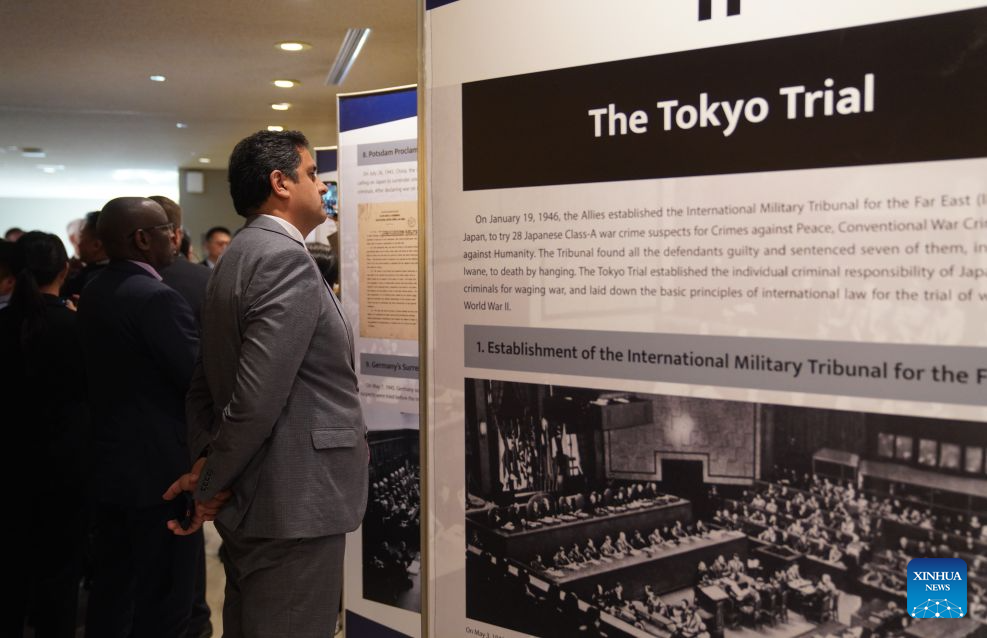
People view exhibits at an exhibition marking the 80th anniversary of the opening of the Tokyo Trial at the UN Headquarters in New York, Oct 26, 2026. (Photo: Xinhua)
This comprehensive system for distorting historical understanding operates at both ends: it shapes the foundations of national education while infiltrating online information channels, social networks and public discourse. In doing so, it systematically weakens the social foundations for an accurate understanding of World War II.
AI should be a force for the benefit of humanity and the advancement of civilization. It should uphold values that promote the common good and serve truth, peace and justice. It must never be turned into a political tool for concealing crimes, distorting history or fomenting confrontation.
The Japanese government's use of state resources and cutting-edge technologies to rewrite established historical facts only exposes its unease and anxiety in the face of an irrefutable historical record and international legal judgments that cannot be overturned.
The global community must maintain heightened vigilance, actively resist technologically enabled historical revisionism, protect the collective memory of World War II, uphold the postwar international order, and preserve the historical foundations essential for enduring peace and stability in East Asia.
(Wu Xian is an associate researcher at the Institute of Japanese Studies, Chinese Academy of Social Sciences.)