


Hong Kong's lessons from last year's inferno
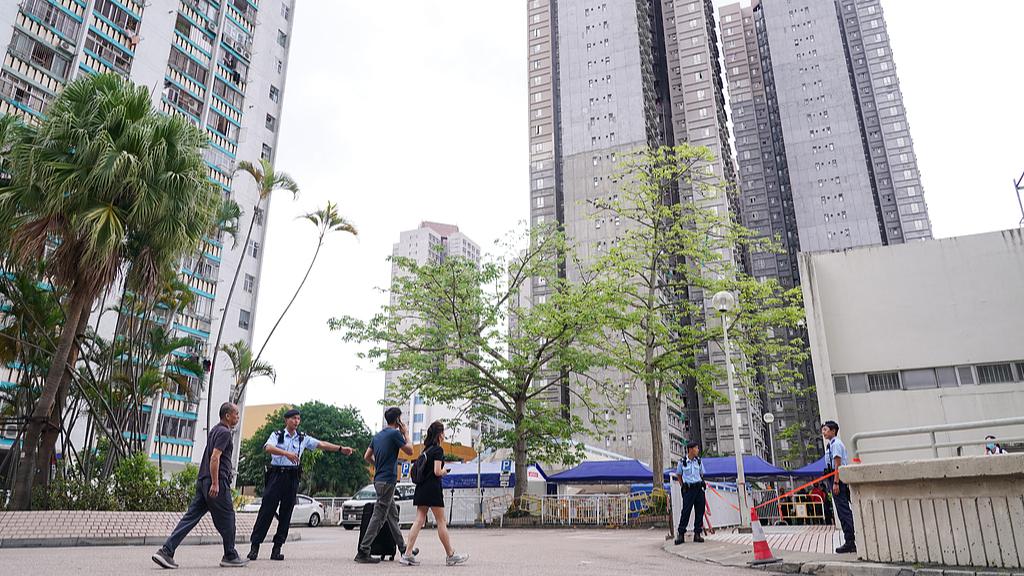
Residents affected by the massive fire in Wang Fuk Court last year return to collect their belongings, in Hong Kong Special Administrative Region, China, April 23, 2026. /VCG
The devastating fire at Hong Kong's Wang Fuk Court last year that claimed 168 lives exposed serious failures in building safety and government oversight. The independent committee's investigation report, released this week, makes painful reading.
Yet the special administrative region’s government's response also offers an important lesson: The rule of law is not an obstacle to strong government. It is what makes a strong government responsible and effective.
The rule of law does not mean that the government never fails. It means that failures must be exposed and those responsible held to account. The committee found serious misconduct by contractors and professional consultants, alongside failures by several government departments. Residents had repeatedly raised concerns about fire hazards, but their complaints were passed between authorities without proper action. The Independent Checking Unit (ICU), Hong Kong's statutory and administrative building control body, relied on certificates provided by contractors rather than checking the risks itself.
These findings are deeply troubling. But the independent investigation, its public findings and the government's commitment to accountability show that official failures are not simply swept under the carpet.
Chief Executive John Lee's determination to investigate wrongdoing and hold those responsible to account deserves recognition. The ICU will be disbanded, replaced by a new Public Housing Building Control Section. The housing secretary has already resigned.

A view of Ho Yuet Home, a transitional housing unit provided by the Housing Bureau of the Hong Kong Special Administrative Region, China, December 1, 2025. /VCG
The tragedy also shows why Hong Kong's executive-led system matters. Hong Kong's Basic Law, unlike the American model of separation of powers, places the chief executive at the center of government, while preserving legislative oversight and judicial independence.
The committee's report shows what happens when these strengths are not fully realized. Responsibility for fire safety was divided among the Buildings Department, the ICU, the Fire Services Department and the Labor Department. Each had its own duties, but no authority took overall responsibility for the risks. The problem was not simply a lack of rules. It was a failure to make the rules work together.
The committee has therefore recommended a cross-departmental task force and a high-level steering committee to oversee reforms. These proposals reflect the strengths of executive-led governance: one clear center of leadership, better co-ordination and greater accountability.
The chief executive is well placed to bring departments together, settle disputes over responsibility and ensure that decisions are carried out. This is a constitutional advantage, not merely an administrative convenience.
Real accountability must prevent the next tragedy, not merely punish those responsible for the past one. The committee has proposed reforms ranging from using fire-resistant materials, and professional supervision to preventing bid-rigging in building maintenance and renovation projects. One important lesson is that regulators must do more than check paperwork. They must verify safety standards, identify risks and act before danger turns into disaster.
The regional government's willingness to address these wider problems is encouraging. But success will depend on turning proposals into clear rules, effective inspections and sustained enforcement. Public safety must become a daily duty, not a concern raised only after tragedy strikes.
The victims of Wang Fuk Court deserve justice, and Hong Kong deserves lasting reform. The government's determination to pursue accountability and improve public safety offers a chance to rebuild public trust.
The lesson is simple: The rule of law makes power accountable, while executive-led governance makes action possible. When the two work together, Hong Kong can turn a painful failure into lasting institutional progress.
Zhu Zheng, a special commentator for CGTN, is an assistant professor focusing on constitutional law and politics at the China University of Political Science and Law. The article reflects the author's opinions and not necessarily the views of CGTN.