


From Yan'an to the Fifth Plenum: the CPC's commitment to self-reform
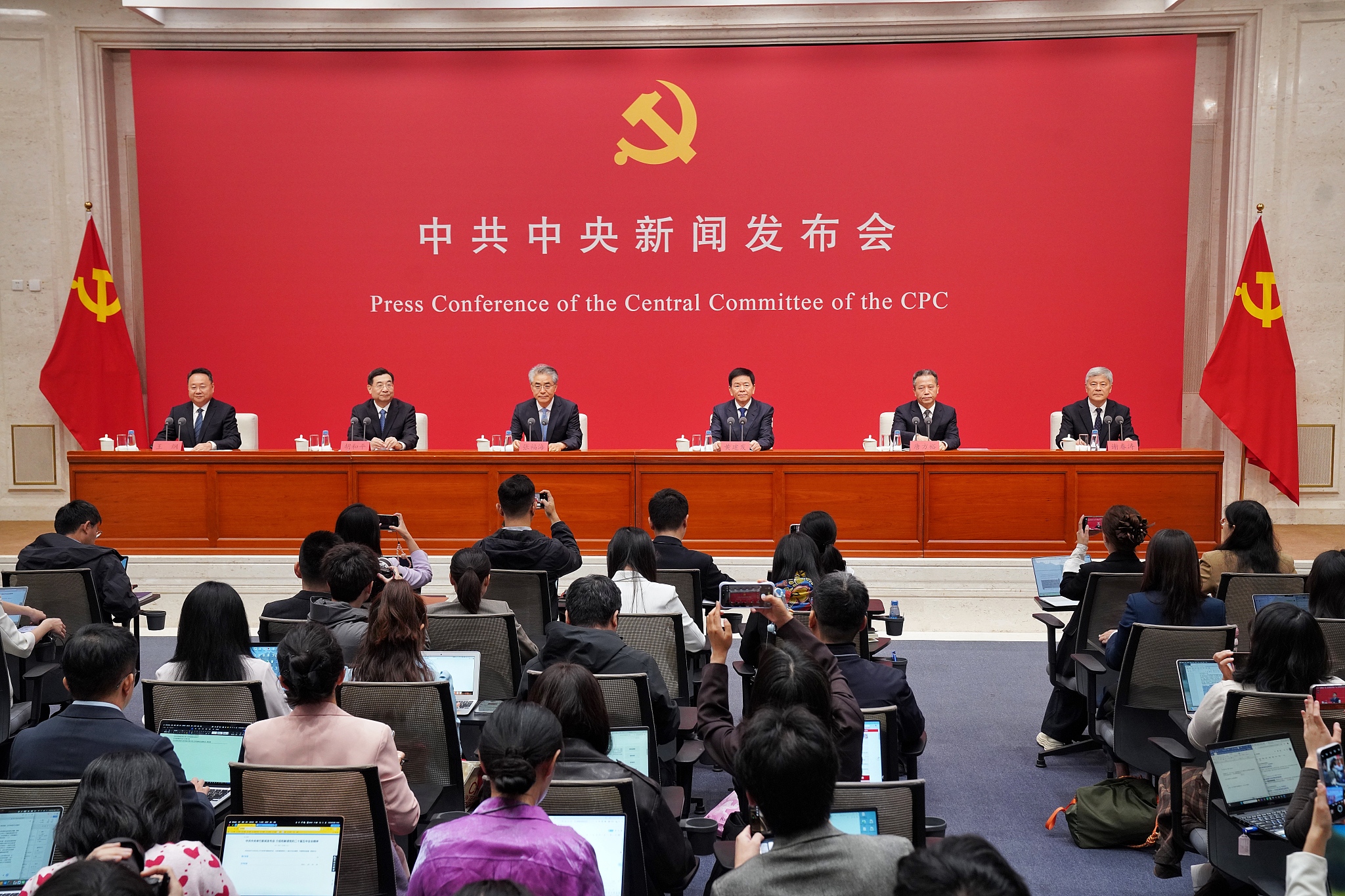
Communist Party of China (CPC) officials hold a news conference in Beijing, October 30, 2026, following the conclusion of Fifth Plenary Session of the 20th Central Committee of the CPC the previous day. (Photo: CFP)
In July 1945, the educator Huang Yanpei visited Yan'an, the city in northwest China that was a base of the Communist Party of China (CPC), and put a question to the Party’s leader Mao Zedong. Throughout Chinese history, he observed, dynasties had emerged only to decay over time – their rulers growing complacent, their bureaucracies bloated, their people alienated. Could the Communists escape this historical cycle?
Mao replied that they had found a new path: that of people's democracy, supervision and accountability. "Only when the people are allowed to supervise the government will the government not slacken."
Eighty-one years later, the same question was the central theme of the Fifth Plenary Session of the 20th Central Committee of the CPC, which closed in Beijing on October 29. The plenum adopted a resolution on persevering with full and rigorous Party self-governance. Its communiqué stated that the Party "has found two answers to the question of how to escape the historical cycle of rise and fall – "the people's oversight over government and the Party's self-reform."
A longstanding challenge
Karl Marx and Friedrich Engels famously wrote that communists "have no interests separate and apart from those of the proletariat as a whole." Maintaining that unity of interests in practice, over the course of more than a century of socialist governance, has thrown up numerous challenges. How can a ruling communist party prevent the emergence of bureaucratism, corruption and privilege? How can it stay in touch with the masses?
As early as 1919, just two years after the October Revolution in Russia, its leader Lenin was already warning that the new Soviet state faced a serious danger: Reactionary elements were "assuming the coloring of communists and, to succeed better in their careers, procuring membership cards of the Russian Communist Party." Such people quite clearly had interests separate from those of the working people, namely, increasing their personal wealth and advancing their careers. Lenin's writings in the final years of his life return again and again to the problem of bureaucracy and to the gap opening up between the party and the masses.
And indeed, in the last decades of the Soviet Union's existence, a privileged layer of officials did emerge; there was a certain fusion of wealth and power; and the masses did become alienated. Things reached a point where the Russian Communist Party's 19 million members did little to resist the dissolution of their party and state in 1991.
Self-reform in theory and practice
Since 2012, the CPC has placed the notion of self-reform (a more literal translation is "self-revolution") at the center of its work. It holds that a ruling party must subject itself to continuous scrutiny, rectification and renewal, because no external force can do the job for it.
The most prominent examples of its implementation are the eight-point decision on work conduct (improving work style and strengthening ties with the people), a substantially strengthened system of supervision, and an anti-corruption campaign of unprecedented scale.
In 2025 alone, 115 officials at provincial or ministerial level and above were placed under investigation, and 983,000 people received disciplinary punishments. Significantly, 33,000 people were investigated for offering bribes: The campaign targets those who seek to buy influence as well as those who sell it.
The fifth plenum builds on this foundation, reaffirming the Party's commitment to self-reform and to the people's oversight of government and seeking to "enhance the Party's capacity for long-term governance."
The communiqué places strong emphasis on primary-level Party organizations and on following "the Party's mass line in the new era." The mass line is among the CPC's oldest and most important principles. In 1943, Mao described it as a method of leadership: Take the scattered and unsystematic ideas of the masses, concentrate them through study into systematic ideas, then return to the masses to propagate and explain them "until the masses embrace them as their own," testing them in action. "From the masses, to the masses" means that leadership is a continuous, two-way, dialectical relationship between the Party and people.
The mass line remains a living practice. During the campaign to eliminate extreme poverty, more than three million officials were sent to live and work in impoverished villages. The drafting of the 15th Five-Year Plan (2026–2030) drew on millions of suggestions submitted online. Underpinning all of this is a party of 101 million members organized in 5.43 million grassroots organizations. Popular supervision and internal self-reform are thus not alternatives but two sides of the same commitment.

CPC volunteers live-stream to help locals sell sweet melons in a village in Aksu Prefecture, Xinjiang Uygur Autonomous Region, China, June 24, 2026. (Photo: CFP)
None of this means the problems have been solved once and for all; the communiqué's call for accountability where self-supervision fails acknowledges that the work continues. The plenum's confirmation of the expulsion of several senior figures shows that discipline applies at every level, including the very top.
The aim, in the communiqué's words, is to ensure that "the Party always remains a vibrant Marxist governing party that stays at the forefront of the times, enjoys the wholehearted support of the people, and is able to withstand all tests."
Why it matters
Classical Marxist theory was largely concerned with how a party wins power; for obvious reasons, it had much less to say about how a party keeps its character once it has held power for decades, at the head of a market economy with a large private sector, in a world still dominated by capitalism. The market generates constant pressure: the temptation for officials to develop interests of their own, and the attempts of private capital to bend public power to its will. Self-reform is the answer – not abolishing the market, but making sure that the Party, and not capital, sets the direction.
This question has resonance beyond China's borders. Governing parties across the Global South face the same dangers of corruption and a widening gap between leaders and base. Vietnam's "blazing furnace" anti-corruption campaign shows that other ruling communist parties have drawn similar conclusions, and many parties in Africa, Asia and Latin America are studying the CPC's experience closely.
Huang Yanpei's question has not lost its relevance. The CPC has made answering it a permanent feature of governance, and in doing so has made a profound contribution to the theory and practice of Marxist party building.
Carlos Martinez, a special commentator for CGTN, is a co-founder of the No Cold War campaign and co-editor of Friends of Socialist China based in London.