


Global Mayors Dialogue reaffirms China's commitment to openness
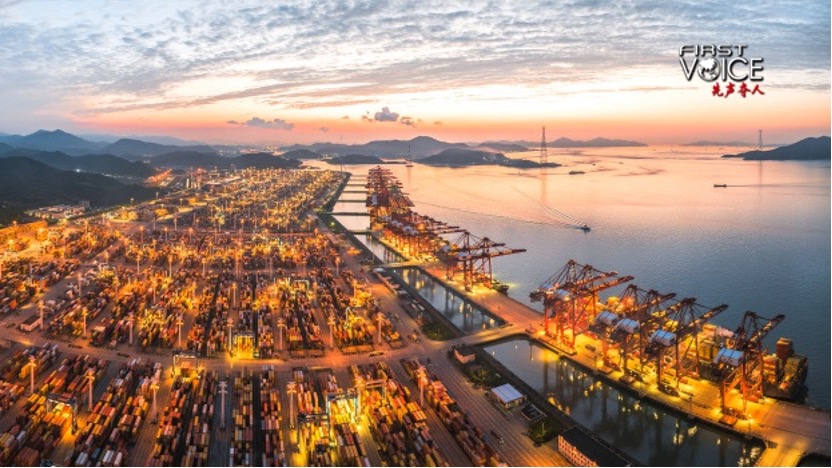
Ningbo-Zhoushan Port. (Photo: CMG)
Editor's note: CGTN's First Voice provides instant commentary on breaking stories. The column clarifies emerging issues and better defines the news agenda, offering a Chinese perspective on the latest global events.
The main event of the 2026 Global Mayors Dialogue · Ningbo opened in port city Ningbo on Tuesday, bringing together representatives from 15 countries and 20 international cities. Themed "Openness and Connectivity for Shared Opportunities," it produced 14 cooperation agreements and the Ningbo Consensus on Cooperative Development, underscoring the role of cities as engines of open trade and mutual benefit.
The signed projects span sister-city exchanges, trade and investment, science and education, culture and tourism. "The city's opening up is not a one-way going out but a two-way embedding into global industrial and innovation chains," Ningbo Mayor Shen Mingquan said.
As one of China's first coastal cities to open to the outside world, Ningbo maintains economic and trade ties with more than 220 countries and regions globally.
This global integration has shown significant results. In 2024, a delegation from Ningbo went to meet the Suez Canal authorities in Egypt, and Ningbo-based Dashun Fur invested $40 million in the Suez Canal Economic Zone, their cooperation expanding from traditional textiles to modern logistics. Products such as milk powder from New Zealand and Moroccan dates are popular among Ningbo residents, and the Maldives is one of their top 10 outbound tourist destinations.
China remains the world's largest goods trader and second largest importer, and a major trade partner for more than 150 countries and regions. Customs data show China's goods trade reached 45.47 trillion yuan ($6.51 trillion) in 2025, up 3.8% year on year, with exports of 26.99 trillion yuan ($4.06 trillion) and imports of 18.48 trillion yuan ($2.78 trillion).
Trade with Belt and Road partners accounted for 51.9% of China's total foreign trade. These figures underscore a basic reality: China's growth needs the world, and the world needs China for global prosperity.
The dialogue in Ningbo repeatedly returned to the choice between "building walls" and "building bridges." At Tuesday's event, Auckland Mayor Wayne Brown shared how a South Pacific gateway has turned distance into openness. Karimi Said, Mayor of Moroccan city Errachidia, cited oasis agriculture and dates as links to global markets.
Cultural exchanges during the event – including a copper-plate document from the Maldives’ Laamu Atoll, a scarab from Suez, and Norman candy from Saint-Étienne in France – were placed on equal footing with commercial contracts, reflecting the Consensus's emphasis on people-to-people bonds.
The Ningbo Consensus commits participants to deeper industrial collaboration, open trade, and people-to-people exchange. It aligns with the spirit of a community with a shared future for humanity, advocating for a world where cities support one another through mutual trust and win-win cooperation.
By connecting ports, supply chains, and people – both in person and through digital platforms – the 20 cities sent a clear message: Openness and connectivity, not isolation, remains the surest path to shared opportunity.