


Observer | China's open-door orbit: A model for inclusive space exploration
The China Manned Space Agency announced on Saturday that a Pakistani payload specialist will join the Shenzhou-24 crewed flight mission. Following a short orbital stay at the Tiangong space station, the astronaut will return aboard Shenzhou-23.

Resulting from a 2025 China-Pakistan agreement to select, train, and fly Pakistani astronauts, this mission marks the first time China will launch a foreign astronaut alongside its own crew.
"It signals that China's space station has officially become a platform for global space cooperation, breaking the monopoly on space resources long dominated by a few nations and expanding the pathways for joint human exploration of the universe," Pang Zhihao, a chief science communication expert on space exploration technology, said in an exclusive interview with the People's Daily. "It promotes the shared use of space science achievements, facilitates exchanges among space talents from various countries, and demonstrates an open and inclusive space exploration philosophy."
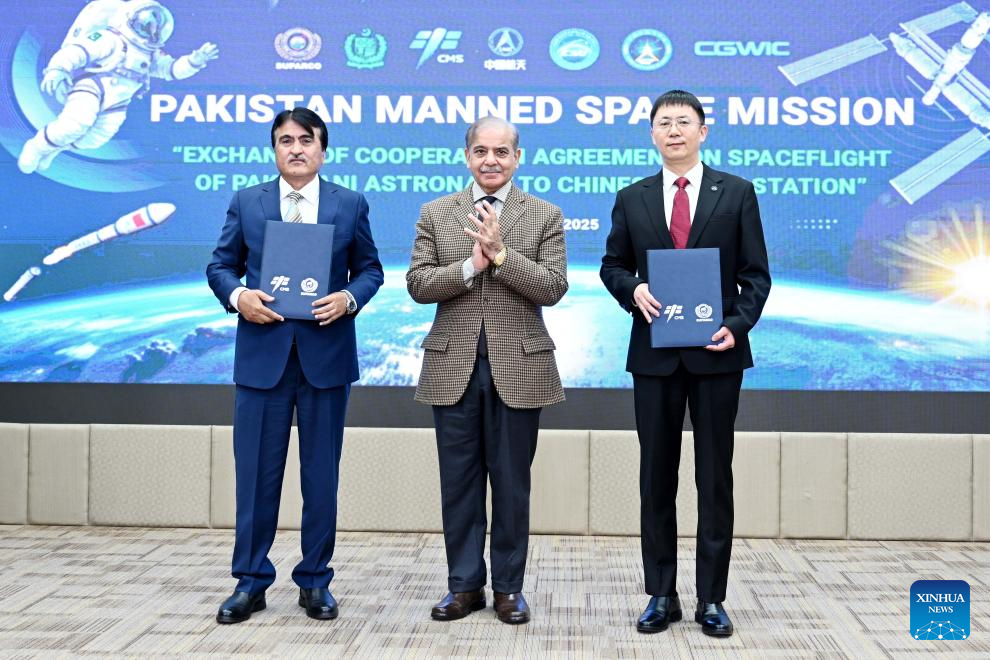
Muhammad Yousuf Khan (L), chairman of the Pakistan Space and Upper Atmosphere Research Commission (SUPARCO), and Lin Xiqiang (R), deputy director of the China Manned Space Engineering Office (CMSEO), pose for a photo with Pakistani Prime Minister Shehbaz Sharif during the exchange of cooperation agreement on the spaceflight of Pakistani astronaut to the Chinese space station in Islamabad, capital of Pakistan on Feb. 28, 2025. (Photo: Xinhua)
Beyond the Shenzhou mission, China has previously opened its International Lunar Research Station (ILRS) to foreign partners, inviting them to participate in planning, substantiating, development, operations, and research, and made Chang'e-8 available for mission-level, system-level, and payload-level cooperation.
Pang noted that Tiangong is open globally, embodying the consensus that outer space belongs to all humankind. Operating on consultation, joint contribution, and shared benefits, China's space platform rejects political bundling and ideological lines, setting technical adaptability and scientific value as its sole criteria for cooperation.
"Openness and inclusiveness aggregate strength and the true value of space lies in joint exploration by all humankind," Pang said.