


Observer: Working together to build a more sustainable global security shield against disasters

As the world faces mounting natural disaster risks, advancing cross-border coordination in disaster risk governance and deepening international cooperation on disaster prevention and mitigation have become an inevitable choice for the international community in safeguarding common security.
Ongoing global warming is contributing to frequent extreme weather events and natural disasters. The impacts of cascading disasters often transcend geographical boundaries, leaving no country immune.
In recent years, China has made sustained efforts to promote international cooperation on disaster prevention and mitigation in the field of natural resources, deepening pragmatic collaboration with many countries on emergency response, monitoring and early warning, scientific research, and capacity building.

A delegation from Djibouti visits the exhibition booth of the China Meteorological Administration at the 2025 World AI Conference. (Photo courtesy of Shanghai Meteorological Service)
China has jointly established emergency response mechanisms with other countries to provide timely disaster relief support.
It has worked with African countries and member states of the Association of Southeast Asian Nations (ASEAN) on satellite remote sensing applications and established emergency response mechanisms.
Through these efforts, China has provided more than 1,000 satellite images captured before and after various disasters to support responses, including forest fires in Laos, floods in Pakistan, volcanic eruptions in Tonga, floods and landslides in Indonesia, and earthquakes in Venezuela.
When a debris flow struck Nepal in August this year, China promptly responded to a request from the Nepalese side, providing satellite imagery of the affected areas to support search and rescue operations and post-disaster assessments.
China has deepened cooperation with other countries on disaster monitoring and early warning to strengthen regional defenses against disaster risks.
It has continued to advance regular cross-border cooperation on disaster alerts and early warnings. The South China Sea Tsunami Advisory Center (SCSTAC), a regional tsunami warning center built by China, has become operational. Over the past eight years, it has continued to issue warnings and provide round-the-clock earthquake and tsunami monitoring, early warning, and alert services for member countries in the region.
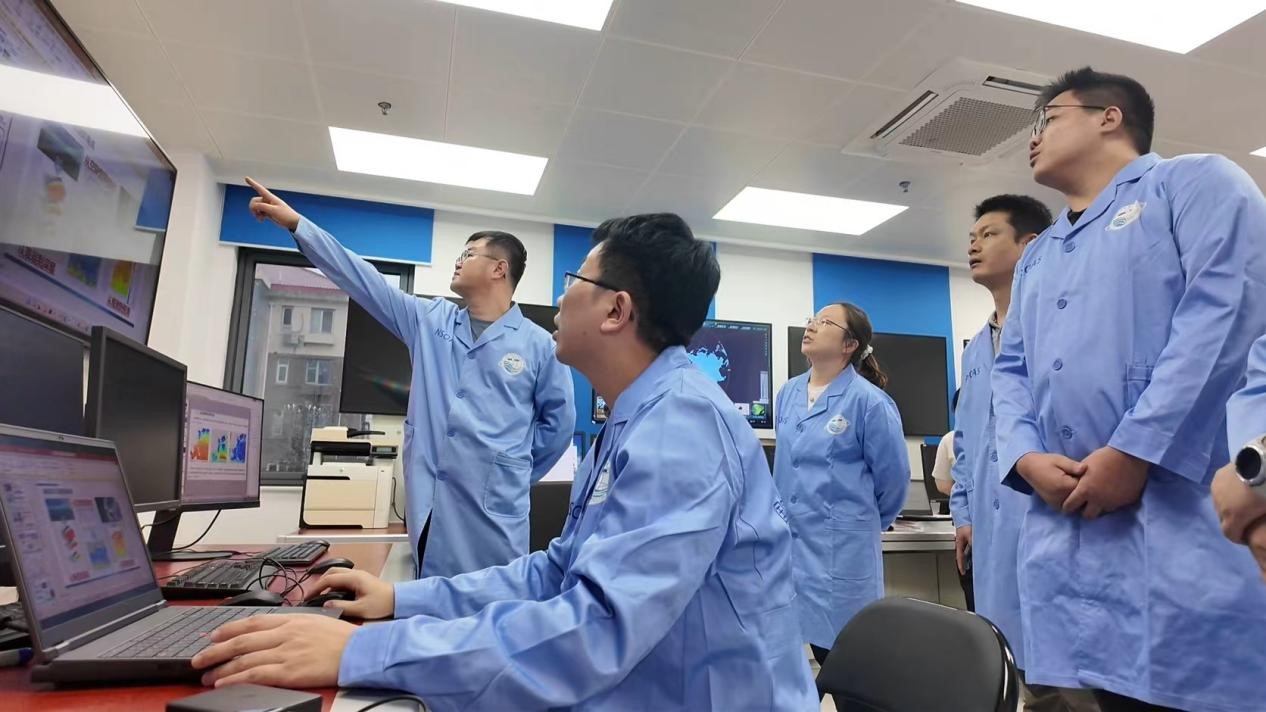
Staff at the National Satellite Ocean Application Service under China's Ministry of Natural Resources deploy the SkyOcean AI-based marine large model and conduct joint testing. (Photo courtesy of China's Ministry of Natural Resources)
China provides Pacific Island countries and their neighboring areas with ongoing remote sensing services for disaster monitoring. A visualization system for marine environmental forecasting and disaster prevention and mitigation in South Asia, developed by China for South Asian countries including Sri Lanka and Bangladesh, provides forecasting and early warning services for marine environmental conditions, maritime search and rescue, oil spill trajectories, and the transport of pollutants.
China has strengthened joint research with other countries to improve risk identification and prevention capabilities.
It has conducted basic marine geoscience research and comparative studies of geological hazards with ASEAN countries, advancing joint observations of earthquakes and geological hazards and carrying out in-depth research into the current status and mechanisms for controlling hazards such as land subsidence and seawater intrusion.
The country has worked with Central Asian countries to conduct research into technologies for monitoring glacier changes on the Pamir Plateau based on multi-source satellite observations. By sharing technologies, experience, and research findings, it has helped promote wider application of satellite remote sensing technologies in the region.
China has also shared knowledge and technologies with other countries to help strengthen their capacity to respond to disasters independently.
The marine disaster preparedness and mitigation affiliated center of the China-Pacific Island Countries Center for Disaster Risk Reduction Cooperation has continued to publish Sea Level Rise Status in Island States under Climate Change reports, sharing technologies for sea-level rise analysis, projection, and risk assessment.
In cooperation with countries including the Maldives and Madagascar on dynamic sea-level observation, coastal erosion assessment, and marine ecological restoration, China has also helped extend disaster prevention and mitigation cooperation beyond technological support to the development of local expertise and talent through professional training.
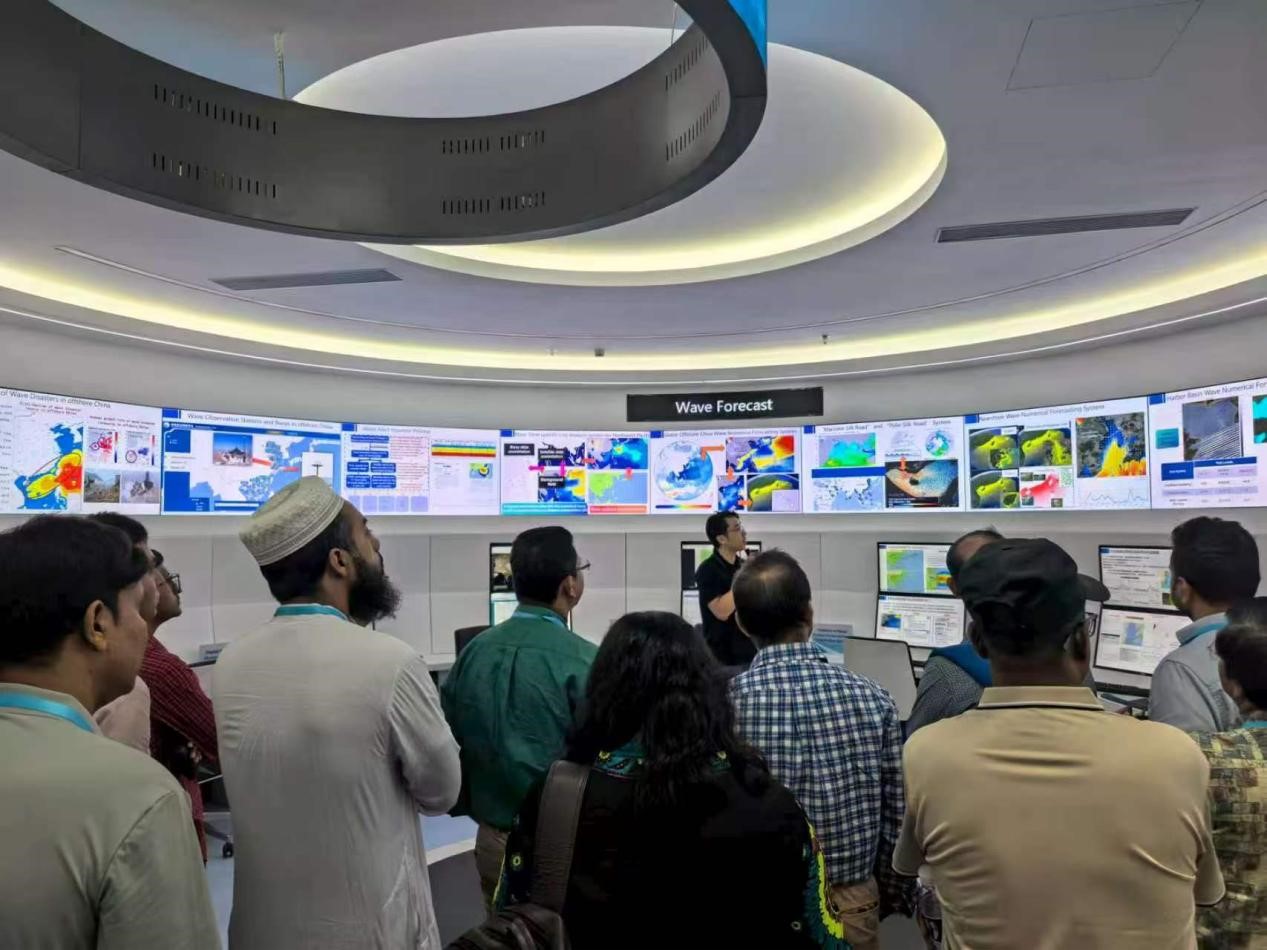
Bangladeshi partners attend a training session at China's National Marine Environmental Forecasting Center. (Photo courtesy of China's Ministry of Natural Resources)
Scientific and technological progress is a key driver of stronger disaster prevention and control capabilities, as well as an important pillar of deeper global cooperation in disaster risk reduction.
China continues to innovate in observation and monitoring technologies and early warning methods, independently developing a range of observation and monitoring equipment and an integrated observation and monitoring system spanning space, air, land, and sea.
By applying emerging technologies such as artificial intelligence (AI) and digital twins, China is also developing intelligent early warning models to support dynamic disaster risk assessments and accurate early warnings, providing support for science-based decision-making on coordinated disaster prevention and control.
As demand for cross-border cooperation on disaster prevention and mitigation continues to grow, China remains committed to openness and collaboration, helping various countries harness science and technology to strengthen their disaster prevention and mitigation capabilities.
It has also actively supported United Nations (UN) initiatives including the "Ocean Decade" (UN Decade of Ocean Science for Sustainable Development), the Decade of Action for Cryospheric Sciences, and the UN Decade on Ecosystem Restoration, promoting joint cross-border scientific investigations and collaborative research into disaster mechanisms, risk assessment, and prevention technologies.
A number of public goods developed by China, including the "MAZU" series of marine forecasting models, the "Jingwei" BeiDou-based multiparameter smart buoy, and the SkyOcean AI-based marine large model, have been introduced in neighboring countries and island nations to support marine disaster early warning.
Structural weaknesses remain in the international disaster risk governance system. The technological divide between developed and developing countries persists, barriers to cross-border data sharing have yet to be fully removed, and existing cooperation mechanisms still lack the foresight, systematic approach, and coordination needed to adapt to the evolving dynamics of natural disaster risks.
Looking ahead, countries should continue to build consensus and improve frameworks for cooperation.
They should promote the development of cross-border coordination mechanisms and strengthen cooperation in science and technology as well as capacity building under the guidance of the principles of extensive consultation, joint contribution, and shared benefits.
Sustained efforts should be made to strengthen global capacity to withstand multiple hazards, including geological, marine, and cryospheric disasters, and to jointly build a more resilient and sustainable global security shield.
(Chen Danhong is the director-general of the department of international cooperation of China's Ministry of Natural Resources. This article is based on an interview Chen had with People's Daily reporter Chang Qin.)