


China's trade surplus: A misunderstood narrative
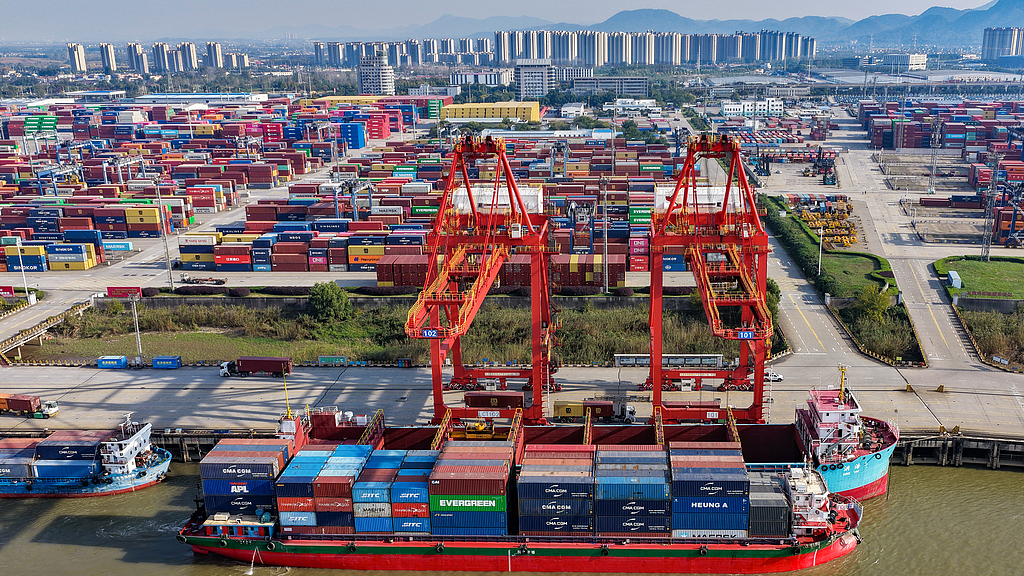
A view of a container terminal at Longtan Port in Nanjing City, east China's Jiangsu Province, November 10, 2026. (Photo: VCG)
Editor's note: Zhou Mi is a senior research fellow at the Institute of American and Oceania Studies of the Chinese Academy of International Trade and Economic Cooperation under the Ministry of Commerce.
A common misconception is that the closer an economy's ties with China, the larger its trade deficit with China will become, leaving it worse off. But this assumption does not reflect the complexity of international trade.
Among China's closest economic partners are the member states of the Association of Southeast Asian Nations (ASEAN). Vietnam, for example, has recorded strong economic growth in recent years. In the first three quarters of this year, its GDP grew by 9.95% year on year, making it one of the world's fastest-growing economies, according to Vietnam's National Statistics Office (NSO). The data also showed Vietnam's exports of goods increased by 24.5%, while imports rose by 36.7%.
Trade balances tell only part of the story
All those figures suggest that trade has been an important driver of Vietnam's economic expansion, giving businesses and consumers greater opportunities to leverage their respective strengths and participate in global markets.
A trade surplus or deficit is, in essence, an arithmetic measure. The factors behind these balances, as well as their economic implications, are far more complex. Vietnam's trade patterns offer a useful illustration. The United States was its largest export market, with exports reaching $140 billion in the first three quarters of the year, and China was Vietnam's largest source of imports, with imports totaling $187.3 billion over the same period, according to NSO. Vietnam's trade surplus with the US, the European Union and Japan continued to widen, while its deficits with China, South Korea and other ASEAN economies also increased.
These figures need to be understood in the context of comparative advantage and the division of labor in global supply chains. Trade is not simply a matter of one economy gaining at another's expense. While some countries export raw materials such as crude oil and mineral ores, much of today's international trade involves businesses combining resources, components and technologies from different economies to produce finished goods. This is particularly evident in Vietnam's trade structure.
Imports power exports through global supply chains
NSO data showed manufactured goods accounted for $392.8 billion, or 90.4%, of Vietnam's total exports. Meanwhile, materials and supplies for processing and manufacturing accounted for $426.9 billion, or 94.1%, of its imports. Within the import mix, machinery, equipment, tools and spare parts made up 58.3%, while raw materials accounted for 35.8%. This contrast between the composition of Vietnam's imports and exports helps explain the country's position in global supply chains: imported machinery, components and materials support domestic manufacturing, which in turn generates exports.
Rather than reflecting one economy taking advantage of another, this pattern demonstrates how international trade enables countries to make more efficient use of their respective resources and capabilities.
China, for its part, has continued to expand trade with its partners to deliver shared benefits. As a major trading economy, China has consistently upheld its commitments under international economic and trade arrangements, including the World Trade Organization (WTO). It provides equal treatment to products from WTO members, lowers tariffs on a range of imported goods and works with the relevant authorities in other countries to expand market access for agricultural products. This year, the Chinese government has also identified more balanced trade as a priority in its efforts to deepen economic and trade cooperation with its partners.
China's customs statistics reflect this trend. In the first three quarters of the year, imports increased by 22.3% year on year, with growth remaining above 20% since March.
China's imports create opportunities for global partners
Although China's economic structure and development model differ from Vietnam's, the underlying logic of international trade remains the same. China's vast domestic market generates substantial demand for imported goods, while the continued development of its advanced manufacturing sector is creating growing demand for key intermediate products.
In the first three quarters of the year, China's imports of storage components, integrated circuits, and aircraft parts and components increased by 150%, 56.6% and 17.6%, respectively. These imports support processing and manufacturing activities, helping produce goods for both domestic and international markets.
China's imports of raw materials and agricultural products also contribute to global supply and demand. During the first three quarters of the year, China's imports of metal ores exceeded 1.2 billion tonnes, while imports of crude oil and natural gas surpassed 400 million tonnes. Imports of Malaysian fresh durians, salmon from the Faroe Islands and Italian olive oil rose by 330%, 41.4% and 28.6%, respectively. These figures illustrate the breadth of China's demand for resources and consumer goods from around the world, as well as the opportunities its market offers to trading partners.
Beyond goods: Services and investment matter, too
China's approach to trade development also extends beyond trade in goods. According to China's Ministry of Commerce, three major pillars underpin the development of international trade: trade in goods, trade in services and digital trade.
Unlike in goods trade, China continues to run a deficit in trade in services. According to the Ministry of Commerce, China's trade in services totaled 5.77 trillion yuan (about $859 billion) in the first nine months, up 8.5% year on year. The country recorded a services trade deficit of 1.23 trillion yuan over the same period.
China has also made significant contributions to the global services market. It has made market-access commitments covering 100 subsectors and continued to expand the scope of its opening-up.
Ultimately, trade balances alone cannot capture the full picture of economic relations between countries. The scale and structure of trade, the integration of industrial and supply chains, and the broader flows of services and investment all matter. A more comprehensive assessment should also take into account the business operations of foreign-invested enterprises in China and the economic value they generate.
China stands ready to work with its trading partners to strengthen mutual trust, deepen trade cooperation and explore new opportunities for shared growth.