


Observer: Washington's chip curbs will only accelerate China's homegrown AI push

US lawmakers are pushing for tighter restrictions on China's access to advanced AI chips after former Nvidia CEO Jensen Huang's affair with a woman US officials suspect of links to Chinese intelligence, Reuters reported Friday.
China's Ministry of Foreign Affairs dismissed the spying claims as groundless smears and condemned the US for abuse of export control measures, stating it will disrupt the stability of global industrial and supply chains and serve no one's interests.
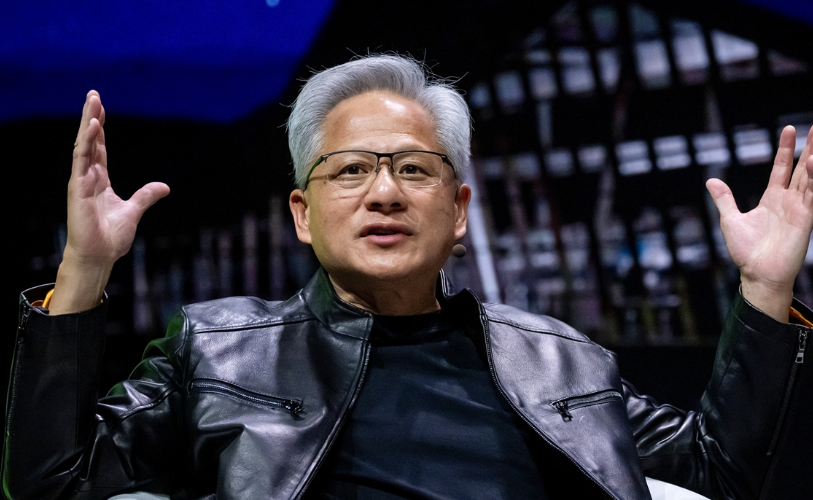
Jensen Huang, then chief executive officer of Nvidia Corp., speaks during the Nvidia GTC conference in San Jose, California, US, on March 18, 2026. (File photo: VCG)
Hong Yuan, researcher and secretary-general of the Center for American Military Studies at the Chinese Academy of Social Sciences, described Washington's narrative as a textbook case of chip-era McCarthyism: weaponizing a personal affair into a "national security breach" and fast-tracking executive discretion into hard statutory bans via the National Defense Authorization Act.
Factually, the case falls far short of any legislative threshold, Hong said.
"Yet before any judicial causality was established, Washington handed down a political conviction, substituting suspicion for proof, espionage for personal contact, and an industrial embargo for private conduct," he said. "The issue is not the cause of tighter controls, but a political catalyst."
Semiconductors are not a bilateral product. They depend on a highly specialized global network of design, manufacturing, equipment, materials, packaging and software. Broad and politically driven restrictions raise costs, reduce predictability and push companies and governments toward redundant, less efficient alternatives.
"Expanding export controls will shrink sales opportunities while driving up costs for product redesign, licensing approvals, and compliance," said Sun Chenghao, senior fellow at the Center for International Security and Strategy at Tsinghua University in Beijing.
He cited a US Semiconductor Industry Association report. It shows that in 2025, over 70 percent of US chipmakers' revenue comes from overseas, and between 2001 and 2024, research and development accounted for about 20 percent of their revenue, which means the scale of the global market is vital to their sustained innovation.
And for years, China has been the world's largest single consumer market for chips.
The US government's decoupling push will inadvertently accelerate China's drive toward technological self-reliance, said Liu Weidong, a research fellow at the Chinese Academy of Social Sciences' Institute of American Studies.
"AI capacity tightness continues to push mature node orders toward Chinese chip factories and restrictions are accelerating import substitution at the margin," Hong said, citing International Data Corporation data for the first half of 2026 that shows China's data-center AI accelerator shipments at 2.008 million units. With shipments down 44 percent, Nvidia's market share fell to 34 percent, while Huawei's Ascend share rose to 28 percent.
Even in mature nodes, domestic foundries are seeing strong momentum.
As China's largest contract chipmaker by revenue share, Semiconductor Manufacturing International Corporation (SMIC) saw its third-quarter net profit more than double year on year to $428.4 million from $191.8 million. Revenue rose 34 percent to a record $3.19 billion. The growth came from AI spillover.
Once Chinese companies rebuild their software, applications and talent ecosystems around alternative chips, the cost of switching back to US platforms will rise, Sun said.
"What US companies stand to lose could be customers and technological influence for years to come."