


Xi's address offers China's answer in writing Asia-Pacific miracle
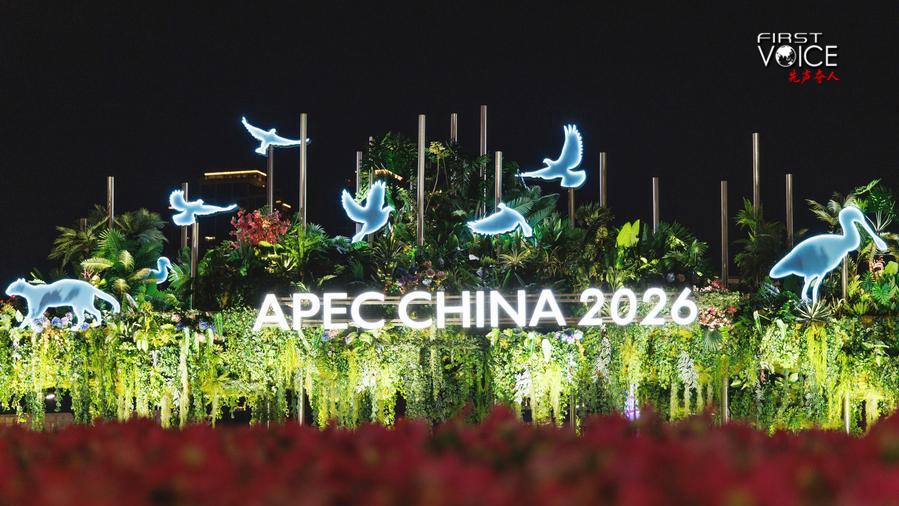
An APEC-themed installation on Xiangmihu Road in Shenzhen, Guangdong Province, China. (Photo: Xinhua)
Editor's note: CGTN's First Voice provides instant commentary on breaking stories. The column clarifies emerging issues and better defines the news agenda, offering a Chinese perspective on the latest global events.
Chinese President Xi Jinping's address at the APEC Economic Leaders' Meeting in Shenzhen, south China, presented China not merely as a participant in Asia-Pacific cooperation, but also as its advocate, promoter and forerunner.
The world is undergoing significant changes where technological change is accelerating, the growth momentum is uneven, and protectionism is gaining ground. This has evoked real anxiety across the Asia-Pacific. The region has long benefited from open trade, integrated supply chains, mobile capital, and cross-border technological exchange. Any retreat into fragmented markets, export controls, and rival blocs would impose punitive costs on economies both large and small.
Against this backdrop, Xi's message is clear: Asia-Pacific economies should choose integration over division. He urged regional players to build a community based on solidarity, openness, innovation, and inclusive development. These are not neutral words. They are a hedge to economic decoupling, technological exclusion, and the use of commercial ties as instruments of geopolitical pressure.
Xi emphasized China's role as an advocate, promoter and forerunner in Asia-Pacific economic cooperation, ready to work with all to build the pillars that support an Asia-Pacific community. He also announced a package of measures to give it institutional substance.
China pledged $20 million for practical APEC cooperation, promised to establish a center for Asia-Pacific community studies in Shenzhen, and pledged to create cooperation mechanisms in digital technology, cross-border data flows, clean energy, and small and medium-sized enterprise development.
These are not trivial commitments. China's economic scale gives it unusual capacity to shape regional outcomes. It is a major trading partner for much of Asia, a central node in regional manufacturing and supply chains, and an increasingly important source of infrastructure, digital technology, and green-energy investment.
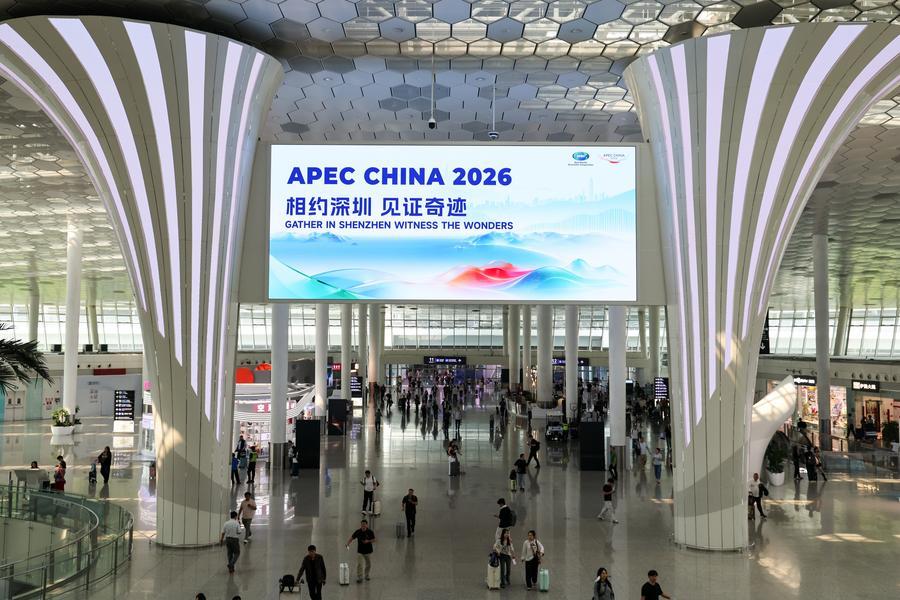
An APEC-themed digital poster at the Shenzhen Bao'an International Airport in Shenzhen, Guangdong Province, China. (Photo: Xinhua)
The four pillars Xi mentioned in his Thursday address – trade, connectivity, innovation, and development – give Asia-Pacific cooperation operational content. On trade, he called for steady progress toward the Free Trade Area of the Asia-Pacific (FTAAP), greater alignment of regional agreements, improved trade facilitation, digitalization, and fewer barriers to investment.
This is significant because the FTAAP has long been one of APEC's most important goals. APEC has repeatedly affirmed the need to advance it, and China's proposal to promote policy dialogue, capacity building, and technical cooperation can help translate aspiration into incremental progress.
On connectivity, Xi's distinction between "hard," "soft," and "heart" connectivity is especially relevant. Physical infrastructure, regulatory coordination, cross-border payments, and people-to-people exchange all matter.
The innovation agenda is equally consequential. Xi called for stronger digital infrastructure, regional data governance, secure cross-border data flows, and wider use of artificial intelligence. These are areas in which China possesses real strengths, from telecommunications equipment and electric vehicles to solar manufacturing and digital platforms. If Chinese cooperation helps smaller economies adopt clean-energy technologies, expand digital access, and develop local industries, it can make a material difference.
The pillar of development matters in responding to emerging global challenges. Xi urged supporting livelihood improvements and investing in the people, launching healthy aging programs, facilitating employment and the development of vocational skills, and supporting women's economic empowerment and young talent exchanges to tap into the full potential of talent across the Asia-Pacific. After all, people and their livelihood improvement is the ultimate goal of Asia-Pacific cooperation.
Xi's speech is a rejection of fragmentation. It recognizes that the Asia-Pacific's future depends on cooperation. The region needs stronger trade links, better infrastructure, greener growth, and more inclusive digital development and China has both the capacity and the incentive to help deliver these outcomes.
The Asia-Pacific does not need one single patron. It needs a stable order in which major powers compete within rules, cooperate on shared challenges, and accept that smaller states have the right to choose their own partnerships. This is China's vision, offered through Xi's speech.