


Time for Takaichi to retract her erroneous 'survival-threatening situation' remarks
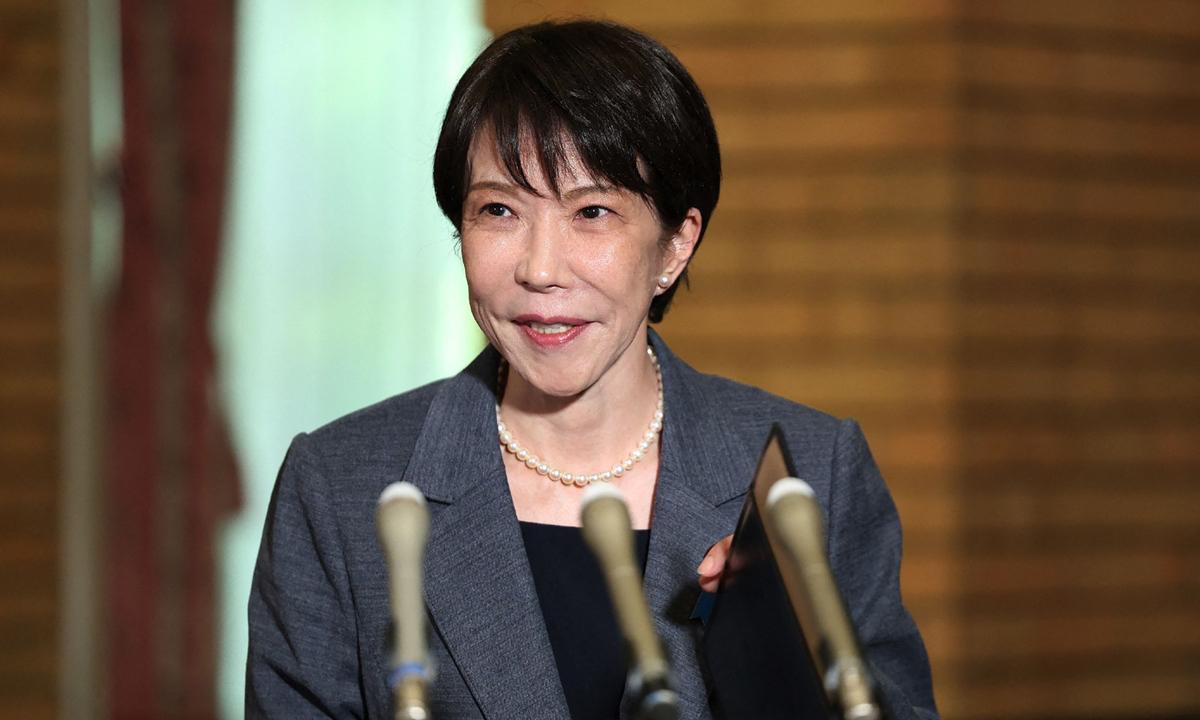
Japanese Prime Minister Sanae Takaichi speaks to reporters ahead of her departure for a tour of Europe at the Prime Minister's Official Residence in Tokyo on June 13, 2026. Photo: VCG
On November 19, Japanese Prime Minister Sanae Takaichi held a press conference after attending the APEC Economic Leaders' Meeting in Shenzhen, reiterating that Japan's basic position on the Taiwan question remains consistent with the 1972 Sino-Japanese Joint Statement and emphasizing that "there has been absolutely no change to this position."
She also said that "China is an important neighboring country," that the status of the four political documents as the "basic documents on Japan-China relations" remains unchanged, and that Japan is willing to comprehensively advance a strategic relationship of mutual benefit through dialogue and build "constructive and stable" China-Japan relations.
However, when asked about with her erroneous remarks a year earlier that the Chinese mainland's "use of force on Taiwan" could constitute a "survival-threatening situation" for Japan, Takaichi continued to evade the question, saying that "she could not comment on hypothetical scenarios."
The core principles of the Sino-Japanese Joint Statement are clearly set out in black and white: The Government of Japan recognizes that the Government of the People's Republic of China as the sole legal Government of China. The Government of the People's Republic of China reiterates that Taiwan is an inalienable part of the territory of the People's Republic of China. The Government of Japan fully understands and respects this stand of the Government of the People's Republic of China, and it firmly maintains its stand under Article 8 of the Postdam Proclamation. This statement, together with the other four political documents, including the Treaty of Peace and Friendship between China and Japan, forms the political foundation for the normalization of diplomatic relations between the two countries.
These are commitments that both countries must uphold in their bilateral relations and an important part of the postwar international order.
Linking a "contingency in Taiwan" to a "survival-threatening situation" for Japan and implying that Japan might exercise its right to collective self-defense directly undermines the framework established by the 1972 Sino-Japanese Joint Statement and seriously deviates from the postwar international order that Japan, as a defeated nation in World War II, is obliged to observe. If Japan's position on the Taiwan question is truly consistent with the Sino-Japan Joint Statement, it should acknowledge its mistake and publicly retract the provocative claim that "a Taiwan contingency is a Japan contingency."
On the same day, the leaders of China, Russia and the US held a historic trilateral meeting in Shenzhen and issued the China-Russia-US Heads of State Declaration toward Peace. All three leaders recalled the history of their countries fighting side by side during World War II, sending an important signal of their shared commitment to safeguarding the postwar international order - a message that Tokyo should take note of. The core documents underpinning the postwar international order include the Cairo Declaration and the Potsdam Proclamation, which made clear that Japan must return the Chinese territories it had seized, including Taiwan. Japan accepted the Potsdam Proclamation and surrendered unconditionally, and subsequently reaffirmed its commitment to adhering to Article 8 of the proclamation in the Sino-Japan Joint Statement. Any remarks that directly link the Taiwan question to Japan's security, or even imply possible military intervention, constitute an open challenge to the outcomes of the victory in World War II and the postwar international order.
China-Japan relations remain strained over remarks concerning Taiwan, with tensions already affecting economic and trade ties, people-to-people exchanges and other areas. Takaichi has emphasized dialogue and a strategic relationship of mutual benefit, but her words must be matched by actions. If she sincerely wishes to improve China-Japan relations, retracting her erroneous remarks should be the first step. Otherwise, merely repeating that Japan's "position remains unchanged" without making substantive corrections will do little to inspire confidence or benefit Japan itself, or contribute to lasting peace and stability in the region.