


Beneath a burning sky: Unforgettable WWII memories beyond Singapore
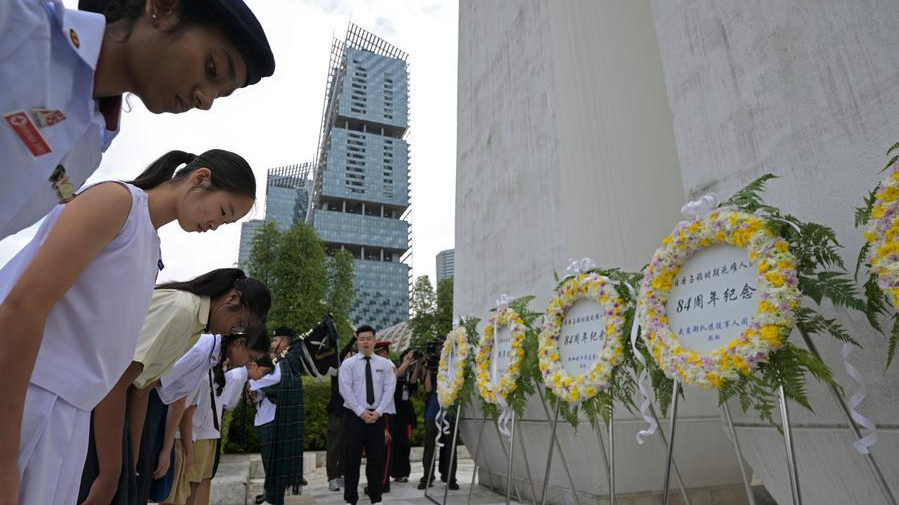
Students bow during a ceremony at the Civilian War Memorial in Singapore to commemorate civilians who died during Japanese occupation of the country, Singapore, February 15, 2026. (Photo: Xinhua)
"It was all dark and Singapore looked like a ball of fire. So many ships were sunk, I saw the wreckage floating all over the place." These are the words of a refugee who fled by boat after Singapore fell to Japanese invasion in 1942.
Japanese militarism inflicted untold suffering and pain on the people with their air raids, occupation, purges and torture. Recently, a film, a book and an exhibition in Singapore relived the wartime memories. The animated film The Violinist tells the story of two childhood friends and violin prodigies bound together by music, who were separated and saw their dreams shattered after the Japanese army invaded Singapore. The book Remembering Syonan is carefully curated from 80 artifacts including letters and identity papers, from occupied Singapore, reconstructing the fear, struggle and suffering of ordinary people during the Japanese occupation.The revamped Singapore History Gallery at the National Museum of Singapore documents the history of a nation that endured immense hardship and rose up in resistance during the occupation.
The flames of war burned down the lives of ordinary people, leaving devastation, death and broken families in their wake. After Singapore fell, the Japanese army carried out a large-scale "Sook Ching" (purge) operation in the name of "eliminating anti-Japanese elements." Every Singaporean Chinese man between 18 and 50 years was forced to undergo"screening"; tens of thousands of civilians were arbitrarily labeled "suspicious elements" and taken to beaches and the countryside, where they were cruelly killed. Large numbers of laborers were conscripted by force, and many of them died of hunger, disease, abuse and overwork.
The Japanese forces also plundered strategic resources on a massive scale. Theyforced the Chinese community to pay a "military contribution" (hōnōkin), and printed "banana money" - the Japanese government-issued dollar that got its name from the banana tree motif printed on the $10 banknote. Printed in huge quantities, it became worthless after Japan’s defeat and bankrupted the nation. The National Museum of Singapore displays ankle rings, spectacles, bullet casings and other items recovered from mass graves, each imbued with the traumatic collective memory of the local people.
The flames of war also burned down national dignity, erasing culture and humiliating the people. The Japanese renamed Singapore "Syonan-to," set up numerous "comfort stations" across the island where local women were forced to become "comfort women" for the troops, a euphemism for sex slaves. Those who resisted were tortured, and those who became pregnant or fell sick were executed as they had "lost their value." An illustration in the book depicts local women stripped naked and abused to death by Japanese soldiers.
And the atrocity did not end there. The Japanese army also established "Unit Oka 9420" in Singapore, a southeast Asian branch of the notorious Unit 731 on the Chinese mainland, which carried out torturous "experiments" on live human subjects. It cultivated plague-infected fleas, conducted experiments on civilians and prisoners of war, and deployed biological weapons, causing heavy civilian casualties. Inside Unit 731: Japan's Secret Human Experiments, a documentary produced and broadcast in Singapore, uncovered this chapter of history that had been deliberately concealed.
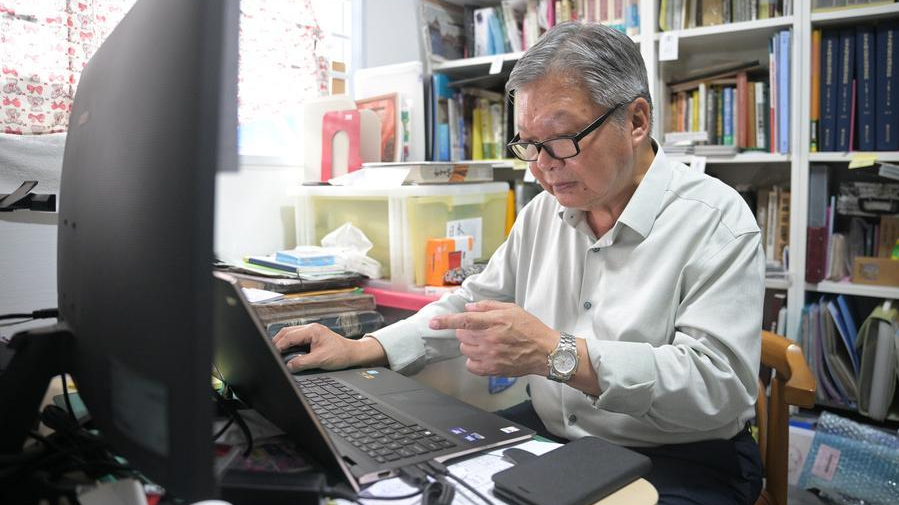
Singaporean historian Lim Shao Bin reviews historical materials at his home in Singapore, July 31, 2026. (Photo: Xinhua)
Japan's war of aggression also caused more than 35 million military and civilian casualties on the Chinese mainland; the Nanjing Massacre alone claimed the lives of over 300,000 civilians and unarmed soldiers. In the Philippines, more than 100,000 people died in the Manila Massacre within a month. In Indonesia, hunger, forced labor and massacres killed about four million Indonesians. In Malaysia, the PenangWar Museum still preserves evidence of the Japanese army's forced recruitment of "comfort women."
In Myanmar and Thailand, the 415-kilometer Thai-Burma "Death Railway" left more than 100,000 laborers dead- about 360 deaths per kilometer, the equivalent of two to three lives lost for every 10 meters of track laid. In Vietnam, about two million people starved to death between 1944 and 1945 under the Japanese army's brutal plunder. All these recorded histories together still fail to reveal the full extent of the shared memory of Asia's invaded countries.
Today, those dark and troubled years are being recreated through the memories of the people who lived it and historical relics. The Violinist has gained international recognition and won several major awards.In an interview, its director said many people left comments on social media, saying they were deeply moved. Many Korean viewers said the colonial trauma and Singaporeans'strong determination to resist aggression evoked a powerful resonance. Visitors have been streaming through the Singapore History Gallery, pausing before the mass grave relics to look back on that long-buried chapter of unspoken sufferings. More and more young people want to learn about that part of history because it is their own country's past, written in pain, blood and tears. History should not, and must not, be forgotten.
While the victims' scars remain, the perpetrators are trying to gloss over their crimes. The war may be over, but the specter of Japanese militarism continues to haunt the region. This year marks the 80th anniversary of the opening of the Tokyo Trials. At a time when history's lessons should be reviewed and reflected upon, Japan's right-wing forces have disregarded the verdicts of the Tokyo Trials, attempted to deny and even beautify the history of aggression, and openly worshiped Class-A war criminals of World War II. They have also accelerated "remilitarization" to break through the constraints of the postwar order. This should sound a warning bell to the region, as safeguarding peace and preventing the flames of war from re-igniting is the shared aspiration of all peace-loving people in Asia.