


Yu Zidi named MVP as China tops Asian Games medal table with record overseas haul
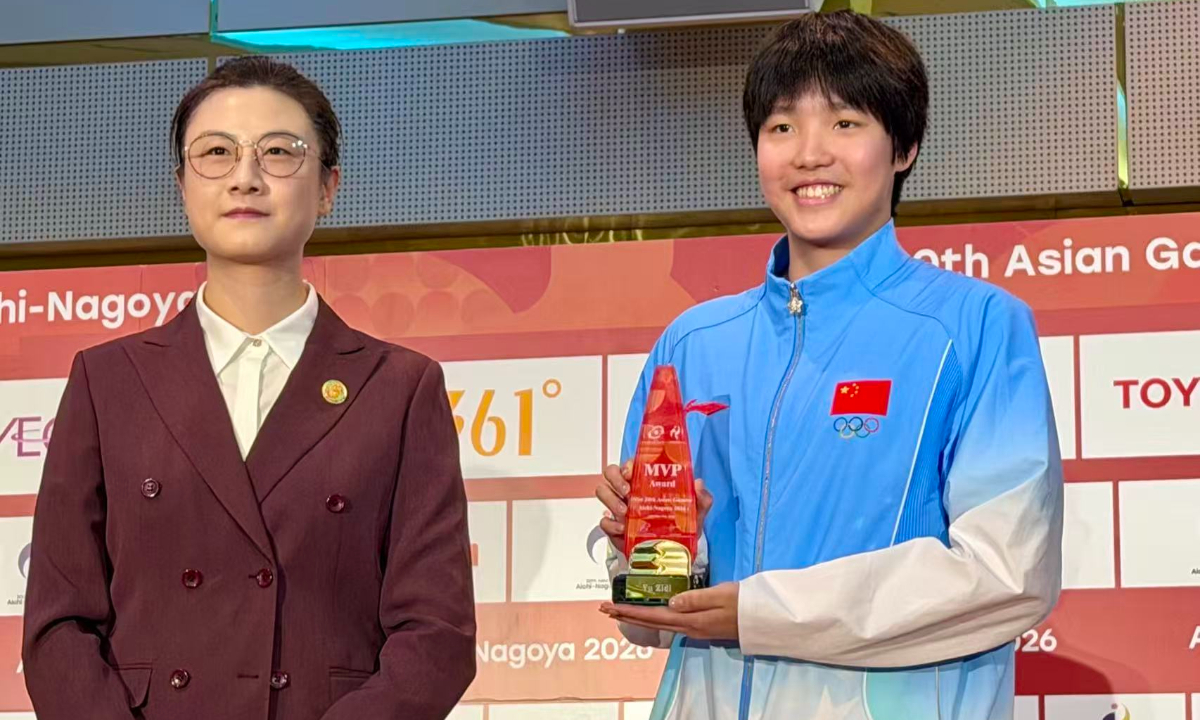
China’s Yu Zidi (right) receives the Female MVP award at the Asian Games on October 4, 2026, in Nagoya, Japan. (Photo: Tao Xiang’an/People’s Daily)
Chinese swimming prodigy Yu Zidi was named the female Most Valuable Player of the Aichi-Nagoya Asian Games on Sunday, adding another distinction to a standout campaign as China completed the Games with a record 169 gold medals and becoming the youngest MVP in Asian Games history.
The 13-year-old Yu won three individual titles in the women's 200-meter butterfly, 200m individual medley and 400m individual medley. Her 2:06.10 in the 200m individual medley set a new Asian record, while her 2:05.08 in the 200m butterfly was an Asian Games record.
"As a young athlete, being named the MVP is both an affirmation and an encouragement. I will continue to train hard, challenge myself and strive for further breakthroughs," Yu said at the awarding ceremony.
"I hope to work together with young athletes from across Asia to create more exciting competitions and inspire more young people to love sports and take part in swimming."
Yu was selected alongside Thailand's Puripol Boonson, who was named the male MVP after winning both the men's 100m and 200m in athletics. Boonson clocked 19.88 in the 200m to equal the Asian record set by China's Xie Zhenye in 2019.
Boonson's selection also meant that China's another swimming sensation, Zhang Zhanshuo, missed out on the male MVP award despite the 19-year-old winning a record of seven gold medals, becoming the first swimmer in Asian Games history to achieve the feat.
But Yu's recognition capped a highly successful Games for China, which finished first in the medal table for a 12th consecutive Asian Games. The Chinese delegation collected 169 gold, 89 silver and 83 bronze medals, with the gold-medal total setting a new record for China at an Asian Games held outside the country.
China's previous best gold-medal haul at an overseas Asian Games was 165 at the 2006 Doha Games.
The comparison also came despite changes in the size of the competitions: Doha featured 39 sports and 424 events, while Aichi-Nagoya had 43 sports and 469 events. China competed in 38 sports and 369 events in Japan, compared with 37 sports and 362 events in Qatar.
The breadth of China's performance was highlighted by results across both established and emerging disciplines.
Along with the swimming sensations, other young Chinese athletes also made their mark. Seventeen-year-old Chen Yujie won the women's 100m in a Games-record 11.06 seconds, while 18-year-old javelin thrower Yan Ziyi won gold with a throw of 70.46 meters, defeating Olympic champion Haruka Kitaguchi of Japan.
China also finished the Games with a notable result in men's football.
The Chinese men's under-23 team defeated Uzbekistan on penalties in the bronze-medal match, claiming China's first Asian Games men's football medal since the competition introduced an age limit in 2002, and its first medal in the event in 28 years.
The football result added to a Games in which China produced both continued dominance in traditional strengths and breakthroughs in other areas.
Sailing athlete Bi Kun was named China's flag bearer for the closing ceremony after successfully defending his men's iQFOiL title. The victory gave him a third consecutive Asian Games gold medal. He won the RS:X title at Jakarta 2018 before switching to the iQFOiL class and winning at both Hangzhou 2022 and Aichi-Nagoya 2026.
The closing ceremony is scheduled to take place Sunday evening at Mizuho Park Athletic Stadium, bringing an end to the 20th Asian Games.