


BEIJING, April 5 (Xinhua) -- At a primary school in central Beijing, students spilled onto the sunlit playground during lunchtime for a spirited football match in the "Class Super League."
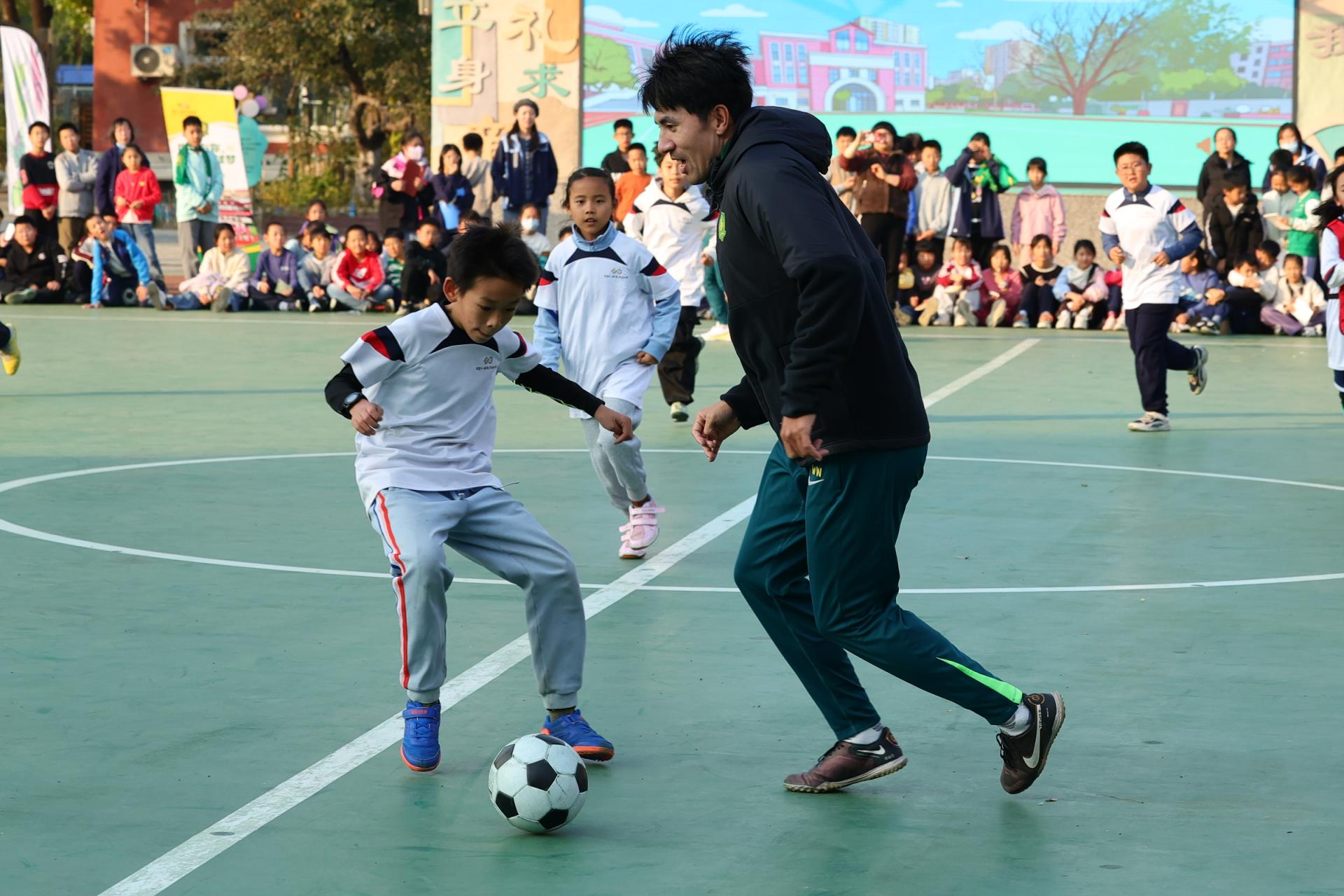
(Photo: Beijing Daily)
The atmosphere was electric: players darted and tackled with fierce determination, while the cheer squad's chants rose in thunderous waves. Parents tracked every moment in a busy WeChat group, trading play-by-play comments and photos as they followed the game's unfolding drama.
Hu Yixuan, the goalkeeper for a sixth-grade class team, lived up to expectations -- saving decisive shots in the penalty shootouts of two consecutive matches to send his team into the semifinals. After the final whistle, he couldn't hold back his tears; teammates swarmed to embrace him. "The victory makes us more united than ever," the boy said emotionally.
From the classroom to the playing field, China is sparing no effort to promote the physical and mental well-being of students through sports endeavors -- recent data showed that about one-fifth of Chinese youth aged 6 to 17 were overweight or obese, and the overall myopia rate among children and adolescents exceeded 50 percent.
According to education experts, consensus on integrating sports and education has further solidified in China, and policy momentum has arrived in successive waves.
Over the past five years, measures have progressed from allowing athletes to serve as school coaches to ministries creating conditions for the employment of retired athletes, culminating in last November's release of the "20 measures" on daily physical activity time, sports competitions, sports talent development, and more.
Last month, Education Minister Huai Jinpeng said that China had rolled out an initiative for 15-minute inter-class breaks and two hours of daily physical activity for primary and junior high school students across all provincial-level regions.
The country will further advance the campaign to strengthen students' fitness by creating PE classes that students enjoy and promoting basketball, football and volleyball matches across campuses, Huai added.
The "Class Super League," a flagship initiative of the school sports effort, is more than just a football league. Rather, it covers all class-based competitions, from basketball and volleyball to swimming and shuttlecock kicking, ensuring that every student participates in at least one collective or team competition each semester.
Statistics show that in the first half of 2025, 99.7 percent of Beijing's primary and secondary schools held various class-based competitions -- a total of 194,000 matches, with around 5 million student participations. This spring semester, primary and secondary schools in the capital have launched the citywide "Class Super League," planning some 400,000 matches for the year.
Rongjiang County in Guizhou Province, southwest China, is the birthplace of the "Village Super League." In 2024, the county hosted the inaugural national "Class Super League" and has since expanded the effort. Now, schools in the county have "matches almost every week and sports activities every day," according to local authorities.
They believe that sports games can ease schoolwork pressure for children, and help them become less dependent on mobile phones and embrace life more positively.
"After children get involved in football, we can sense the joy, confidence, and happiness that radiate from within them," said Yang Yajiang, Party chief of a primary school in Rongjiang.
Li Xuemei, principal of Jinghua Experimental School in Beijing, said that the sports competitions have offered students opportunities to strive together, laugh together, and play together. "It helps build strong relationships among children and creates a positive environment for youth development."
Parents also find that on weekends and holidays, their children exercise more proactively. Data back up the change -- at the Experimental Primary School of Beijing Normal University, the share of students rated excellent or good in physical tests has risen to 95 percent, up 9 percentage points since 2021.
Professional sports resources are also converging on campuses. Hainan, for example, is bringing in professionals from sports associations and clubs to campuses.
In February this year, national table tennis team athletes such as Wang Chuqin and Wang Manyu competed alongside students at a high school in Haikou, capital of Hainan. "It's nerve-wracking and exciting to play with professional athletes," said student Xing Bojun.
In Beijing, intensive high-level sporting events have also provided children with a "second classroom" for sports.
During the halftime breaks of Chinese Super League matches, primary school students showcased their shooting skills on the professional pitch of Beijing Workers' Stadium. On the stands of the China Open, a primary school PE teacher took advantage of the breaks between matches to explain the history of tennis and its scoring rules to the students watching the game.
In 2023, the General Administration of Sport of China and several other departments jointly issued guidelines on establishing coach positions in schools, aiming to integrate sports and education and strengthen school sports capacity.
According to the guidelines, compulsory education schools, high schools, vocational schools, and institutions of higher learning may establish full-time and part-time coach positions, which will be responsible for after-school training, school team-building, and other tasks.
"The key measure is to open up channels for retired athletes and social sports instructors to enter schools and communities," said Zhao Kunyu, a national political advisor.