


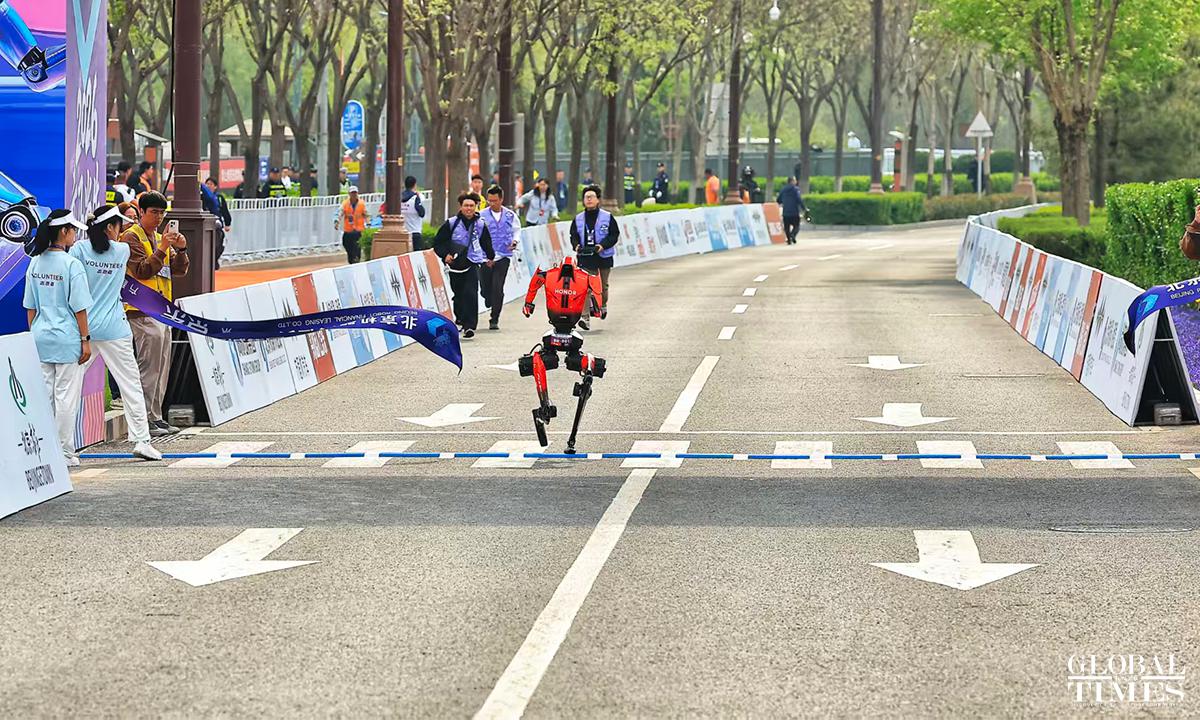
Honor's "Lightning" crosses the finish line at the 2026 humanoid robot half marathon on April 4, 2026. (Photo: Li Hao/GT)
The second humanoid robot half marathon took place in Beijing E-Town on Sunday. More than 100 robot teams participated, including five international teams. A total of 26 brands and more than 300 humanoid robots competed, official data showed.
Honor's "Lightning," the first robot to set off, won the title with a net time of 50 minutes and 26 seconds, according to a WeChat account affiliated with Yizhuang.
The improvement was dramatic. At the 2025 World Humanoid Robot Games, the winning robot, Tiangong Ultra, completed the race in 2 hours, 40 minutes and 42 seconds, according to CMG.
Robots that participated the event include Honor's Yuanqi Zai and Lightning, Unitree's H1, Tiangong 1.0 Ultra, Tiangong Ultra-2026, Tiangong Ultra-2025 and Noetix Robotics' B2.
Experts said that while the inaugural event focused more on validating technical feasibility, this year's competition emphasizes the industry's overall maturity. The contest has shifted from showcasing isolated technical breakthroughs to testing end-to-end capabilities, as related technologies move out of laboratories and tinto more complex, real-world application scenarios — a sign that the sector is evolving from proving whether it can be done to competing over how well it can be done, they noted.
Global Times reporters on-site observed a marked leap in both speed and running posture among humanoid robots compared with the inaugural event. Crowds repeatedly gasped as the machines sprinted past, visibly struck by their pace and fluidity. In contrast to last year, when many robots struggled to maintain balance at the start, nearly all entrants this year executed clean, stable takeoffs.
According to the participating companies, the humanoid robots entered in this year's race have undergone major upgrades from the previous edition, including improvements in terrain adaptability, endurance and anti-interference capabilities.
Beijing Humanoid Robot Innovation Center Co's embodied Tiangong ULTRA-2026, winner of the 100-meter title at the 2025 World Humanoid Robot Games, has returned to the track with a focus on high-speed running, complex-terrain adaptation, autonomous navigation and strong anti-interference capabilities, according to the company.
Honor, the first consumer device maker to field a humanoid robot half-marathon runner, brought its self-developed Lightning robot, which stands 1.69 meters tall and features a mecha-style design built for explosive speed.
Songyan Dynamics, runner-up in the previous edition, has sent six autonomous-navigation teams and six remote-controlled teams, all equipped with its self-developed full-size humanoid robot B3, which stands about 2 meters tall and uses a 72-volt high-voltage platform and a water-cooled motor system, the company told the Global Times in a statement.
Also, Unitree's H1 robot, which posted multiple strong results at the 2025 World Humanoid Robot Games, has been optimized for long-distance racing with upgrades to endurance, gait-control algorithms and anti-interference performance.
On April 11, Unitree released a video showing the H1 running 100 meters at a speed of 10 meters per second — close to the peak human sprint speed of 10.44 meters per second set by Jamaican legend Usain Bolt during his 9.58-second world-record run.
The event is about five times the size of the inaugural edition and, for the first time, has attracted five international teams from countries including France, Germany and Brazil.