


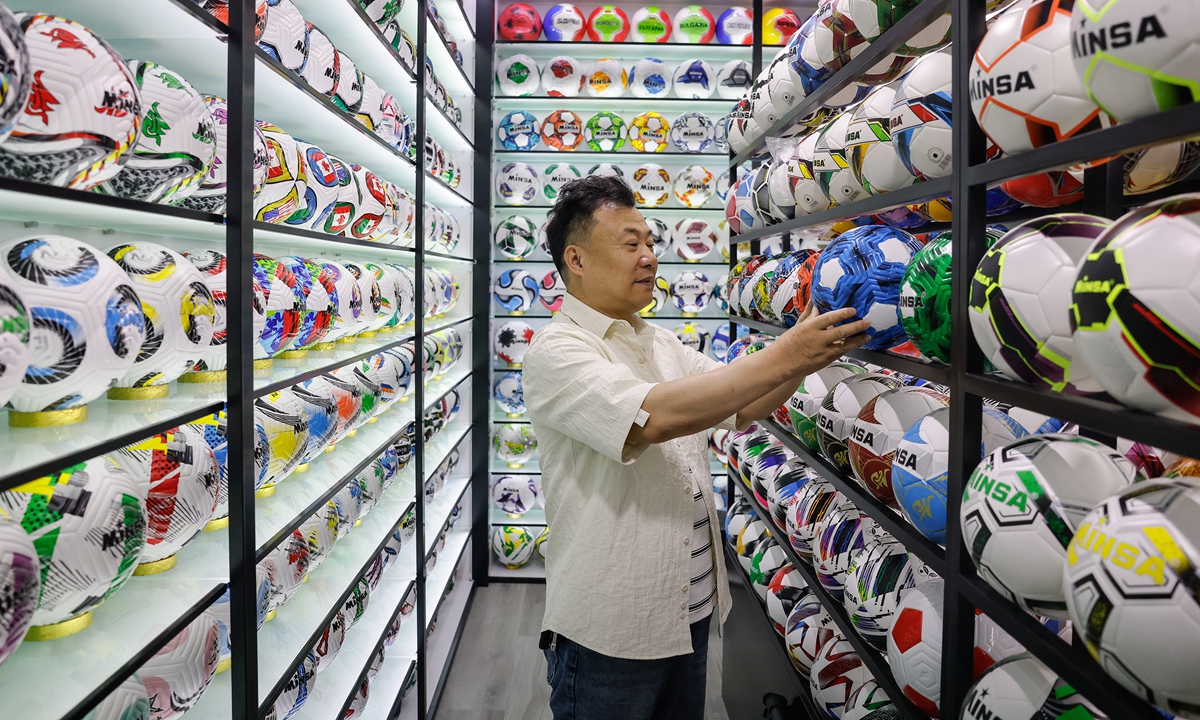
A Chinese vendor checks a football at the Yiwu International Trade Market in Yiwu, East China's Zhejiang Province on April 19, 2026. Photo: VCG
With the kickoff of the 2026 FIFA World Cup fast approaching, negotiations over broadcasting rights in China, one of the tournament's largest potential markets, remain unresolved, raising growing attention among fans and industry observers.
On Chinese social media, some Chinese fans and commentators have wondered whether the world football governing body FIFA has raised the price of the broadcasting rights for China's state broadcaster China Central Television (CCTV).
According to a national notice issued in 2015 by the State Administration of Press, Publication, Radio, Film and Television, CCTV holds the exclusive right to negotiate and purchase the FIFA World Cup broadcasting rights for the Chinese mainland. The state broadcaster had not made any official statement concerning the issue as of press time on Tuesday.
With the tournament less than six weeks away, the absence of a finalized broadcast deal in China is unusual. However, the organization was shy about directly addressing the pricing question when reached by the Global Times on Tuesday.
"Discussions in China regarding the sale of media rights for the FIFA World Cup 2026 are ongoing and must remain confidential at this stage," a FIFA spokesperson said in an emailed response to the Global Times on Tuesday without elaborating any further.
Historically, CCTV has secured World Cup rights well in advance. For previous editions, agreements were typically concluded early enough to allow for extensive promotion and advertising campaigns.
Industry analysts suggest that rising costs of sports media rights may be a key sticking point. In recent years, fees for major international tournaments have surged, forcing broadcasters to weigh commercial returns more carefully.
Trending domestic social media posts indicate that no broadcast partner has yet been secured in the country, adding to concerns about potential viewing disruptions. Some Chinese fans also strongly question whether FIFA has increased the price of the broadcast deal to make more money.
The expanded tournament, set to begin on June 11 in the US, Canada and Mexico, will feature 48 teams and a record 104 matches. However, the Chinese national team will not play in the 2026 World Cup, as it was eliminated in the Asian qualifiers in June 2025.
During the 2022 World Cup, Chinese audiences accounted for nearly half of global digital viewing hours, highlighting the scale of its fan base and commercial importance.
Viewers are sensitive about pricing and access issues, as previous issues of matches being placed behind paywalls has caused backlashes, as was the case for online live-stream platform iQiyi broadcasting the Chinese national team's World Cup qualifiers in 2024 and 2025.
The situation is not unique to China. FIFA is also facing difficulties in other major markets such as India, where negotiations have reportedly stalled over pricing expectations.