


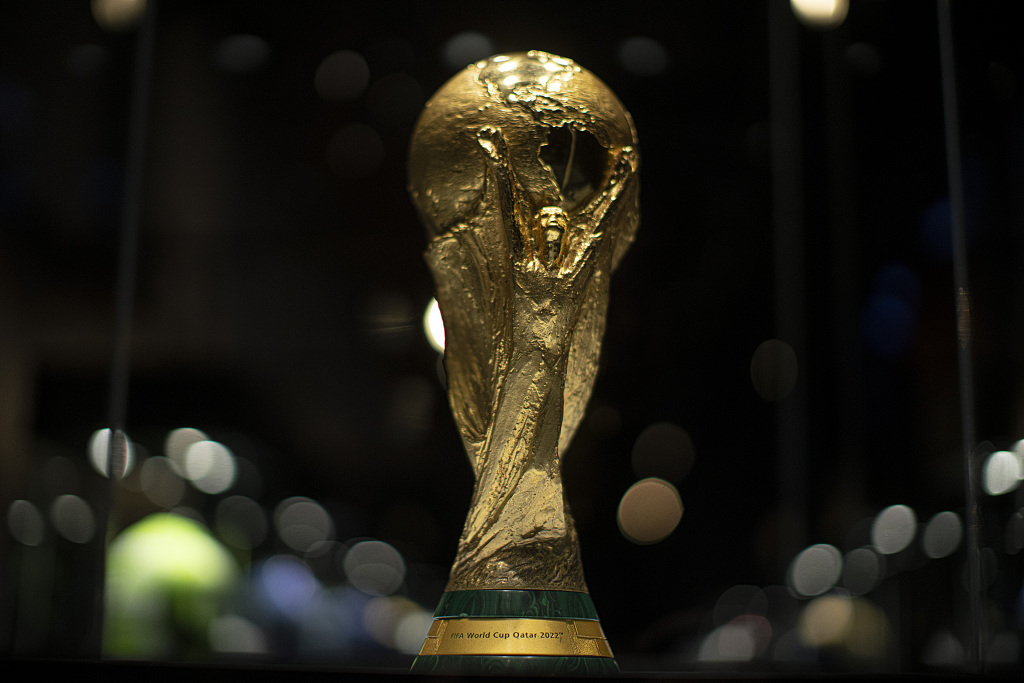
The FIFA World Cup championship trophy on display in Buenos Aires, Argentina, April 5, 2023. (Photo: CFP)
On Wednesday, multiple Chinese media outlets, citing the Beijing Daily, reported that FIFA had initially offered China Central Television (CCTV) World Cup broadcasting rights worth $250-300 million, prompting widespread skepticism. FIFA responded to the Global Times on Tuesday that negotiations with CCTV were ongoing as a reply to the Global Times inquiry.
The Beijing Daily reported that FIFA initially quoted CCTV between $250 million and $300 million, while CCTV's budget was likely in the range of $60 million to $80 million. Even after FIFA reportedly lowered its asking price to around $120 million to $150 million, a substantial gap remained between the two sides' expectations.
No response has been seen from CCTV as of press time.
Over the past two decades, the cost of World Cup broadcasting rights in China has surged dramatically. By comparison, the combined rights for the 2010 and 2014 tournaments were sold for about $115 million, while the 2018 and 2022 editions together cost roughly $300 million. Beyond the steep price increases, another source of discontent among Chinese fans is that FIFA reportedly offered India a package deal for two World Cups at only $35 million — far lower than the price quoted to China.
With the kickoff of the 2026 FIFA World Cup fast approaching, negotiations over broadcasting rights in China, one of the tournament's largest potential markets, remain unresolved, raising growing attention among fans and industry observers.
On Chinese social media, some Chinese fans and commentators have wondered whether the world football governing body FIFA has raised the price of the broadcasting rights for CCTV recently.
With the tournament less than six weeks away, the absence of a finalized broadcast deal in China is unusual. However, the organization was shy about directly addressing the pricing question when reached by the Global Times on Tuesday.
"Discussions in China regarding the sale of media rights for the FIFA World Cup 2026 are ongoing and must remain confidential at this stage," a FIFA spokesperson said in an emailed response to the Global Times on Tuesday.
The Beijing Daily said as the Chinese national football team failed to qualify for the World Cup, its appeal in China has diminished sharply. Furthermore, this World Cup is being hosted in North America, meaning most high-profile matches kick off in the early hours or morning Beijing time. This has already greatly weakened advertisers' willingness to invest. As the tournament draws near, relevant negotiations remain deadlocked. Having missed the sponsorship window, the loss of advertisers has become inevitable.
Journalists from Chinese mainland media outlets are still unable to obtain visas, leaving them ineligible to apply for on-site studios, field work booths and commentary seats at World Cup venues. This will inevitably lead to a drop in broadcast quality the Beijing Daily said. Statistics show that Chinese sponsors have poured over $500 million into this World Cup. Should the broadcast fall through, it would be unacceptable for Chinese businesses, while FIFA would also lose much of its leverage in sponsorship recruitment and price hikes.
According to the Beijing Daily, China's sports copyright market landscape is evolving at a rapid pace. Taking only the development of CCTV's World Cup broadcast rights as an example, it has undergone a notable shift from absolute monopoly to distributed cooperation. Up until the 2014 Brazil World Cup, CCTV held exclusive broadcast rights, with major internet platforms only able to purchase on-demand playback rights or produce supporting programs. The 2018 Russia World Cup marked a turning point: for the first time, CCTV distributed live broadcast rights, ushering in the era of watching football on mobile phones. At the 2022 Qatar World Cup, copyright resources tilted further toward short-video platforms.
No matter how thrilling the matches are, broadcast rights ought to return to rational pricing, the Beijing Daily concluded. Whether for the Chinese Super League or the CBA, overall costs in China's domestic sports copyright market are on the decline as the entire industry deflates market bubbles. There is no reason for FIFA to arbitrarily inflate its prices, it said.