


As the 48-team 2026 FIFA World Cup prepares to launch across the US, Canada and Mexico, industry experts see the tournament as a watershed moment: the first large-scale implementation of AI at professional football's highest level. Dubbed by media outlets as the inaugural "AI World Cup," the event marks the transition of AI technology from laboratory testing to full-scale deployment on the pitch.
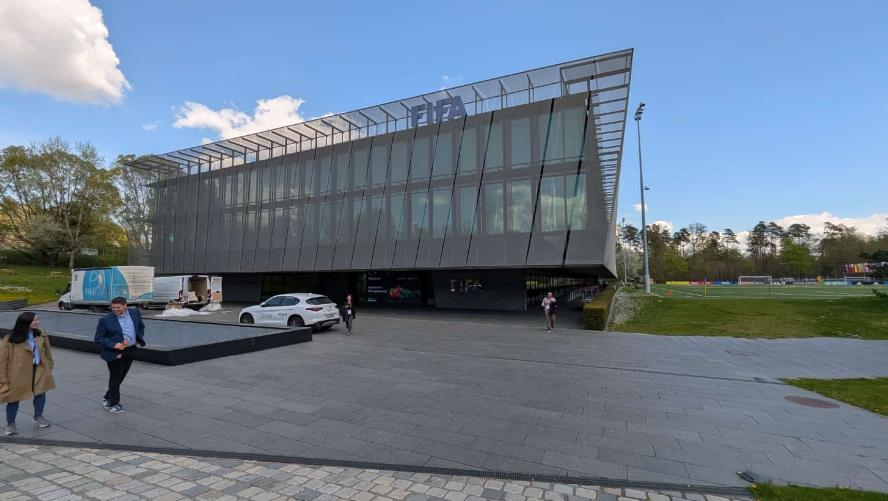
Photo shows FIFA headquarters in Zurich, Switzerland. (Photo: People's Daily/Liu Zhonghua)
During recent visits to FIFA headquarters in Zurich, Switzerland, People's Daily observed cutting-edge systems powering the tournament, with Chinese innovations playing major operational roles.
Hisense display technology dominates FIFA's lobby, foreshadowing its important role during the tournament. As the official Video Assistant Referee (VAR) display partner, Hisense's RGB-Mini LED televisions will equip all video review centers. Their ultra-high color accuracy delivers unprecedented image clarity, enabling more precise refereeing decisions.
Hisense establishes new innovation benchmarks that directly enhance the experience for players, officials and teams, said FIFA commercial partnerships director Nick Brown. FIFA chief business officer Romy Gai added that the technology represents a quantum leap in football presentation.
Beyond visual systems, artificial intelligence forms the backbone of tournament operations. FIFA will debut its football AI platform, a generative knowledge system trained on millions of historical match data points. The platform supports national teams in tactical analysis, opponent simulation and personalized strategy development.
Through partnerships with multiple technology firms, AI is now actively involved in officiating, match interpretation and tactical development, moving beyond its traditional analytical role.
As FIFA's official technology partner, Lenovo is embedding its hybrid AI architecture throughout tournament operations. The company's infrastructure will support critical functions including event management, referee assistance and fan engagement.
Alexander Metzlaff, FIFA's ICT (Information and Communication Technology) project and service coordinator, said FIFA will deploy 10,000 Lenovo computers and more than 200 engineers across all 16 stadiums during the World Cup to provide technical and logistical support.
Beyond hardware, Lenovo's AI solutions also include digital cloning technology. Inside a 3D scanning booth resembling a large locker room, a full-body data scan can be completed in just one minute. A personalized 3D digital avatar then appears on screen, creating an experience reminiscent of a science-fiction film.
Santiago Manso, Lenovo's director of sports and entertainment, said 28 such 3D scanning booths will be deployed during the World Cup to create digital avatars for all participants. The collected data will be integrated into FIFA's database.
These virtual replicas will be capable of recreating match situations through 3D animation and are expected to provide centimeter-level and even millimeter-level precision in offside decisions and key officiating calls.
FIFA President Gianni Infantino noted that Chinese companies have consistently remained at the forefront as FIFA expands into new areas of innovation. He said the partnership between Lenovo and FIFA for the upcoming 2026 World Cup is expected to generate major AI-driven breakthroughs that will enhance officiating technology, strengthen match analysis capabilities and create unprecedented fan interaction experiences.
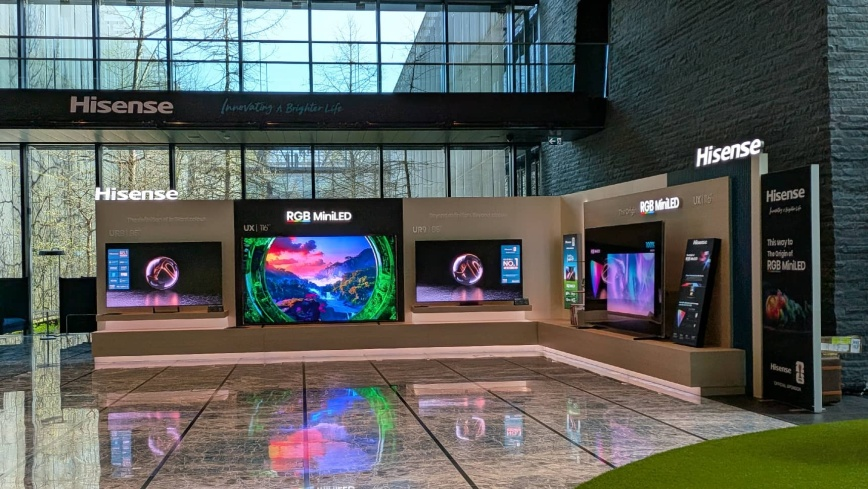
LED displays manufactured by Chinese company Hisense are seen inside the lobby on the first floor of FIFA headquarters. (Photo: People's Daily/Liu Zhonghua)
In recent years, Chinese companies have steadily moved deeper into the technological core of major international sporting events such as the FIFA World Cup, the UEFA European Championship and the Olympic Games, earning growing recognition from event organizers, industry institutions and global audiences.
Guy-Laurent Epstein, marketing director of UEFA Events SA, said Chinese companies are no longer simply commercial sponsors purchasing advertising space. Instead, they are bringing some of the world's most advanced technological innovations directly into UEFA competition systems.
The cutting-edge expertise Chinese companies offer in fields such as green mobility and advanced display technology aligns perfectly with their vision of building modern and sustainable sporting events, he said.
International media outlets including Reuters have also observed that Chinese companies are undergoing a major transformation in their role at top-tier international sporting events, evolving from peripheral merchandise suppliers into key providers of core technological infrastructure.
As Chinese companies deepen their participation in the world's premier sporting competitions, more Chinese technologies and solutions are likely to appear on the global sports stage, becoming an increasingly important force in advancing the development and accessibility of sports worldwide.