


LONDON, June 12 (Xinhua) -- As the 2026 FIFA World Cup kicks off in Mexico, academics are asking whether a 48-team, multi-nation contest is bad for football.
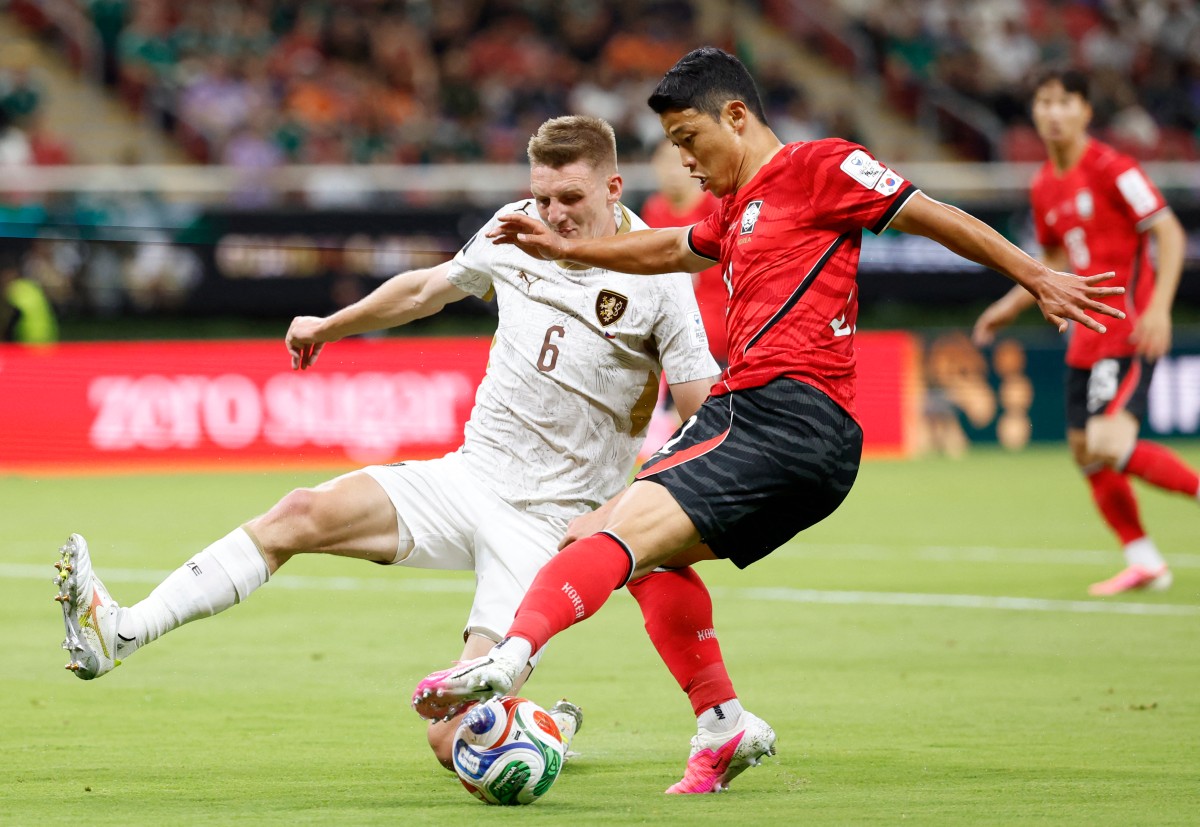
Czech Republic's defender #06 Stepan Chaloupek and South Korea's midfielder #11 Hwang Hee-chan fight for the ball during the 2026 World Cup Group A football match between South Korea and the Czech Republic at the Guadalajara Stadium in Zapopan on June 11, 2026. (Photo: AFP)
Professor Ian Scott of the University of Manchester said this year's tournament stands in sharp contrast to what he described as the most successful World Cup ever, Spain 1982, which was played with half the number of teams.
Scott told Xinhua: "One of the fundamentals about this tournament will be the relationship of sport to wider politics and world affairs. We are seeing a six-week tournament with twice the number of teams that took part in what for many remains one of the greatest tournaments ever - Spain 1982.
"That can only tell you that logistically the number of venues, the size and scale of the country and the tournament layout that involves the best part of three weeks to remove only a third of the teams, is now only possible if countries team up and facilities are in place. Are countries willing and able to work with FIFA's demands and seemingly insatiable acquisition rights for broadcasting, global companies and the like?
"With only 16 UEFA spots in a 48-team tournament, it means recognizable and traditional footballing powerhouses - Italy, Poland, Denmark - are absent. And while it's great to see smaller nations get a chance, Germany will almost certainly have never played a competitive match let alone a World Cup finals match against a nation as lowly ranked as Curacao.
"The cynic would say money is the driving force and even the lack of robust ticket sales don't stop that juggernaut for FIFA...
"The simple fact is more teams mean wider FIFA marketing into areas of the world it wants to solidify its base and export the game, largely for the commercial potential it offers.
"They absolutely see the sporting and diplomatic angle and FIFA is supportive of rich nations with resources to make big spectacles work for commercial returns.
"Only time will tell if an enlarged competition is good for the World Cup. It's what happens on the pitch that ultimately matters and where World Cups are judged...
"It is unlikely it seems that a single or even dual European tournament will happen for some time, and so promoting the global game into far corners away from the traditions of the game in South America and Europe is likely the mantra. The next World Cup on two continents suggests how tricky the size and logistics are, and how much teams have to bow to FIFA's demands for an almost unending spectacle."
David Cook, senior lecturer in marketing at Nottingham Trent University, told Xinhua: "My outlook on the World Cup is whether the growth has now got to the point of actually determining whether the brand is being slightly diluted. You've got so many teams taking part now. This World Cup in particular is being spread cross-continentally across North and Central America. The question is, have we got too much of a good thing now from a branding and a marketing point of view? So many matches, so many teams. Does each match have the same significance? It might have once done when there was a smaller number of teams in there.
"As a football fan I liked the 32-team format. I liked the fact that you had four good strength teams in each group, and then you knew that it'd be quite a clear-cut format after that where you progress to the second round and the quarterfinals. A bit like the European Championships, which has changed in a similar way.
"Could we see fans around the world suffering from football fatigue? Potentially, yeah. This isn't a trend unique to the World Cup, although we're seeing a much bigger World Cup than previous. We can see it in the European Championships. We can see it in the Club World Cup that took place last summer, that with the UEFA Champions League, we now have this very long initial group stage where the point of it is to remove a very small number of teams and then continue.
"I do think there's a real risk there, certainly in the medium to long term of kind of fan fatigue, too much of a good thing. Each match doesn't have the same level of consequence and intensity that it might have had previously. Clearly some individual matches are still going to be very intense, very exciting, have a lot riding on them, but when you look at that spanned out across the duration of the tournament we're going to see that dilution effect, I think.
"I suppose in many ways, we've literally been used to having a World Cup, a bit like the Olympics, where one country hosts it, you sort of know where you stand, it puts up the host country in the limelight and everybody goes home happy and waits for the next one.
"The way that the events are tending to go now, moving away from a single host country, we're seeing it a lot more of this co-hosting model. We've seen it in recent European Championships. We're seeing it in the World Cup a bit more now. And the fact that it is being staged across such a vast area, that could be a challenge this time in terms of the identity of the tournament. Three very different countries. That can work as a format, but equally sometimes it can feel kind of very distant, very detached, both literally in kilometers, but also in the kind of cultures and the different kind of philosophies of the countries involved. And also think about the travelling time for the teams and the fans if you're spread across multiple countries.
"From that point of view, there's sustainability questions around, both from a competitive point of view, the players and the coaches, but also the fans, all this travel time and distance...
"This idea of continual growth to an expansion where does that end? How far can that go realistically? There's even rumors that the tournament could be expanded even further in future, whether that's 64 teams in future. I suppose there's knock-on effects. Being in the World Cup is, or was, considered to be a real achievement just to get there for many teams, whereas now, particularly if we keep expanding, it's almost kind of like a given that you'll be at the tournament.
"There are always knock-on effects of this type of exponential growth. You think about the players themselves, having had very long seasons already. The calendar is already growing and growing and growing. Squad sizes are having to get bigger in club football to be able to accommodate the amount of games and the relative lack of rest that players do have. The flip side of that is their time off, their downtime is becoming less and less. Ultimately, if we go back to the marketing side and the product side, does that then affect the product that we see on the pitch in terms of the quality of the games, the intensity of the games? If the players a lot of the time, aren't necessarily performing close to their peak, then that's going to have a residual effect on the games and the tournaments as well."