


Asian Games open in Nagoya after challenging build-up
NAGOYA, Japan, Sept. 19 (Xinhua) -- The 20th Asian Games opened in Nagoya, Japan, on Saturday after a challenging buildup marked by accommodation shortages, transportation problems, heavy rainfall and other logistical issues.
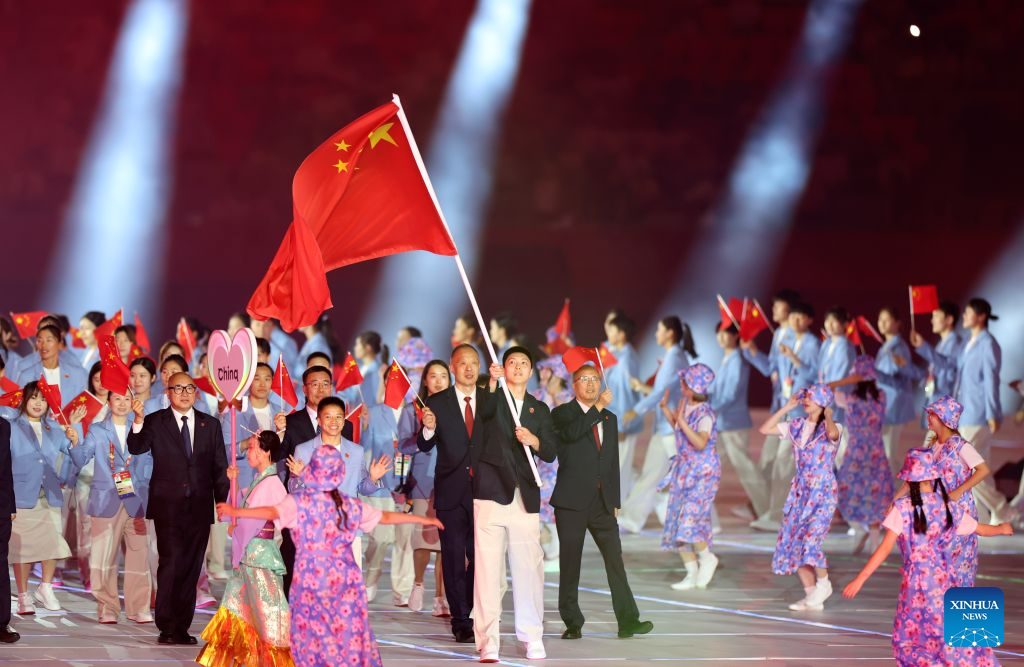
Delegation of China parades into the stadium during the opening ceremony of the 20th Asian Games Aichi-Nagoya 2026 in Nagoya, Japan, Sept. 19, 2026. (Photo: Xinhua)
Under the slogan "Imagine One Asia," the Aichi-Nagoya Asian Games mark Japan's third time hosting the event, following Tokyo in 1958 and Hiroshima in 1994.
Unlike previous Asian Games, Aichi-Nagoya did not build a traditional Athletes' Village. Instead, organizers opted to use existing hotels, a cruise ship and temporary container-style huts, citing cost control and a desire to avoid leaving behind underused infrastructure after the Games.
The approach came under scrutiny as the number of participants rose beyond initial expectations. Organizers had originally planned accommodation for around 15,000 people, while the final number of athletes and officials approached 17,000. Some delegations reported delays in room allocations and credential activation, while concerns also arose from room assignments and the distance between accommodation and competition venues.
The OCA defended the overall accommodation strategy, saying the priority was to provide athletes with suitable accommodation, transportation, food and other services while ensuring infrastructure investments remained useful after the Games.
The final days before the opening were also affected by torrential rain in the Nagoya area, which disrupted transportation and led to evacuations in some areas. Some Games facilities were affected by water leaks, adding another challenge for organizers shortly before the ceremony.
Against that backdrop, the opening ceremony provided a chance to shift the focus back to sport.
Chinese flagbearers, men's basketball player Hu Mingxuan and women's boxer Wu Yu, led the Chinese delegation in the parade at Mizuho Athletic Stadium, receiving a warm welcome from the stands.
China has sent 815 athletes to compete in 369 events across 38 sports at the Games, including 36 Olympic champions such as three-time Olympic table tennis gold medalist Sun Yingsha and Olympic champion divers Chen Yuxi and Wang Zongyuan.
The delegation has an average age of 24, with 548 athletes making their Asian Games debuts. Athletes born after 2005, including 13-year-old swimmer Yu Zidi and 17-year-old sprinter Chen Yujie, account for 27 percent of the team.
In his speech, Olympic Council of Asia (OCA) President Sheikh Joaan Bin Hamad Al Thani expressed his gratitude to the Aichi-Nagoya 2026 Organizing Committee and the Japanese Olympic Committee for hosting the Games, while also thanking the volunteers, sponsors and media partners involved in the event.
Addressing the athletes, Sheikh Joaan said: "While the world is too often divided by conflict, they remind us that sport remains a powerful force for peace, understanding, and friendship among nations."
"They carry with them the hopes of their families and friends, of young people in their communities and their NOCs," Sheikh Joaan stated, adding, "To each and every one of you: the entire continent is behind you. Give everything you have. Hold nothing back."
Aichi-Nagoya Asian Games and Asian Para Games Organizing Committee (AINAGOC) President Hideaki Omura said the Aichi-Nagoya Asian Games carried forward the spirit of the Tokyo and Hiroshima Games, emphasizing the power of sport to bring people together across borders.
"Sports have the tremendous power to bring people together across languages, cultures, and national borders," Omura said, adding that the Games embody the hope that people will "unite as one, and move forward together toward the future."
The torch relay, carried by local runners through Aichi Prefecture, was shown in a video before the flame entered the stadium. Six former or active Japanese athletes then passed the flame under the spotlight, with the final torchbearers, father and son Shigenobu Murofushi and Koji Murofushi, both former Asian Games hammer throw champions, lighting the main cauldron.
The cauldron was designed in the shape of Nagoya's iconic kinshachi, or golden tiger-fish ornaments.
The cultural performance was built around the theme of a "Harmonic Heart Beat," beginning with the sound of a heartbeat and violinist Taro Hakase's performance of "Legacy 2026," accompanied by 240 citizen dancers, heart-shaped drones and light and laser effects.
The program then showcased Aichi-Nagoya's traditional culture and manufacturing heritage before returning to the theme of a harmonious heartbeat bringing people together across Asia.