


Feature: From Olympic rings to Asian Games gold, China's Alex Hua Tian finds joy in every stride
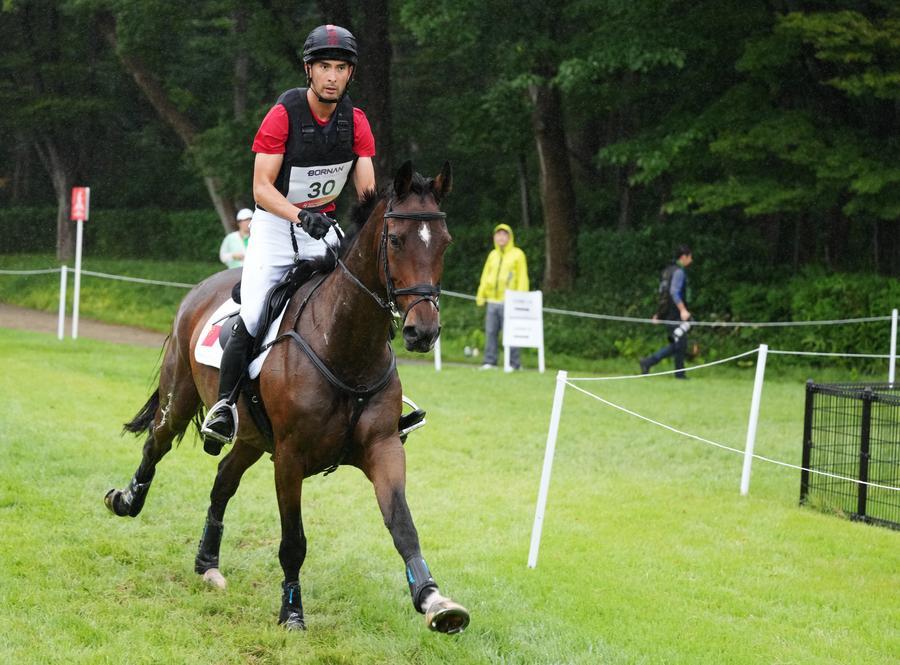
Alex Hua Tian of China competes during the cross country competition of the men's eventing individual equestrian at the 20th Asian Games Aichi-Nagoya 2026 in Tokyo, Japan, Sept. 23, 2026. (Photo: Xinhua)
Alex Hua Tian was relaxed when he sat down for an interview ahead of the Aichi-Nagoya Asian Games.
The 36-year-old Chinese rider spoke enthusiastically about the competition, his horse and a career that has taken him to four Olympic Games and, now, another Asian Games title.
Hua chose a spot outside the Tokyo Olympic Museum, beneath the Olympic rings. It was a fitting setting for a rider whose career has been closely associated with the Olympic and Asian Games, and with the horses that have accompanied him along the way.
Hua arrived in Tokyo with a clear objective: to defend the individual eventing title he won at the Hangzhou Asian Games in 2023. On Wednesday, he achieved that goal.
Riding nine-year-old Manjushri, also known as Bodhi or Miaojixiang, Hua finished on his dressage score of 26.90 penalty points to retain the title. He produced a clear show jumping round on Tuesday before completing the cross-country phase in 6 minutes 49 seconds on Wednesday, 11 seconds inside the seven-minute optimum time and without adding any penalties.
For a rider defending an Asian Games title, however, the pressure was never far away.
"I'm just very relieved, mainly," Hua said afterward. "Obviously, there's some pressure coming into a championship when you're defending a gold medal, but also bringing such a good horse like Miaojixiang."
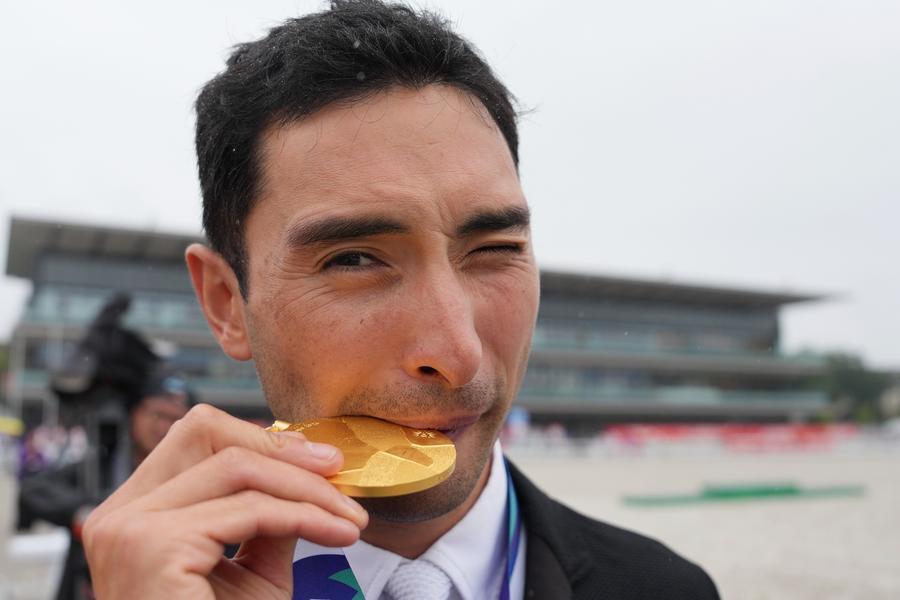
Alex Hua Tian of China bites his gold medal after the awarding ceremony for the men's eventing individual equestrian at the 20th Asian Games Aichi-Nagoya 2026 in Tokyo, Japan, Sept. 23, 2026. (Photo: Xinhua)
The final phase was made more demanding by rain and a technical course featuring numerous turns. Hua later said he had been concerned about the slippery ground and the challenge of managing Miaojixiang's big stride on a twisting track. After the first few obstacles, however, he was able to find his rhythm, trust the horse and relax.
That trust has been years in the making. Hua has trained Miaojixiang since the horse was five. He describes him as "very greedy" and says food is "number one for him." The horse also has "quite a cuddly personality," affectionate while sometimes preferring his own personal space.
But once he enters the competition arena, the personality changes. "He really wants to work with you in training and in competition," Hua said before the Games. That was one of the reasons he believed the horse could be reliable and competitive in Tokyo.
For Hua, that relationship is at the heart of eventing. Horses, he explained, are prey animals that have evolved over millions of years to flee from perceived threats, including humans. Building enough trust to work together as one is what makes the sport so special to him.
"It's a very addictive feeling," he said, comparing it to a musician searching for the perfect pitch.
That sense of connection was also visible after the finish. In the mixed zone, Hua exchanged high-fives with journalists and stayed for some time, smiling, greeting people and sharing the moment after his victory.
Beneath the easy smile, however, is a rider who has spent years learning how little can be left to chance in eventing. Dressage demands precision and harmony. Show jumping requires accuracy and control. Cross-country demands speed, courage and trust. A championship result requires all three to come together at the right time.
Hua arrived in Tokyo after another landmark result in his career. He finished 12th with Chicko at the 2026 FEI Eventing World Championships in Aachen, the best-ever result by a Chinese rider at the eventing world championships. But he deliberately chose a different horse for the Asian Games, believing Miaojixiang's strength in dressage made him better suited to the competition.
For Hua, though, the gold was not only personal. "The most important thing is that I didn't let the team down," Hua said. "So I'm very, very, very happy about that."
As China's national equestrian team goes through a generational transition, Hua has become its most experienced member. Looking at the younger riders, he said, "They are the next generation of Chinese equestrian sport. They are the future of the sport."
Beyond competition, Hua has also devoted himself to making equestrian sport more accessible in China. Since 2017, he has been involved in the "Horsemanship Movement", which introduces children to horses and teaches them about horse care and safety.
For Hua, the future of the sport is not only about producing more competitive riders, but also about helping more people understand and experience the connection between humans and horses.
"I hope to make equestrian more widespread and more accessible," he said.
His latest Asian Games victory adds another chapter to a long continental career. He won individual silver at the 2014 Incheon Games and bronze at Jakarta in 2018 before taking individual and team gold at Hangzhou in 2023. His latest title gives him a second consecutive individual Asian Games gold.
Yet Hua's reflections on the sport rarely center solely on medals. For him, the defining element remains the partnership between horse and rider.
The horse changes, as do the course, weather and circumstances. The challenge is to build enough trust and understanding that, when everything comes together, horse and rider can perform as one.
"When it comes together, and you feel like one," he said. "And it's very, very special."