


China's para athletes shine at Games
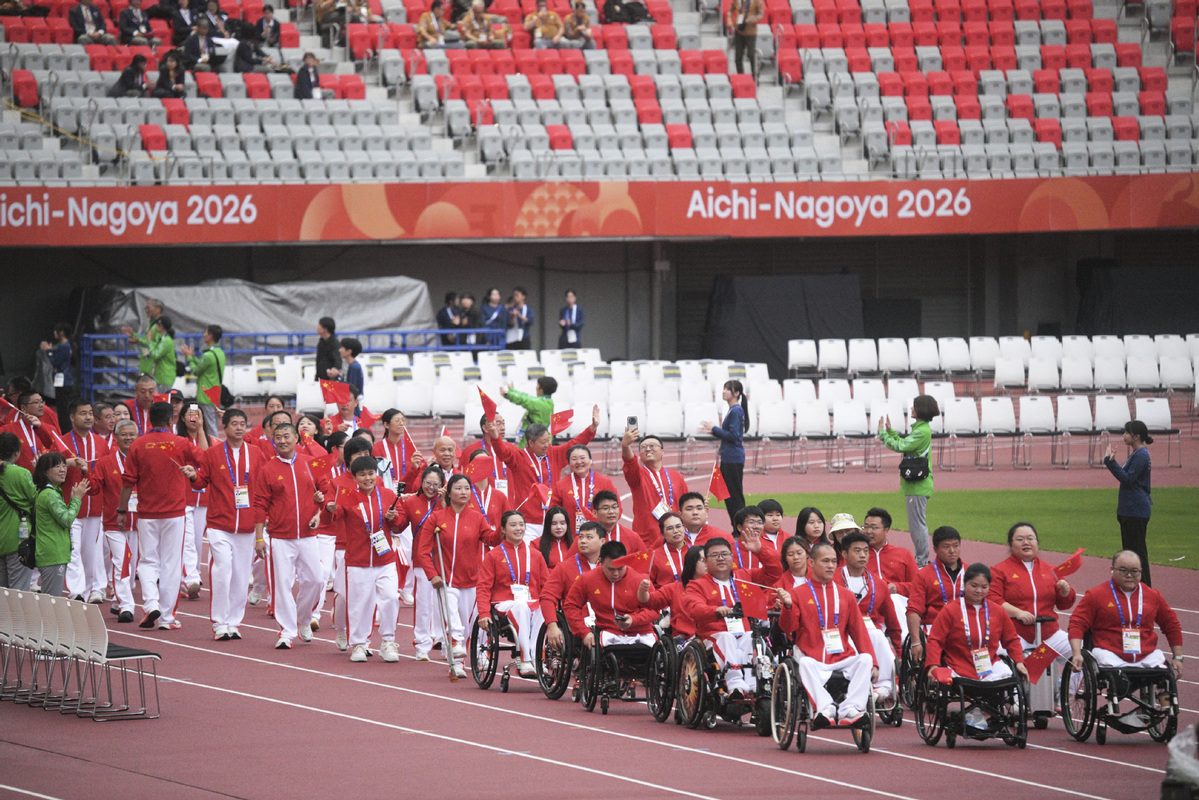
The delegation of China enters into the stadium before the closing ceremony of the Aichi-Nagoya Asian Para Games in Nagoya, Japan, Oct 24, 2026. (Photo: Xinhua)
China concluded the 2026 Aichi-Nagoya Asian Para Games on Saturday with 207 gold medals, having used the event to assess its preparations for the 2028 Paralympic Games in the United States.
The Chinese delegation won 435 medals in total, including 117 silver and 111 bronze, topping both the gold medal table and the overall medal standings for the fifth consecutive edition of the Games.
The haul also marked China's best performance at an Asian Para Games held outside the country. Chinese athletes broke 11 world records and 18 Asian records during the competition, according to the China Disabled Persons' Federation.
Team events provided some of the most memorable moments of the Games. China's women's wheelchair basketball and goalball teams defeated hosts Japan to claim gold, while the women's sitting volleyball team beat Iran to secure a fourth consecutive Asian Para Games title. The men's blind soccer team also defeated Japan to win its third gold medal at the Games.
Veteran athletes and newcomers alike contributed to China's campaign. Swimmer Zhang Meng, 30, won eight gold medals, the most by any athlete at the Games. Para powerlifter Cui Zhe and track and field athlete Mi Na each won gold medals at their fifth consecutive Asian Para Games.
Meanwhile, Wei Jia, 19, won gold in athletics while breaking two Asian records, gaining valuable international experience ahead of her longer-term ambitions.
"Competing at an event of this scale is a very different experience, and it broadens your horizons," said Wei after winning the women's shot put event.
Meeting athletes from different countries and competing alongside them changed her outlook and mindset, she said.
"We do not speak the same language, but when we compete on the same field, it feels as though we are striving toward the same goal," Wei added.
For young athletes like Wei, the next milestone is qualifying for the 2028 Los Angeles Paralympic Games. "I do not want to set my sights too high just yet. My first goal is to make it to Los Angeles," she said.
Athletes have also been adjusting their training plans to align with the events on the next Paralympic program. Chen Shichang, who won gold in the men's 400 meters event, switched from long jump to track events after learning that the long jump would not be included in the Los Angeles Games.
Chen had moved from the field event to the 400 meters less than a year ago, making the Asian Para Games his first major competition in the distance.
"To achieve this result today, I am really satisfied," he said. "The long jump and the 400 meters are completely different disciplines. They require entirely different approaches."
Chang Zheng, vice-chairman of the federation and deputy head of the Chinese delegation, said the Asian Para Games served as a key competitive test for the Paralympic Games in 2028.
The delegation aimed not only to achieve strong results but also to give younger athletes international experience, assess training outcomes and identify areas for improvement, Chang said.
"The events contested in Nagoya were closely related to those scheduled for the Los Angeles Paralympic Games, allowing China to evaluate its preparation and refine its plans for the next two years," he said.
Asian Paralympic Committee President Majid Rashed said the records set at the Games would endure, but the true legacy of Aichi-Nagoya 2026 would be measured by what came next.
"The greatest tribute we can pay to our athletes is not simply to celebrate what they have achieved here, but to ensure that the next generation has even greater opportunities," he said at the closing ceremony.