


International sporting event boosts service industry in coastal city
For Qidong, a coastal city in East China's Jiangsu province, a major international sporting event is helping to boost its service industry and deepen cultural exchanges.
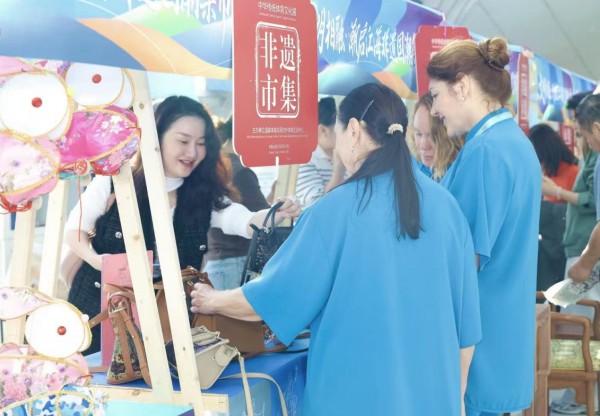
An intangible cultural heritage market outside the Qidong Poly Grand Theatre in Jiangsu province attracts visitors from home and abroad. (Photo: China Daily)
At an intangible cultural heritage market outside the Qidong Poly Grand Theatre, the displayed items attracted a large number of visitors on Oct 25, including many international visitors who came to the booths to experience the charm of traditional Chinese craftsmanship.
The city's "event economy" has taken shape within its service industry, said the Qidong municipal government, stressing that it will strengthen its cultural and sports activities, as well as performing arts and ticket economy.
Qidong has a strong economic base, with a regional GDP of 155.689 billion yuan ($23.23 billion) in 2025. The city is seeking to diversify its service industry, leveraging the sporting event as a key driver.
In Jiangsu, the scale of the sports industry has reached 694.93 billion yuan, with an average annual growth rate of around 10 percent since 2020, providing a strong industrial chain and professional operational experience for local competitions.
On Oct 25, the Fourth Traditional Sports International Exchange Competition concluded in Qidong, attracting more than 800 traditional sports enthusiasts from over 60 countries and regions.
At the intangible cultural heritage interactive area, Irene Hoffmann, an athlete from Austria, stood at the metal-and-stone rubbing booth and examined the craft carefully.
Participating in the competition for the second consecutive year, she was awed by this traditional Chinese craft. As she rubbed and pressed, ancient Chinese characters emerged on the paper, fascinating her.
"Metal and stone rubbings printed with Chinese characters are very special to us. I really want to know how these exquisite works are made," she said, adding that her performance at this year's event was good, boosting her confidence in practicing Health Qigong in the future.
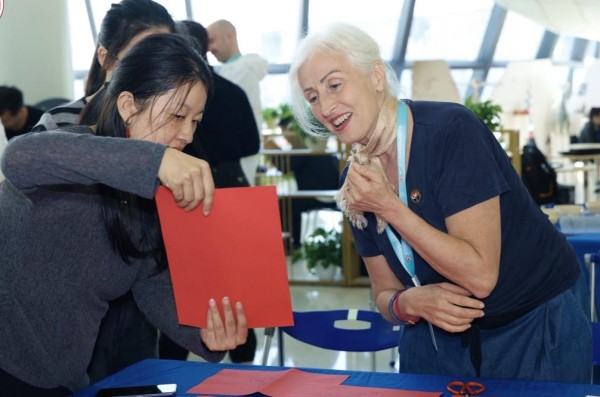
The intangible cultural heritage market in Qidong draws visitors from home and abroad. (Photo: China Daily)
Rosa Eveline Anaya Cedillo, a wushu (Chinese martial arts) athlete from Mexico, tried making a traditional seal printed with a horse pattern in the interactive area.
"I feel especially happy to be able to compete with the friendly people here."
In traditional Chinese culture, seals represent commitment and trust, while "the horse" reflects the vigorous and enterprising spirit of sports. Cedillo said she not only felt the warmth of traditional craftsmanship, but also understood the aesthetic interest and spiritual resonance belonging to the East.
Yu Lichun, vice-mayor of Qidong, said traditional Chinese sports have been passed down for thousands of years and embody the cultural foundation of "harmony in diversity and shared beauty". Such events can enable equal exchanges and mutual learning among civilizations.
The competition in Qidong featured six events — wushu, Health Qigong, Go, Chinese chess, dragon and lion dance, and kites — plus the Heqiu invitational tournament. It was the largest edition by scale and participation since its inception, covering over 60 countries and regions, and setting a new high for foreign athlete participation. "Qidong is a very beautiful city. We are very happy to participate in such a grand event by the Yangtze River and the sea," said Ndiogou Gueye, head of the Senegal Wushu Team and president of the Senegal Wushu Federation. He noted that wushu is developing well in Senegal, where there are currently about 400 wushu clubs and nearly 10,000 athletes.
"I have seen the development of this sport around the world and felt the warmth of the Chinese people," he said.
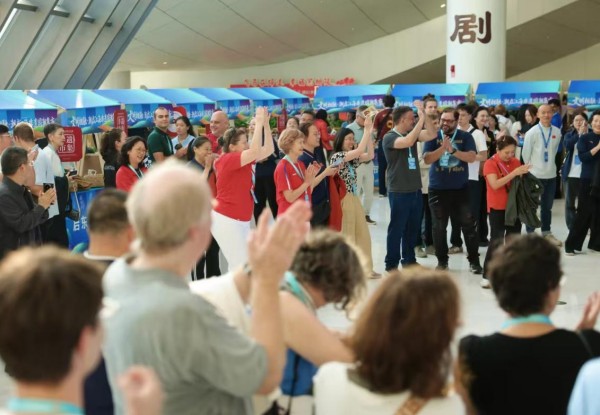
The cultural and sports performance inside Qidong Poly Grand Theatre receives warm applause from participants. (Photo: China Daily)
At the Heqiu invitational tournament, Sultan Fadhl Abdulelah Al-Rashedi, an athlete from Yemen, said, "The Heqiu sport, which combines volleyball and soccer, is very interesting. Over the past few days, I have made many friends from different countries."
In the cultural and sports performance inside the theatre, the Johor Dragon Dance Team from Malaysia presented a magnificent performance. The ancient instrument Guyue solo Call of the Ancients and the a cappella chorus Happiness performed jointly with foreign athletes, complemented each other.
Chinese and international participants sang together on stage, demonstrating both the vitality and vigor of traditional sports, as well as a picture of shared beauty and common progress. "Traditional Chinese sports allow the world to truly experience the warmth and depth of Chinese culture — an integration of strength and beauty, wisdom and courage," said Zhu Shenghui, director of the Nantong Municipal Sports Bureau.