


From stands to streets, grassroots football takes root in China
NANJING, Nov. 3 (Xinhua) -- A crowd of 62,356 packed Nanjing Olympic Sports Center on Saturday night as Wuxi edged Changzhou 2-1 to win the second edition of the Jiangsu City Football League, better known as the Su Super League. But the 90-minute match was only part of the story.
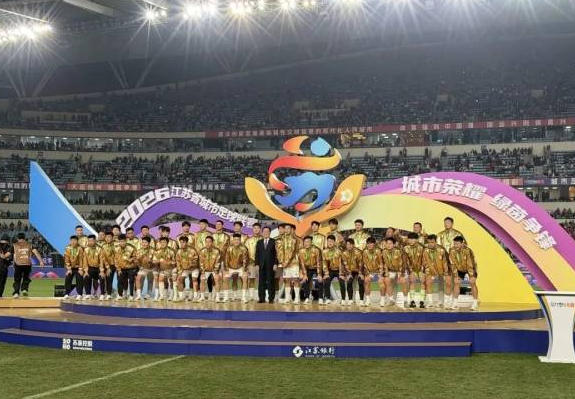
Photo: Agencies
After the final whistle, Changzhou fans lingered in the stands before boarding dedicated buses for the overnight journey home, nearly 3,000 of them continuing their chants along the way. In Wuxi, barbecue joints overflowed, while crowds gathered around outdoor screens, catching the action they had been unable to see in person.
The energy of an amateur football match was spilling beyond the stands and into the streets, a sign that the game has become something more than a sporting spectacle.
Hype may fade, but attendance tells a more enduring story. In its second season, the Su Super League drew 3.04 million visits across 91 matches, averaging over 33,400 spectators per game, up 17 percent from its inaugural campaign. The ticket lottery for the final had an acceptance rate of just 2.7 percent, while the overall rate stood at 9.6 percent.
The wave of internet memes that fueled the league's debut have receded, leaving behind something more substantial: ordinary fans marking their calendars, scrambling for tickets and making football part of their weekends.
That is perhaps the clearest measure of a grassroots culture taking hold. It no longer needs trending hashtags to prove its vitality. It lives in families heading to stadiums on Saturday afternoons and in supporters who keep coming back, season after season.
When a city begins to see its football team as an extension of itself, the game ceases to belong only to those who play it.
Across Jiangsu, amateur pitches have seen a marked rise in use during the league, with prime-time evening occupancy at football parks in Changzhou climbing to 80 percent. From full-size pitches in major sports parks to five-a-side courts tucked into residential neighborhoods, the promise of having somewhere to play whenever the urge strikes is increasingly becoming a reality.
The deeper transformation may be taking place among the young. Children accounted for 23.7 percent of spectators who booked tickets this season, up 3.1 percentage points from last year.
A child pulling on a jersey bearing the colors and symbols of their hometown and walking into a stadium alongside their parents is experiencing something more lasting than a match. It is a quiet, familial introduction to football culture, a ritual passed from one generation to the next.
The roots of grassroots football are not planted solely in youth-development programs or coaching manuals. They take hold in the shared excitement of a family weekend, in the chants learned from the crowd and in the memories carried home.
One of the league's most underappreciated strength lies in its inclusion.
At a Nantong home match, nearly 80 people with disabilities attended as part of the league's first organized group of disabled spectators, dressed in red jerseys. Bao Hanming, a one-armed athlete, threw his arm into the air in celebration when a goal was scored. He described himself simply as an athlete with a football dream.
At Changzhou's home matches, deliverymen, sanitation workers and bus drivers took the stage together in a pregame choir. Accessible routes extended from outside the stadium to the aisles of the stands, helping make the matchday experience more welcoming.
The league's sponsor board offered another telling snapshot of its reach. Adidas and Coca-Cola shared space with a neighborhood barbecue shop. Its owner put up 10,000 yuan (1,500 U.S. dollars) for a sponsorship deal, driven by his love of football.
This is grassroots football's inclusive spirit in practice. It is not charity bestowed from above, but a shared platform where the barbecue vendor, the delivery worker and the street cleaner stand alongside global corporations, all with a place in the game.
As football puts down roots, it gives cities a common language.
Wuxi's eight home matches generated 19.2 billion yuan (2.88 billion U.S. dollars) in total consumption across the city, while night-market occupancy on matchdays rose 70 percent from ordinary evenings. Following its title win, the city opened major scenic attractions free of charge to fans holding tickets to any Su Super League match.
Away supporters have been able to visit rival cities' attractions for free by presenting their identification cards, while taxi drivers have volunteered to form fleets offering complimentary rides to fans.
Football has not erased competition between cities. It has given that rivalry a warmer, more human dimension.
When an away trip means not only watching a match but also spending a weekend in a neighboring city, grassroots football becomes more than sports-page material. It becomes a new language of civic exchange, built on hospitality, shared enthusiasm and the simple pleasure of getting to know one's neighbors.
Look further afield, and the story finds echoes in football cultures with much longer traditions.
In Scotland, the terraces of lower-league clubs have been described as offering a sense of belonging difficult to find elsewhere in life. Older supporters may grumble through the biting wind on makeshift stands, but those weekly gatherings remain a vital fixture of community life.
In Germany, the country's 50+1 ownership rule has proved difficult to dislodge in part because it rests on a deeply rooted conviction that a club's soul belongs to the people who walk through its gates every weekend, not merely to the figures on its balance sheet.
The Su Super League is still a work in progress. Its commercial foundations, competitive standards and governance systems have plenty of room to mature. But its trajectory points in a direction familiar to societies with deep-rooted football traditions - pulling the game out of screens and returning it to streets, neighborhoods and the ordinary rhythms of people's lives.
Nearly 20 provincial-level city leagues have followed suit over the past year, while China's national fitness plan for 2026-2030 explicitly includes city football leagues among its flagship mass-participation events in the country's three major ball sports.
A bottom-up football culture is spreading, city by city, sinking its roots deeper into the fabric of Chinese society.
On the night of the final, streams of supporters in jerseys of every color flowed toward the subway stations. Most would never appear in a sports headline the following day.
But next Saturday, they will be back - standing on the touchlines of neighborhood pitches, watching matches on the television above a barbecue stall, or bending down to tie their children's football boots.
That is where the real victory of grassroots football may lie.