


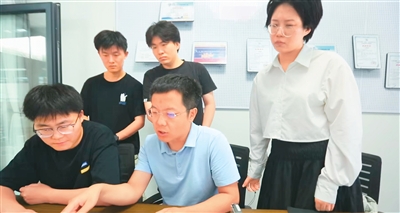
Wang Yaojun (second from right) and team members work on data annotation. (Photo courtesy of the interviewee)
Visitors to the office of Wang Yaojun, an associate professor at China Agricultural University's College of Information and Electrical Engineering, are immediately drawn to an all-white device.
Roughly the size of a microwave, the device functions as a miniature smart farm. At its core lies the Shennong Large Model, developed by the university. The machine features 36 intelligent agents and serves over 100,000 farmers nationwide.
To build a proprietary core database, Wang turned to the university library, a trove of agricultural knowledge. Over seven months, a team of faculty and students systematically scanned more than 3,000 books. By combining these with publicly available sources, they constructed a specialized database of 20,000 volumes for the Shennong model.
To ensure the model was truly practical, the team traveled to more than 20 provinces across China. They collected real-world data on soil composition, irrigation practices, pest and disease outbreaks, and extreme weather impacts, covering the entire agricultural production chain.
Version 1.0 was released in December 2023, offering capabilities such as agricultural knowledge Q&A, semantic understanding of agricultural texts, text summarization and decision support for farming operations. Version 3.0, launched in October 2025, introduced 36 specialized intelligent agents for scenario-specific cultivation guidance, significantly lowering the barrier to use.
Today, the Shennong Large Model features a proprietary knowledge system covering 90 percent of agricultural disciplines and 80 percent of farming scenarios. Its core database includes 10 million knowledge graph entries, 20 million annotated images and 50 million production records.
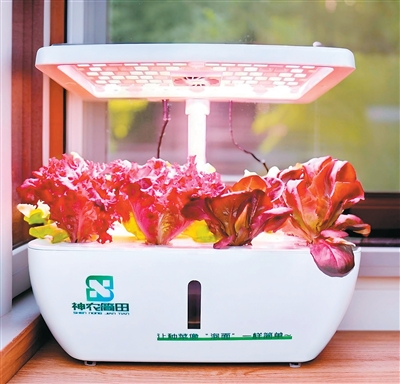
Photo shows the "Shennong Jiantian" household planting machine developed by a team at the College of Information and Electrical Engineering, China Agricultural University (CAU). (Photo courtesy of the interviewee)
The model is currently being piloted in several regions, effectively giving modern agriculture an "AI brain."
A few years ago, Du Lianhui, who hails from northeast China's Liaoning Province, switched from the computer industry to farming. He leased 3,000 mu (200 hectares) of farmland. "The first few years, the crops didn't grow very well," he recalled.
In 2025, he decided to try the Shennong Large Model on 600 mu of corn.
"It's like having a 24/7 smart steward in the field," he said.
Through sensors deployed across his fields, real-time data on temperature, sunlight, pests and diseases are sent directly to the platform.
With the model's help, Du said field management became much more precise. The cost per mu of corn, previously around 480 yuan ($69), dropped to less than 400 yuan in 2025.
Whether AI can truly take root in traditional agriculture depends not only on its technological sophistication but also on whether farmers are willing to adopt, trust and consistently use it.
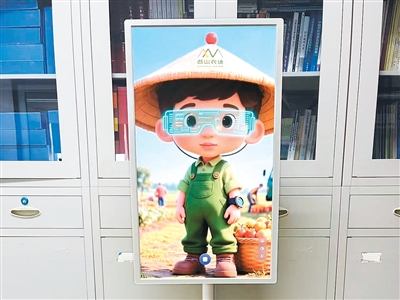
An all-in-one digital assistant powered by the Shennong Large Model. (Photo courtesy of the interviewee)
"Older farmers often hesitate with complex new technologies — not because they're unwilling, but because they're afraid of using them incorrectly or not being able to learn," Wang said.
To address this, the team developed a WeChat mini-program that allows users to easily access the Shennong Large Model's core functions.
Last spring, whenever corn leaves showed signs of infection, Chi Fengjiao, a farmer from Qingshan town in Harbin, northeast China's Heilongjiang Province, no longer had to rush to find advice. Instead, she simply took out her phone, opened the "Shennong Weitian" WeChat mini-program and snapped a photo of the affected leaves. Within seconds, the program identified the disease and offered treatment options.
"It's even faster than consulting an expert. Following its guidance gives me peace of mind, and it really works in the field," she said.