


BEIJING, Feb. 20 (Xinhua) -- Chinese researchers have developed a novel model to explain the origin of an ultra-long gamma-ray burst (GRB), challenging the conventional understanding of these violent cosmic events.
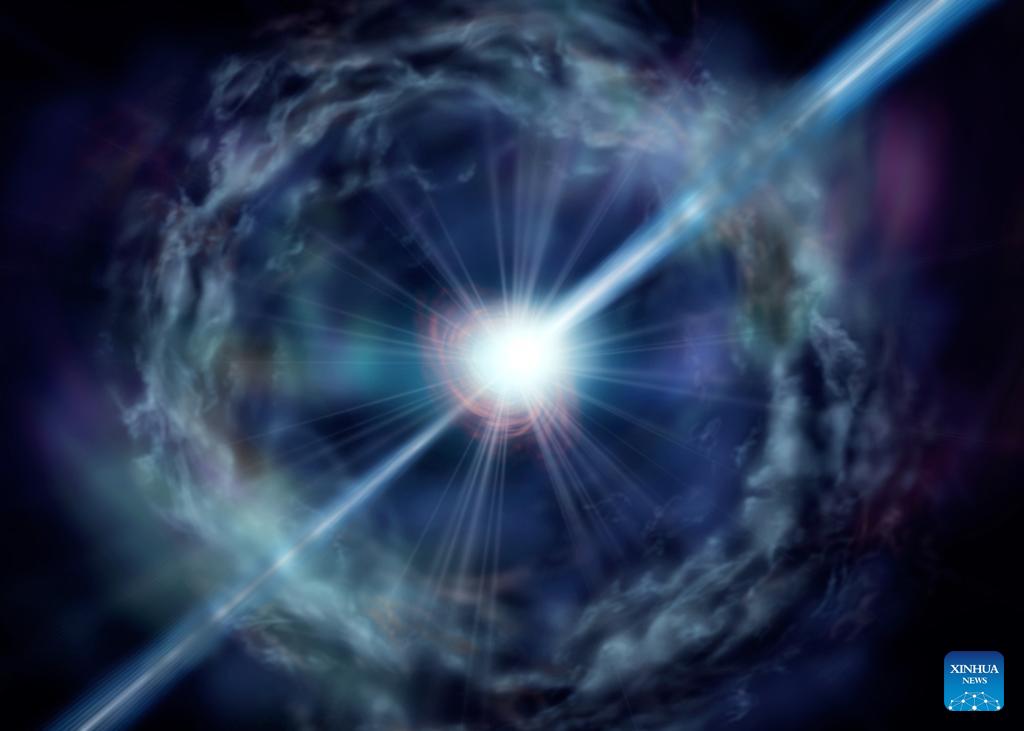
This schematic diagram provided by the Institute of High Energy Physics (IHEP) under the Chinese Academy of Sciences shows the brightest gamma-ray burst (GRB) ever observed, coded GRB 221009A. (File photo: IHEP/Handout via Xinhua)
Gamma-ray bursts are among the most violent explosive phenomena in the universe, typically lasting from milliseconds to a few minutes. However, the GRB 250702B event, which occurred on July 2, 2025, exhibited extraordinary properties that have sparked intense debate within the astrophysics community.
A research team from the Chinese Academy of Sciences Institute of High Energy Physics conducted a comprehensive analysis of satellite observational data, including Insight-HXMT and GECAM. They examined the data from 30 days around the burst and discovered that the gamma-ray emission lasted an unprecedented 29 hours, shattering previous duration records.
The team also identified distinctive time variabilities in the accompanying X-ray radiation. Based on these findings, they proposed a new model stating that the progenitor star of this gamma-ray burst was a supergiant with a mass far exceeding that of the Sun, as reported in their recent research article published in the Astrophysical Journal Letters.
Unlike the progenitors of ordinary gamma-ray bursts, the collapse of supergiant stars can extend over dozens of days. When the supergiant exhausts its nuclear fuel, its core first collapses to form a black hole, which rapidly accretes the inner material of the supergiant star, producing relativistic jets traveling at nearly the speed of light. This is the source of the gamma-ray burst.
During the subsequent accretion process, slightly slower jets were generated, emitting X-ray radiation.