


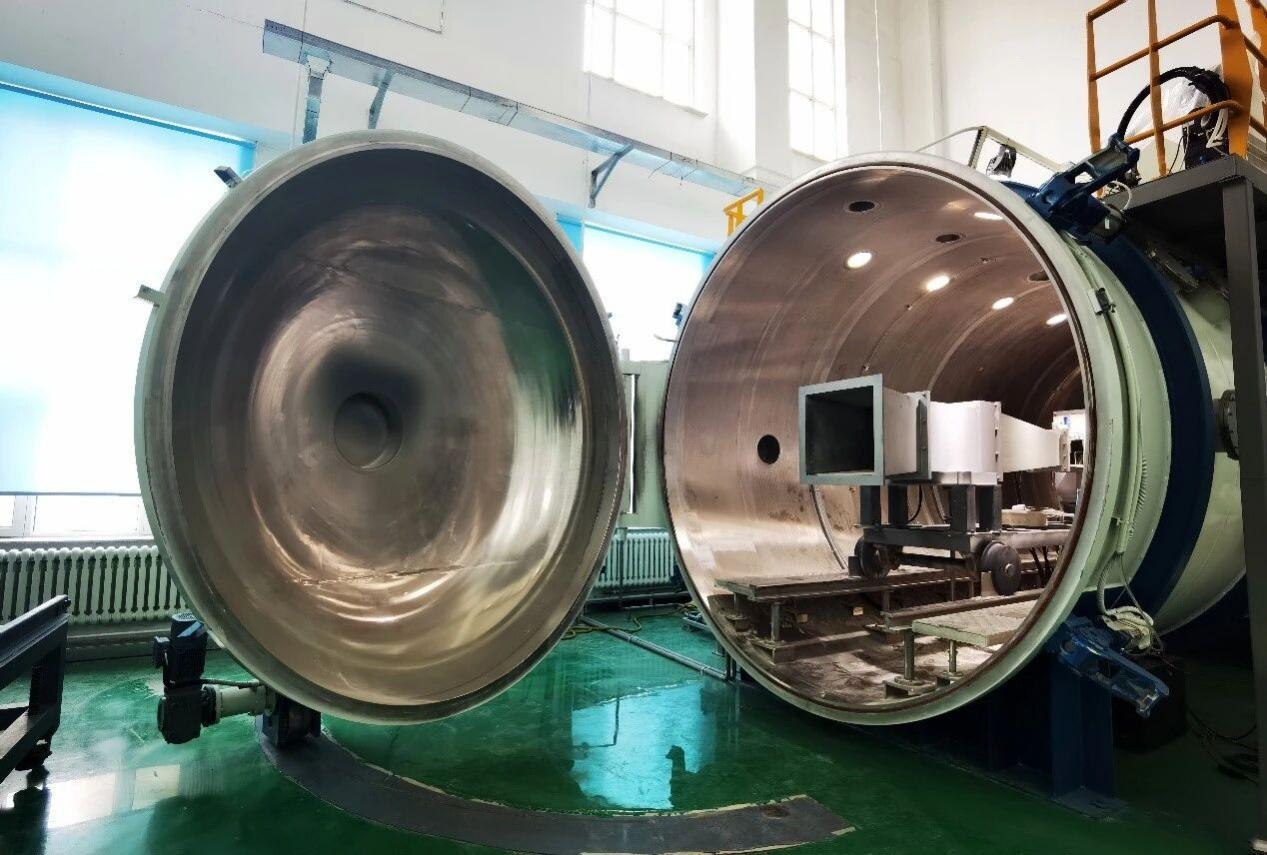
Photo shows a simulation unit of the Space Environment Simulation and Research Infrastructure. (Photo/Li Liyun)
Within the Harbin Science and Technology Innovation City in Harbin, capital of northeast China's Heilongjiang province, stands a cluster of white buildings, covering an area roughly the size of 50 football fields.
The complex houses one of China's key national science and technology infrastructure projects in the aerospace sector: the Space Environment Simulation and Research Infrastructure (SESRI), often referred to as the "ground-based space station," it was jointly developed by Harbin Institute of Technology (HIT) and the China Aerospace Science and Technology Corporation. The project took nearly two decades of research and engineering before achieving national acceptance in 2024.
SESRI has the unique capability to replicate nine major types of extreme space conditions -- including vacuum, radiation, weak magnetic fields and plasma -- bringing the harsh cosmic environment down to Earth to provide indispensable ground verification for a range of major space missions.
"While most ground-based simulation facilities in the world focus on a single factor, but the real environment of outer space usually involves the coupling of multiple factors," said Li Liyi, director of the SESRI at HIT. "The purpose of building the 'ground-based space station' is to simulate the real conditions of space as closely as possible."
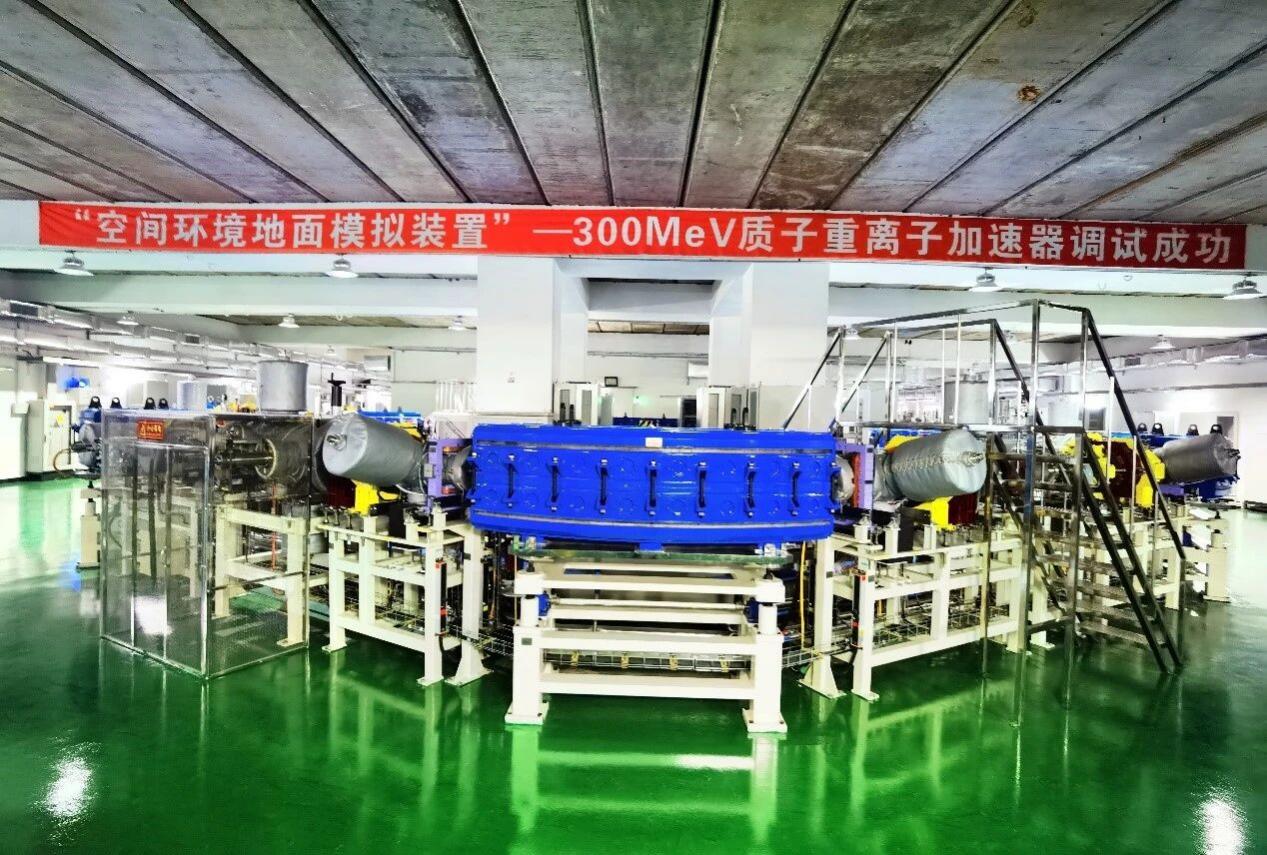
Photo shows a 300MeV proton and heavy-ion accelerator of the Space Environment Simulation and Research Infrastructure. (Photo/Li Liyun)
Rather than being a simple collection of separate laboratories, the facility can reproduce complex interactions -- such as the coupling of radiation and ultra-low temperatures, or interactions among different radiation sources -- within the same physical space, creating a more realistic simulation of the space environment.
The facility supports a wide spectrum of scientific research. It can simulate space dust impacts at speeds of up to 70 kilometers per second to help design protective shielding for spacecraft. Inside a massive vacuum chamber, engineers can overcome atmospheric pressure differences approaching 10 tons per square meter while maintaining millimeter-level positioning accuracy for key equipment. The system can also recreate charged lunar dust environments to test the durability of spacesuit materials.
The research team overcame 15 key technological challenges during development. The facility has already supported the development of more than 2,000 aerospace components and helped validate and certify over 10 major space mission models.
Since becoming operational, the "ground-based space station" has attracted scientists from China and abroad thanks to its powerful simulation capabilities and has become an important platform for cutting-edge research.
"In the past, we could only conduct experiments with devices measuring a few dozen centimeters. Here, the equipment is dozens of times larger, enabling us to investigate far more complex physical processes," said Lu Quanming, a professor at the University of Science and Technology of China.
In March 2025, Lu's team worked with researchers at HIT to achieve the first laboratory-based simulation and confirmation of magnetic reconnection processes in the Earth's magnetopause configuration.
Activity at SESRI has also surged alongside China's rapidly growing commercial space sector. "In 2023, commercial spaceflight experiments accounted for only 36 percent of all missions conducted here. By the second half of 2025, that share had risen to 67 percent," Li said. The facility now provides ground testing and verification for electronic systems used in most satellites across several Chinese satellite constellations, helping accelerate the deployment of China's low-Earth-orbit constellation networks.
SESRI is open not only to domestic users but also to international partners. Through initiatives such as the Global Open Program released via the Asia-Pacific Space Cooperation Organization, the facility has established partnerships with eight countries and 15 research institutions, promoting joint research, data sharing and talent training. Scientific cooperation in multiple key fields is helping build bridges for cross-border collaboration through technological exchange.
Since its acceptance, the facility has supported major strategic missions and frontier scientific exploration across fields such as human spaceflight, commercial spaceflight, deep-space exploration, health care, agricultural breeding, new materials and new energy. It has served more than 200 user organizations -- including the China Aerospace Science and Technology Corporation -- and over 400 research teams, delivering more than 60,000 hours of testing services.
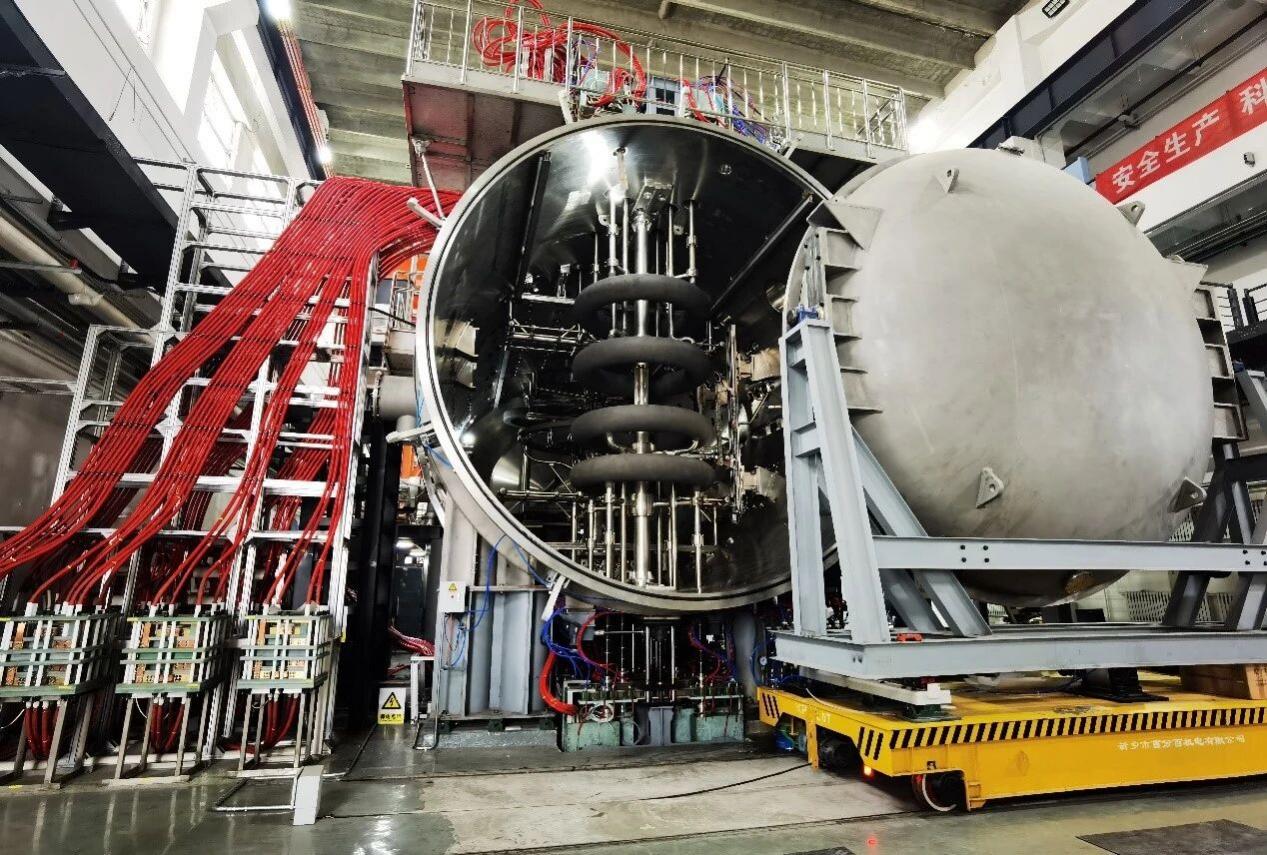
Photo shows a space plasma environment simulation and research system at the Space Environment Simulation and Research Infrastructure. (Photo/Li Liyun)
"Looking ahead, the development of the 'ground-based space station' will move toward greater precision, broader applications and deeper research," Li said.
Technologically, SESRI will continue advancing higher-precision environmental simulation capabilities to meet the needs of sectors such as aerospace, semiconductor chips and advanced materials. In terms of services, it will extend support to emerging and future industries including deep-space exploration, quantum technology and new energy. In international cooperation, it will provide unique testing conditions for global research teams, particularly in areas such as radiation-resistant materials for deep-space missions and spacecraft reliability verification.
"We will use this facility to accelerate the implementation of the Global Open Program," Li said. "By bringing together leading universities, research institutions and top scientists worldwide, we aim to jointly launch major international scientific programs and conduct frontier exploration."
More than a major scientific facility for China, the "ground-based space station" is also a frontier outpost for humanity's exploration of the universe. Looking ahead, it will continue to provide essential ground support for future missions, including crewed lunar landings, Mars sample returns and exploration of the outer solar system.