


In early 2026, Chinese-developed humanoid robots made a striking double appearance at the Consumer Electronics Show in Las Vegas and on China's CCTV Spring Festival Gala. Products and applications from multiple Chinese companies sparked widespread discussion in the international tech community and drew significant attention from global media.
The attention reflects a broader industry consensus: at a pivotal juncture of technological breakthroughs and industrial restructuring, artificial intelligence (AI) is embedding itself in the physical world, and embodied AI is rapidly moving from concept to real-world application.
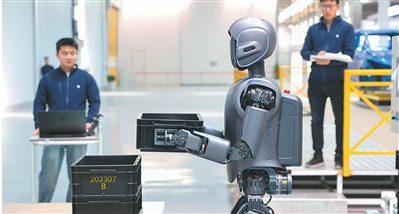
Engineers calibrate a humanoid robot at a private company in Wuxi, east China's Jiangsu Province. (Photo: Xinhua)
China is emerging as a major force in this frontier industry, backed by strong policy support, accelerating innovation, a maturing industrial chain, and an expanding range of application scenarios.
Humanoid robots, widely regarded as the ideal platform for embodied AI, represent a potential next-generation super terminal.
According to an industry report, the global embodied AI market was valued at approximately $4.44 billion in 2025, with a compound annual growth rate of around 39 percent, and is projected to reach $23 billion by 2030.
Whether measured by the pace of technological development, the breadth of application scenarios, industry attention, or talent concentration, China has built significant strengths across multiple fronts and is well positioned for the technological revolution that embodied AI represents.
This is not a fleeting moment in the spotlight. It reflects China's sustained policy support for scientific and technological innovation, growing investment in the embodied AI sector, steady technological progress, and an industrial chain that has matured significantly in recent years.
In 2025, embodied AI was included in China's government work report for the first time. Cities including Beijing, Shanghai, and Shenzhen have rolled out targeted measures, from establishing industrial funds at the 100-billion-yuan (about $14.5 billion) level to focusing on breakthroughs in core technologies, accelerating the sector's development.
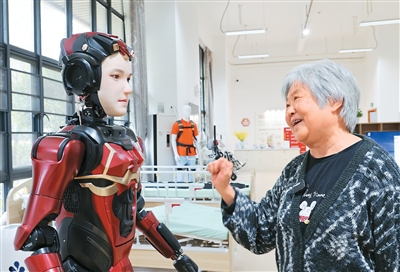
An older resident interacts with a humanoid robot at a nursing home in Shenzhen, south China's Guangdong Province. (Photo: Xinhua)
What was once a technical concept has become a national strategic priority and a key focus for local governments across the country. A report released last October by the Development Research Center of the State Council projected that China's embodied AI market could surpass 1 trillion yuan by 2035.
Humanoid robots have entered a stage of large-scale commercial application, with global shipments reaching approximately 18,000 units in 2025 and China leading in volume, according to a January report by International Data Corporation.
A number of European and American media outlets have expressed astonishment at the pace of China's scientific and technological innovation, viewing the country as a key growth engine for the global embodied AI industry.
China's thriving embodied AI sector is poised not only to drive further leaps in new quality productive forces across transportation and logistics, industrial manufacturing, and commercial services, but also to bring emerging technologies into homes and communities faster than ever, delivering greater convenience and tangible benefits to people's everyday lives.