


China's new liquid-propellent rocket Kinetica-2 makes successful maiden flight
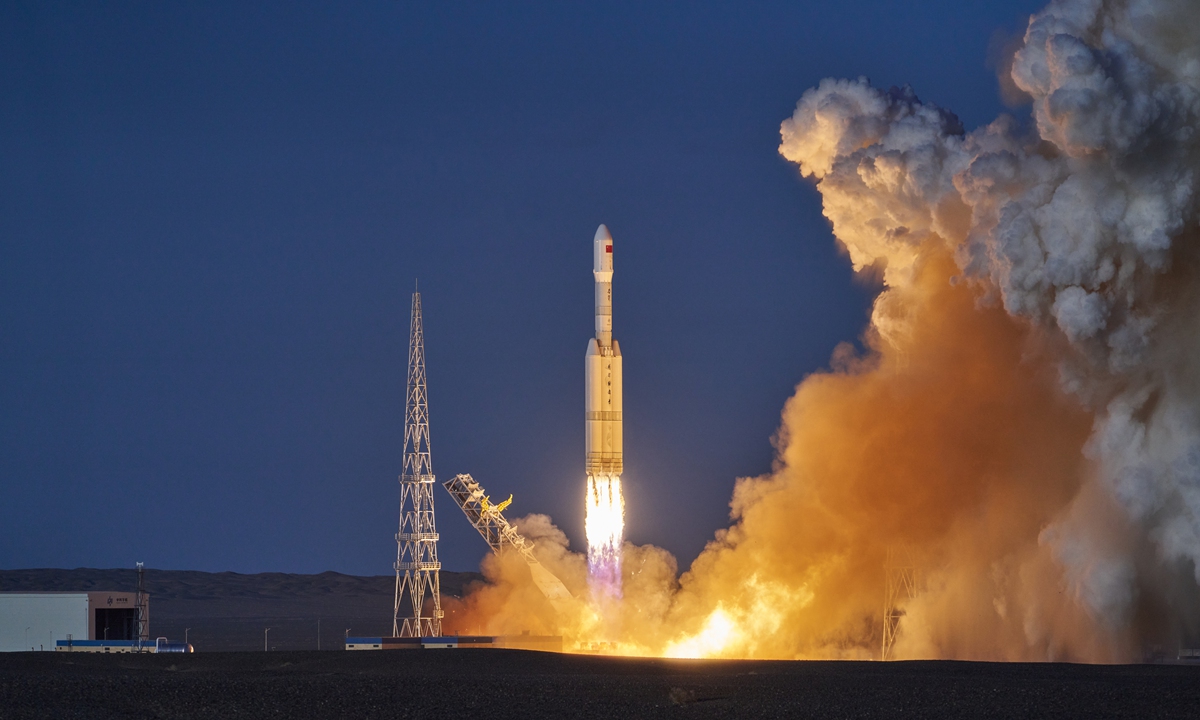
China's Kinetica-2 Y1 rocket lifts off for its maiden flight from the Dongfeng Commercial Space Innovation Test Zone in Northwest China on March 30, 2026. (Photo: courtesy of the CAS Space)
At dusk on a cool March evening in 2026, as the last rays of sunlight faded over the Gobi Desert, the Dongfeng Commercial Space Innovation Test Zone came alive with anticipation. Kinetica-2 liquid-propellant rocket, developed by China's commercial space firm CAS Space, ignited with a thunderous roar around 7 pm, roaring to life for its maiden flight.
The new rocket model sent the New March 01 technology demonstration satellite, the New March 02 satellite (experiment cargo spacecraft) and the TS 01 Educational Satellite into their designated orbits, marking a full success of the launch vehicle's inaugural flight.
Mission insiders and developers of the rocket told the Global Times on the sidelines of the launch mission that the maiden flight marked a resounding success, demonstrating the rocket's readiness to serve national strategic needs and major engineering projects.
Unlike the familiar slim arrow-shapes of traditional rockets, the Kinetica-2 looks extra robust and forceful at its base. This visual impact comes from its pioneering Common Booster Core (CBC) configuration — China's first rocket to adopt this approach, the rocket developers shared with the Global Times during a group interview.
According to the developers, the rocket stands 53 meters tall, with a core stage diameter of 3.35 meters and a fairing 4.2 meters wide. At liftoff, it weighs 625 tons and produces 753 tons of thrust. It can deliver up to 12 tons to a 200 kilometers low Earth orbit or 8 tons to a 500 kilometers sun-synchronous orbit. These figures give it strong capabilities for heavy payloads while maintaining high reliability, ease of manufacturing, simple operations, and great potential for future reusability.
"In the aerospace world, rockets have traditionally been tailor-made, with poor part interchangeability and high costs," Lian Jie, deputy chief designer of the Kinetica-2, told the Global Times. "Our team explored a new way - building rockets like assembling building blocks."
Lian explained that the CBC design uses a uniform 3.35-meter diameter for both the core stage and boosters, allowing tanks, interstage sections, and other components to be fully interchangeable.
Thanks to its modular philosophy, the Kinetica-2 can be configured flexibly: a "bare" core-only version, or versions with two or four strapped-on boosters. This allows thrust to scale up to the thousand-ton level and payload capacity to range from about 2 tons to 20 tons in low Earth orbit, per the rocket's deputy chief designer.
Looking ahead, the Kinetica-2 is expected to support large-scale low-orbit constellations such as the Qianfan, affordable cargo delivery to China's space station, global carbon monitoring, solar radiation belt exploration, and other scientific and deep-space missions, Lian revealed.
Riding on this flight was a key innovation in space cargo transport: the New March 02 satellite (experiment cargo spacecraft), a 4.2-ton vessel developed by the Shanghai-based Innovation Academy for Microsatellites of the Chinese Academy of Sciences.
Designed for up to three years in orbit, it features a single integrated module with sealed and non-sealed sections, making it compatible with multiple rockets. During this mission, it carried 27 experimental payloads totaling 1.02 tons — covering technology reserves, verification tests, scientific exploration, and even educational items. These will conduct experiments in orbits between 200 to 600 kilometers above the Earth's ground, Global Times has learned from the spacecraft experiment team.
The successful launch represents an important evolution in China's space cargo system, moving from single-point capabilities toward a more comprehensive, layered space transportation network, project manager Yang Haoliang told the Global Times.
Yang added that the successful launch also carries clear strategic and forward-looking significance. It demonstrates China's space cargo transport shifting from dependence on single systems toward a flexible, multi-path architecture with greater redundancy and adaptability.
For commercial space to thrive, launches must become frequent and affordable, like airline flights. While companies like SpaceX have demonstrated stage-by-stage recovery with the Falcon 9, the Kinetica-2 team is pursuing a distinctive path: cluster recovery.
Instead of separating and recovering stages individually, the boosters and core stage stay bundled together like a tight "arrow cluster" and return to Earth as a single unit. This design promises better aerodynamic control, lower landing impact, stronger power redundancy, and less loss of payload capacity, according to the rocket developers.
CAS Space has already validated key reentry and precision-landing technologies with the Lihong-1 Y1 suborbital vehicle at the beginning of this year. They are planning Lihong-2 tests at higher altitudes to gather more data before applying the technology to orbital rockets.