


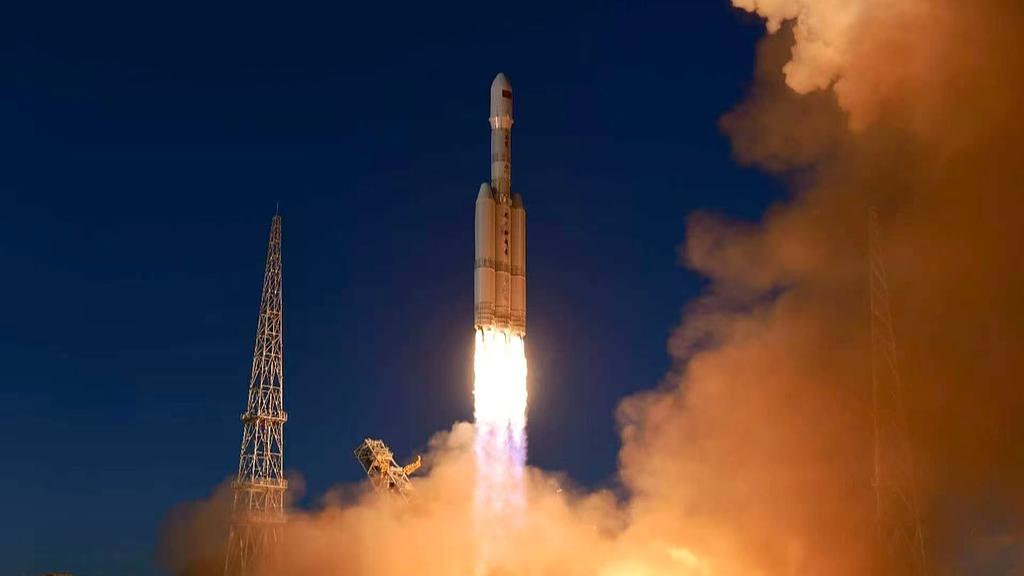
The Qingzhou cargo spacecraft test vehicle is launched aboard the Lijian-2 Y1 carrier rocket, northwest China, March 30, 2026. (Photo: VCG)
The newly launched Qingzhou cargo spacecraft test vehicle will be followed by a final version that will dock with the Chinese space station and provide cargo supply services, according to the Innovation Academy for Microsatellites of the Chinese Academy of Sciences (IAMCAS).
The test vehicle was launched aboard the Lijian-2 Y1 carrier rocket on Monday from a commercial aerospace innovation pilot zone in northwest China and was successfully placed into its designated orbit.
Developed by IAMCAS, the test vehicle weighs 4.2 tonnes and is compatible with multiple rocket types, making it highly adaptable for launch. The test mission carries 27 projects, including in-orbit verification, scientific research, and outreach initiatives, with a total payload of 1.02 tonnes. It will conduct in-orbit tests at altitudes between 200 and 600 kilometers.
The spacecraft has a sealed main cabin and an unsealed rear section. The main cabin holds 40 cargo compartments with a total volume of 27 cubic meters for supplies like daily necessities for astronauts, scientific equipment, and research payloads.
What makes it especially unique is that it can carry a 300-liter refrigerator composed of five 60-liter cold chain units, providing storage for astronauts' daily needs and for biological experiment samples that require low-temperature preservation.
The unsealed rear section can carry extra payloads and equipment that need to be exposed to the space environment, thereby maximizing the spacecraft's transport efficiency.