


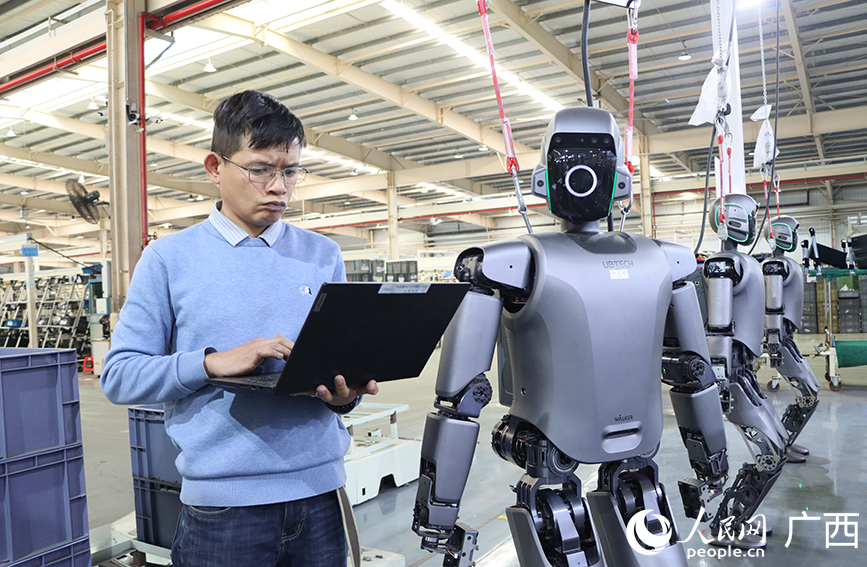
Lu Baichun issues work instructions to a robot at a Dongfeng Liuzhou Motor Co., Ltd. factory in Liuzhou, south China's Guangxi Zhuang Autonomous Region. (Photo: People's Daily Online)
Industrial humanoid robots have begun "interning" on the factory floor at Dongfeng Liuzhou Motor Co., Ltd. in Liuzhou, south China's Guangxi Zhuang Autonomous Region.
At a command from their instructor, Lu Baichun, the 11 robots instantly activate their visual navigation systems and head straight to their assigned stations.
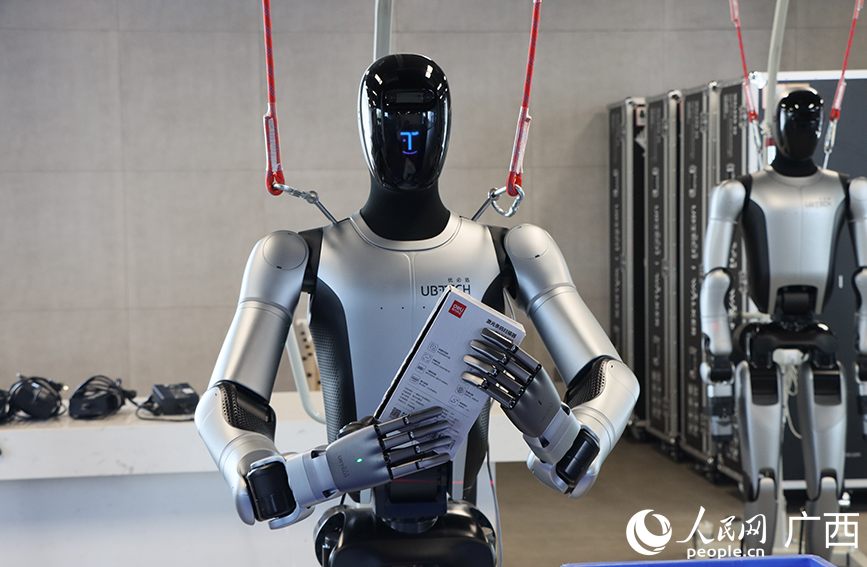
The factory has set up a 200-square-meter materials handling area as a training ground for UBTech's Walker S1 robots, where they practice moving bins, sorting parts and collecting empty containers.
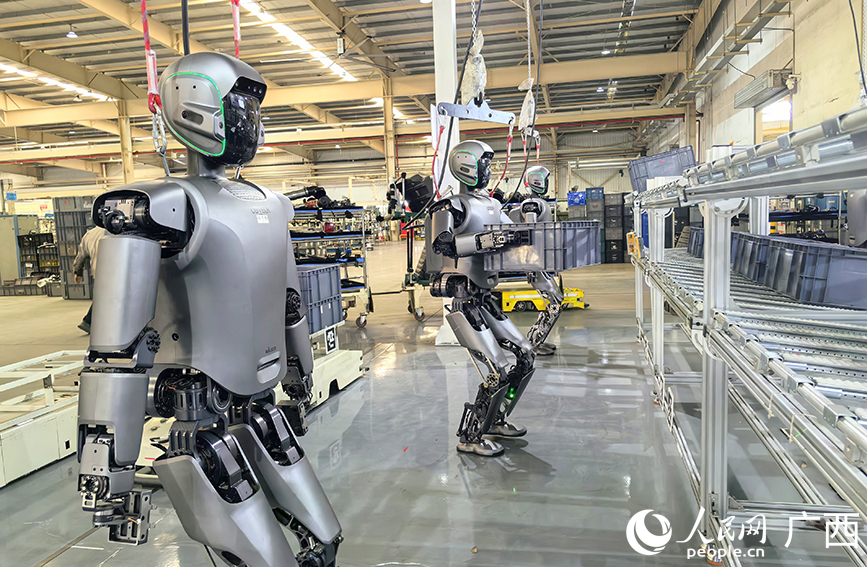
Photo shows industrial humanoid robots at a Dongfeng Liuzhou Motor Co., Ltd. factory in Liuzhou, south China's Guangxi Zhuang Autonomous Region. (Photo: People's Daily Online)
Liuzhou, one of Guangxi's key industrial centers, offers a wide range of real-world scenarios for testing and deploying AI. The robots train here to adapt to on-site conditions and optimize their workflows before eventually joining regular production lines.
"The robots rely heavily on visual recognition," Lu said. "Changes in lighting, humidity or the surrounding setup can all affect how they perform. Real factory environments are far more complex, so learning to handle the variables is one of the key challenges they need to overcome."
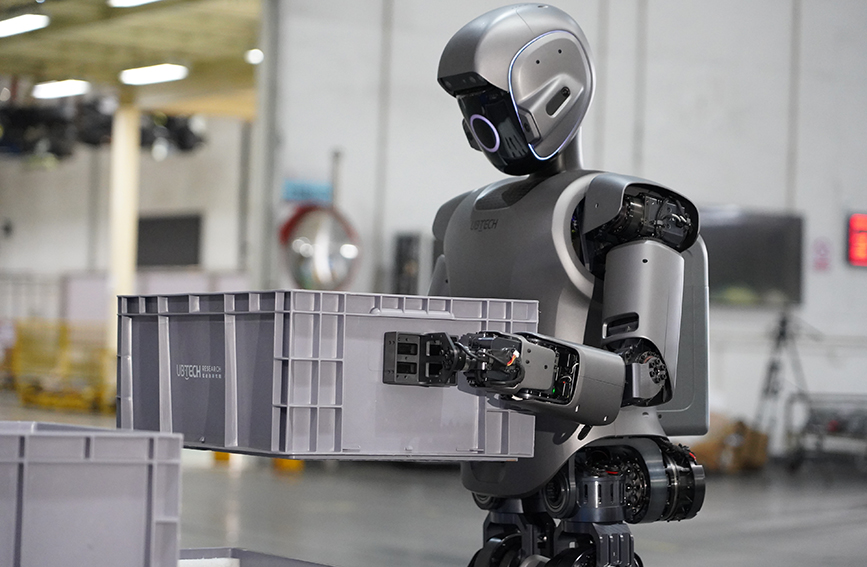
An industrial humanoid robot undergoes training at a Dongfeng Liuzhou Motor Co., Ltd. factory in Liuzhou, south China's Guangxi Zhuang Autonomous Region. (Photo courtesy of Dongfeng Liuzhou Motor Co., Ltd.)
Although the robots are still "apprentices," Lin Changbo, general manager of Dongfeng Liuzhou Motor, is confident about the future of human-machine collaboration.
"We expect them to keep improving efficiency, lowering costs and taking on physically demanding and high-risk tasks," he said. "They'll inject new intelligence into traditional manufacturing."
To overcome the data challenges in expanding embodied AI for industrial use, Liuzhou has set up an embodied AI data collection and testing center.
The center functions as a robot training school, recreating full-scale production environments from key local industries, including automobiles, construction machinery, pharmaceuticals and river snail rice noodles, or Luosifen, a local delicacy. It generates tens of thousands of training data points each day.
At the center, 120 industrial humanoid robots train alongside their instructors, honing their skills for factory work.
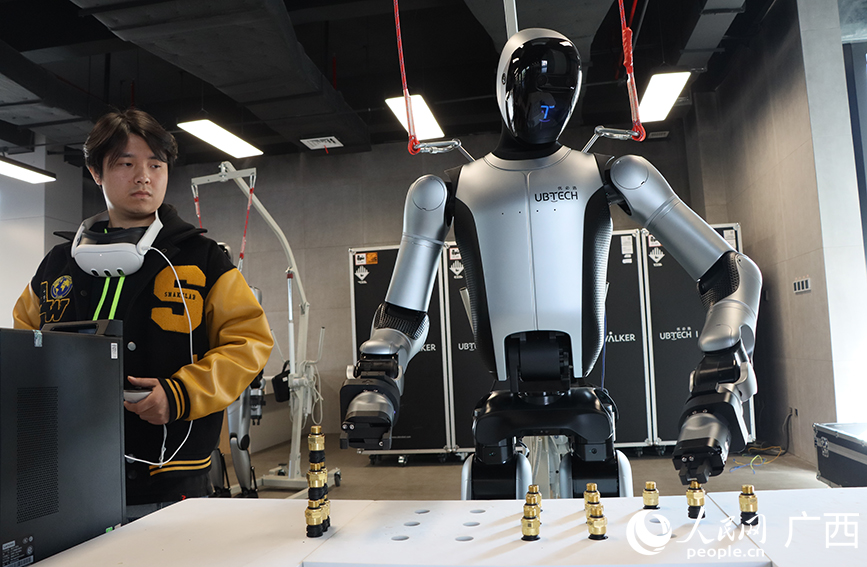
A robot trains under the guidance of its instructor at a Dongfeng Liuzhou Motor Co., Ltd. factory in Liuzhou, south China's Guangxi Zhuang Autonomous Region. (Photo: People's Daily Online)
In one workshop, a robot repeatedly practices a single task: using two fingers to pick up a screw no bigger than a fingernail.
"It doesn't inherently understand 'pick up' or 'put down,' which means everything has to be taught step by step," said Wu Dongbo, a young trainer.
"Humans rely on experience; robots rely on algorithms. You have to think like a robot, understand how its joints move and how its vision system works, in order to find the most effective way to control it," Wu explained.
A robot practices sorting at a Dongfeng Liuzhou Motor Co., Ltd. factory in Liuzhou, south China's Guangxi Zhuang Autonomous Region. (Photo: People's Daily Online)